Tencent Hy4 Fact Check, First 48 Hours: What Can Be Verified and What Is Only Self-Reported
On 2026-11-04 the Tencent Hunyuan team released its newest large language model, Hy4, with 770B parameters. According to Yicai, the weights will be open-sourced “soon”. Within hours the claims started flying: “the strongest open model”, “hallucinations cut by 65%”, “you can run it locally”. This article does one job. It lists the public claims about Tencent Hy4 with their sources, separates what can be checked from what is only self-reported and what cannot be checked yet, and estimates how much memory it would take to run locally if the weights do arrive.
How we checked this: The information comes from reports by Yicai, ITHome and 10jqka, plus the Hugging Face model card for Hy4-preview, all read on 2026-11-04. We have not tested Hy4, and we do not have the formal-release weights. Every memory figure here is an estimate from parameter counts, not a measurement. Most benchmark numbers are Tencent’s own, and we have not reproduced any of them. Stories like this change quickly, so treat the official pages as the source of truth.
Key points (updated 2026-11-04)
- Release: Tencent Hy4, 770B parameters. Yicai reports the weights will be open-sourced “soon”; we saw no formal-release weights.
Tencent’s own wording: Hy4 is “among the strongest open models” but still has a large gap to top closed models. That is Tencent’s statement, not a third-party evaluation.
What you can check today is the preview, Hy4-preview: its model card states 770B total parameters, 49B active, 1M context and an Apache 2.0 license.
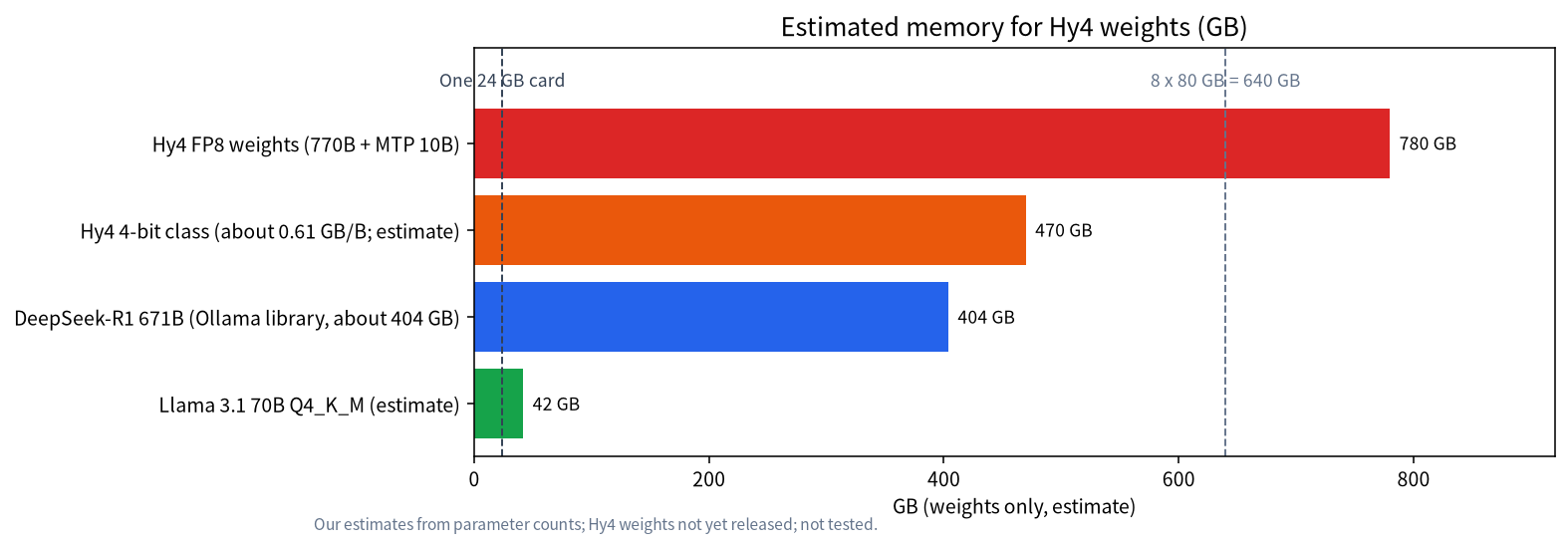
- Running locally: we estimate about 780 GB of weights at FP8 and about 470 GB at a 4-bit class, far beyond a single 24 GB card. These are estimates, not tests.
What Tencent Hy4 actually is: separate the preview from the formal release
The first step in reading news like this is knowing which version a number belongs to.
Hy4-preview: according to its Hugging Face model card, it is a Mixture-of-Experts (MoE) model with 770B total parameters and 49B activated per token. The backbone has 78 layers; the first uses a standard dense FFN and the other 77 are MoE layers, each with 256 routed experts and 1 shared expert, with 8 routed experts plus the shared expert active per token. There is also one native MTP layer of about 10B parameters for speculative decoding. Context length is 1M and the license is Apache 2.0. The card also gives vLLM and SGLang deployment examples, and the vLLM example uses --tensor-parallel-size 8. All of this is written by Tencent on the card, and you can open the page and check it.
Hy4 (formal release): released 2026-11-04. Yicai reports 770B parameters, with better instruction following, long-document understanding and long-horizon agent ability, and says the next generation, Hy5, will be larger. ITHome reports that the formal release is available on Tencent Cloud and OpenRouter at the same price as the preview. But we did not see the formal weights, a system card or technical details when we looked; the reports only say the weights come soon.
So the hard, checkable information is mostly the preview’s model card. Most of what is said about the formal release comes from Tencent’s announcement as relayed by media.
How Tencent rates Hy4: the self-reported part
Yicai reports that the Hunyuan team calls Hy4 one of the strongest open models available, while admitting a large gap to top closed models. The report adds that on benchmarks including ProgramBench, FrontierCode2.0 and Agents’ Last Exam v1.1, Hy4 scored above DeepSeek-V4.1-Flash-1017, in some cases close to Kimi K3.1 Pro and in some above GPT6.1 Sol, but on most benchmarks it still scored below GPT6.1 Sol and Claude Opus 5.5.
ITHome reports a few more figures from Tencent:
- Finance test: on an internal 579-task finance test, Hy4 scored 3.04, DeepSeek-V4.1-Flash-1017 scored 2.97, and GLM-5.3 and Kimi K3.1 Pro each scored 2.68.
- Hallucination: on a Tencent-built test, the hallucination rate fell from 15.76% for the preview to 5.45% (about 65.4% lower in relative terms), and “errors driven by guessing” fell from 23.1% to 5.6%.
- Game development: compared with the preview, GameDev improved by 19.1% and GameLogic by 9.8%.
All of these share one trait: the test sets, scoring methods and graders come from Tencent itself. That does not make them false, but they are self-reported rather than independently reproduced. The safe reading is “the best angle Tencent wants you to see”, to be compared against third-party results once they exist. For how to read benchmark scores in general see how to read LLM benchmarks.
The preview’s blind evaluation: mind the scope
The preview model card says 163 internal Tencent experts rated model outputs on 203 engineering tasks, and Hy4 preview came out slightly ahead of GLM 5.3 (2.99 vs 2.92) and Kimi K3 (2.99 vs 2.94). Note the scope: the raters are Tencent’s own experts, the tasks are engineering tasks, and the gaps are a few hundredths. It shows that Tencent internally thinks the preview holds its own; it does not show it is better across the board.
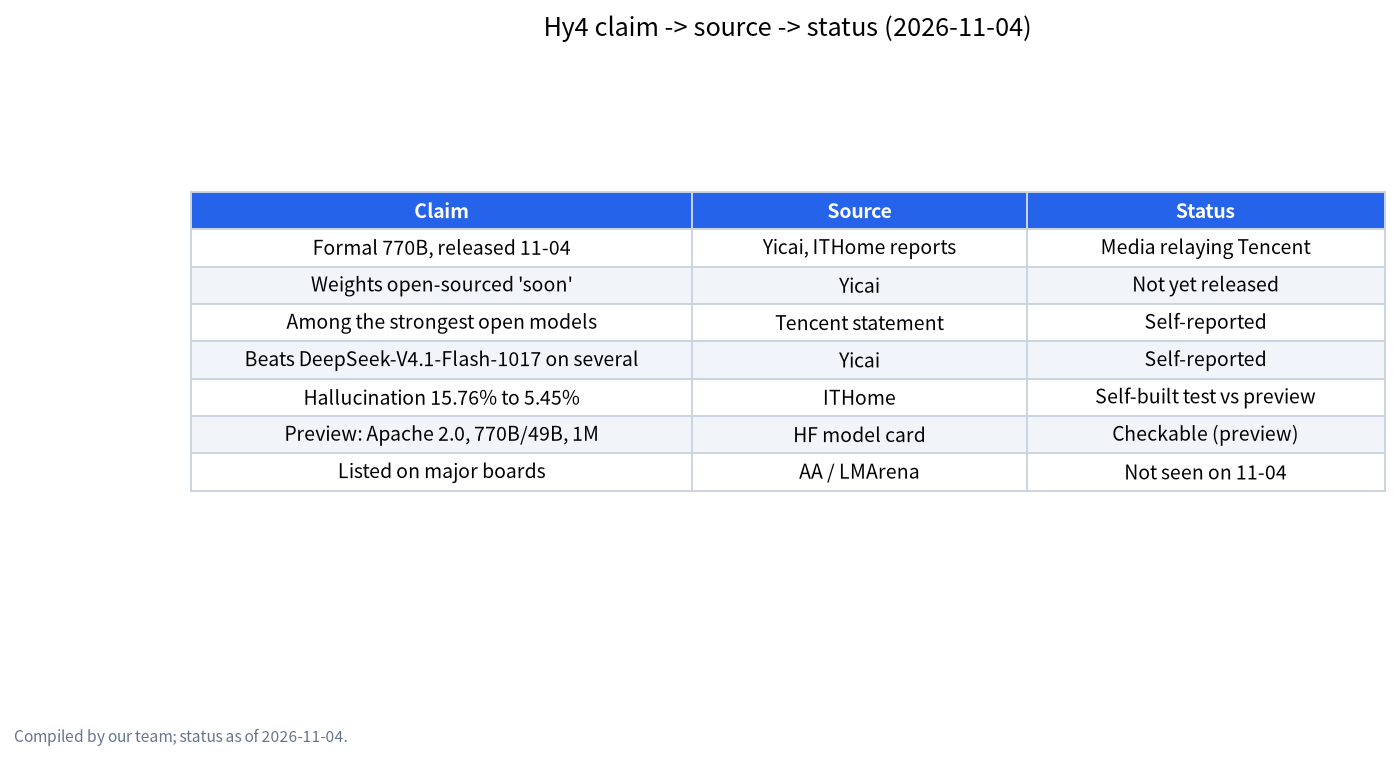
Claim, source, status: one table
| Claim | Source | Status (2026-11-04) |
|---|---|---|
| Formal Hy4 has 770B parameters, released on 4 November | Yicai and ITHome reports | Media relaying Tencent; no independent confirmation |
| Weights open-sourced “soon” | Yicai | Not released; no date given |
| Among the strongest open models | Tencent statement | Self-reported; awaiting third parties |
| Beats DeepSeek-V4.1-Flash-1017 on several benchmarks | Yicai | Self-reported; not reproduced |
| Hallucination 15.76% to 5.45% | ITHome | Self-built test, and only relative to the preview |
| Preview: Apache 2.0, 770B/49B, 1M context | Hugging Face model card | Checkable (preview only) |
| Listed on major leaderboards | Artificial Analysis, LMArena | Hy4 formal not seen when we looked on 2026-11-04 |
A note on the last row: when we looked at Artificial Analysis’s open-weights page (2026-11-04) we did not see the formal Hy4. Our LMArena snapshot is from 2026-10-27, before the release, and it lists only the previous generation Hy3 (rank 14 on the open-license board, score 1454, Apache 2.0), so there is no Hy4 data. That only says it was not on the boards on launch day; it says nothing about quality, since boards usually add models days or weeks later.
Running Hy4 locally: how much memory does 770B need?
Many readers want to know whether they can run it themselves once the weights are out. A rough estimate (estimates, not tests; the formal weights are not released):
- FP8 weights: 770B parameters at about 1 byte each is about 770 GB, plus about 10 GB for the MTP layer, around 780 GB in total. The preview has an FP8 build on Hugging Face.
- 4-bit class: at the roughly 0.61 GB per billion parameters we use elsewhere, 770 x 0.61 is about 470 GB (without the MTP layer).
- For comparison: DeepSeek-R1 671B is about 404 GB in the Ollama library; a 70B at Q4_K_M is about 42 GB; one 24 GB card is a small fraction of any of these.
| Item | Estimate | Basis |
|---|---|---|
| FP8 weights (with MTP layer) | about 780 GB | 770B x 1 byte + about 10 GB |
| 4-bit class weights | about 470 GB | 770B x about 0.61 GB/B |
| Eight 80 GB cards combined | 640 GB | 8 x 80 GB |
| DeepSeek-R1 671B | about 404 GB | Ollama library listing |
| One 24 GB card | 24 GB | Nominal capacity |
What follows from this:
- Eight 80 GB cards total 640 GB, which cannot hold 780 GB of FP8 weights. The preview’s vLLM example uses tensor parallelism of 8, but the part we read does not say which GPU it assumes. By arithmetic, eight 80 GB cards cannot hold the FP8 weights, never mind the KV cache and overhead.
- About 470 GB at a 4-bit class is still far beyond a consumer machine. By capacity alone it takes at least four 128 GB unified-memory machines combined, and we have not tested how fast such a cluster would be, so we draw no conclusion about speed.
- MoE activates only 49B, but every expert must sit in memory. Fewer active parameters affect speed, not capacity. If all weights were in fast memory, the theoretical decode ceiling is roughly bandwidth divided by the active weights read per token: at a 4-bit class, 49B active is about 30 GB, so 800 GB/s gives a ceiling near 27 tokens per second and 400 GB/s about 13. That is a theoretical ceiling, not a test, and real numbers will be lower. For the memory logic of MoE see running MoE models locally.
For most individuals the realistic conclusion is that a model of this size suits a data center or a cloud API rather than a home PC. For similar-scale arithmetic see DeepSeek local deployment cost, for the trade-off see local vs cloud API, and for models that do fit at home see best local LLM models.
A 48-hour checklist you can reuse for any new model
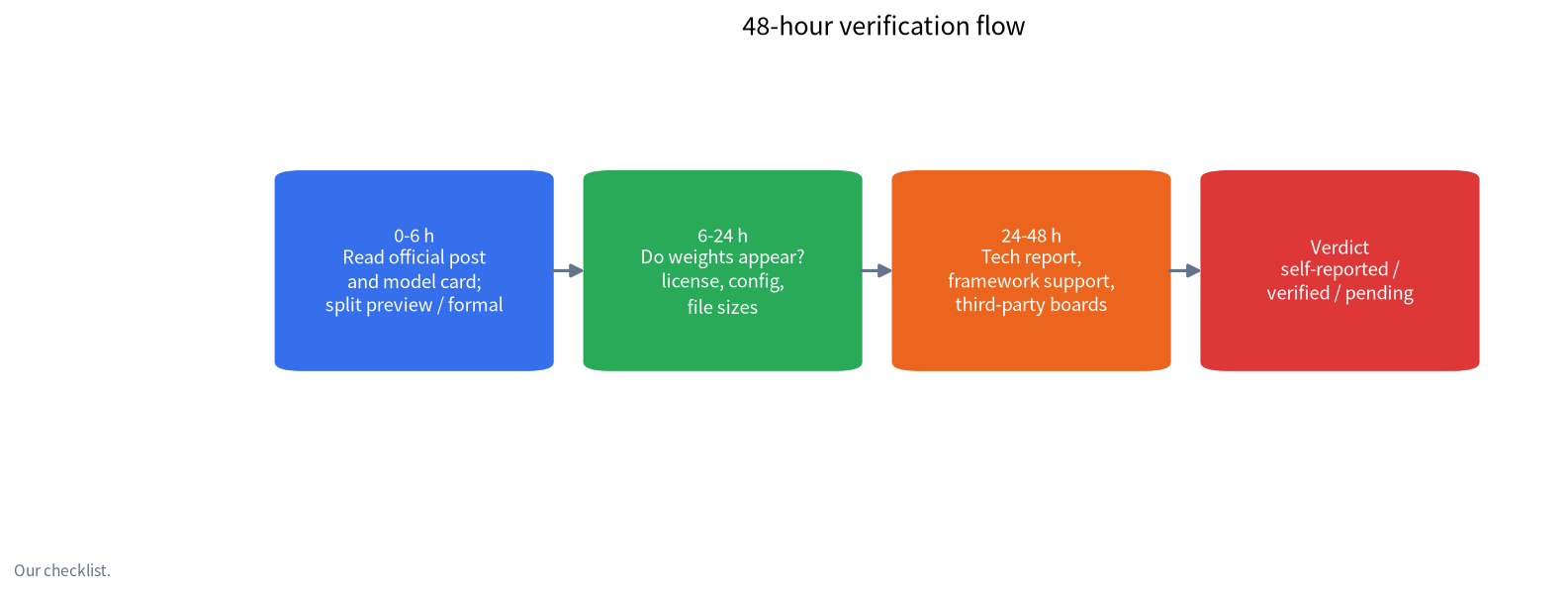
The first 48 hours after a release are when rumor and exaggeration peak. We suggest this order, and every step is something you can do yourself:
Hours 0 to 6: read the primary source. Find the official announcement and the model card, decide whether each number belongs to the preview or the formal release, and note where each came from. Numbers that appear only in second-hand coverage get marked “to be checked”.
Hours 6 to 24: check the weights repo. On Hugging Face, ModelScope and similar sites, see whether the weights really appear, what the license file says, whether the layer count and hidden size in config.json match the advertised parameter count, and whether total file size fits the parameters and precision. For 770B at FP8 the files should add up to roughly 770 GB.
Hours 24 to 48: check the tech report, framework support and third-party boards. Is there a system card or technical report? Are benchmark settings (harness, number of samples, thinking budget) spelled out? Has vLLM or SGLang merged support? Have Artificial Analysis or LMArena listed it? Until a third party lists it, mark every comparison as “self-reported”.
Then give a verdict using only three labels: self-reported, verified, pending. Our current verdict on Hy4: the release itself and the preview facts are “verified”; the formal weights are “pending”; the performance and hallucination claims are “self-reported”. If you want the same treatment for a “leaked” or “cracked” model claim, see how to fact-check leaked or cracked model claims.
Common mistakes when reading a release like Hy4
- Treating preview facts as formal-release facts. The preview’s license and structure do not automatically carry over.
- Treating a self-built test as an industry standard. The 579-task finance test and the 163-expert blind evaluation are not public, reproducible benchmarks.
- Reading relative gains as absolute numbers. A hallucination drop of 65.4% is relative to the preview on a self-built test; it does not mean only 5.45% of answers are wrong.
- Equating “open source” with “runs at home”. Open weights mean the files are public and the license allows use. They do not mean your hardware can hold them; 770B needs tens of times the memory of a home setup.
- Buying hardware early. Do not buy anything for Hy4 until the formal weights and third-party results exist.
What we checked and what we did not
We checked: the Yicai, ITHome and 10jqka reports, the Hy4-preview model card (parameters, structure, license, blind evaluation and deployment examples), the Artificial Analysis open-weights page and an LMArena snapshot. We did not: test any Hy4 version, download the weights, reproduce any benchmark, or verify real prices on Tencent Cloud or OpenRouter. All memory and speed numbers are estimates from parameter counts and formulas. If Tencent releases the weights or a system card, we will update the status table.
FAQ
When was Tencent Hy4 released?
On 2026-11-04 the Tencent Hunyuan team released Hy4, a 770B-parameter language model; its preview, Hy4-preview, had already been open-sourced on Hugging Face.
Are the Hy4 weights open-sourced?
The Hy4-preview weights are on Hugging Face and similar sites under Apache 2.0; Yicai reports the formal weights will follow “soon”, and we had not seen them when we looked.
Is Hy4 really the strongest open model?
That is Tencent’s own claim, and Tencent also admits a large gap to top closed models; we saw no independent third-party evaluation, so we label it self-reported.
Is the 65.4% drop in hallucinations credible?
It comes from a Tencent-built test and is relative to the preview, not an absolute error rate; until there is a public, reproducible test set, treat it as a reference only.
Can a personal computer run Hy4 locally?
By our estimate the 770B model needs about 780 GB at FP8 and about 470 GB at a 4-bit class, far beyond home hardware; these are estimates, not tests, and a cloud API is the realistic route.
How long should I wait before drawing conclusions?
At least until the weights repo, system card, framework support and third-party leaderboards exist; before that, label every comparison score as self-reported.
Want to check a claim together?
Join the community or email admin@microaione.com with the model claim and its source. Our Shenzhen team will label the verdict as self-reported, verified or pending, and say clearly what we did not test.
References: ITHome: Tencent Hy4 release report, 10jqka: Hy4 release report, Yicai: Tencent Hunyuan says Hy4 joins the strongest open models, Hugging Face: tencent/Hy4-preview model card, Ollama library: deepseek-r1.