Open-Source LLMs: What They Are, Which to Use, Where to Download
“What open-source LLMs are there?” is a high-frequency local-deployment query. First, terminology: an LLM is a large neural network trained on massive text for general language tasks. Colloquial “open-source LLM” often means open weights: you can download parameters for local inference even when training data and full code are not OSI-open. That distinction decides how you read licenses and which download sites you trust.
Verification notes. Family lists are educational sketches, not official rankings; see eval sites and our leaderboard reading guide. Always trust each model card.
Key takeaways (updated 2026-11-05)
- “Open-source LLM” in practice often means open weights + diverse licenses—not a free commercial blank check.
Example families: Llama, Qwen, DeepSeek, Mistral, Gemma, ChatGLM (they iterate).
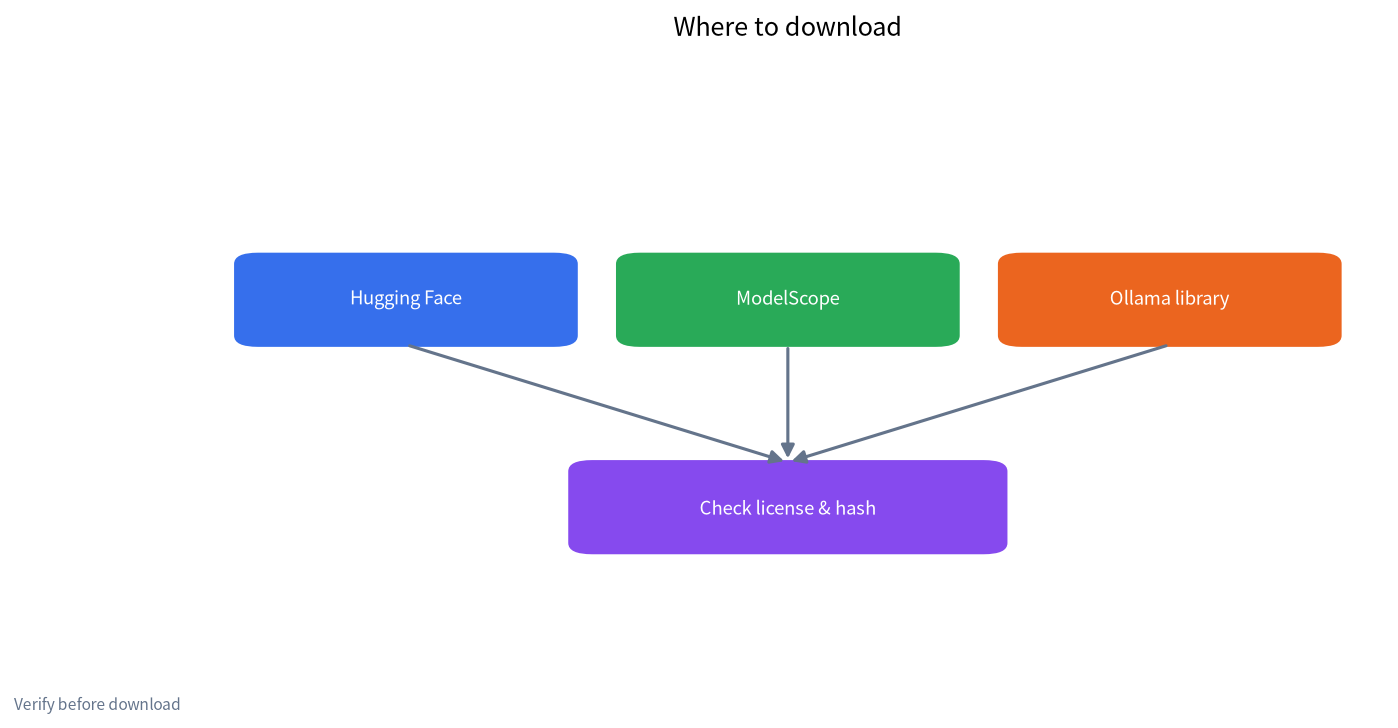
Download sites: Hugging Face, ModelScope, Ollama library—verify LICENSE and hashes.
- Small vs large is a trade-off among capability, VRAM, speed, and ops cost.
Open-source LLMs you should know first
What “open-source LLM” usually means
| Phrase | Common meaning | Ask next |
|---|---|---|
| Open weights | Downloadable parameters | What does the license allow? |
| Strict open source | Code/data/weights under OSS definitions | Are all three open? |
| Commercial-ok | License allows business use | Caps or scenario limits? |
| Free download | No download fee | Account/telemetry requirements? |
Which families exist (sketch)
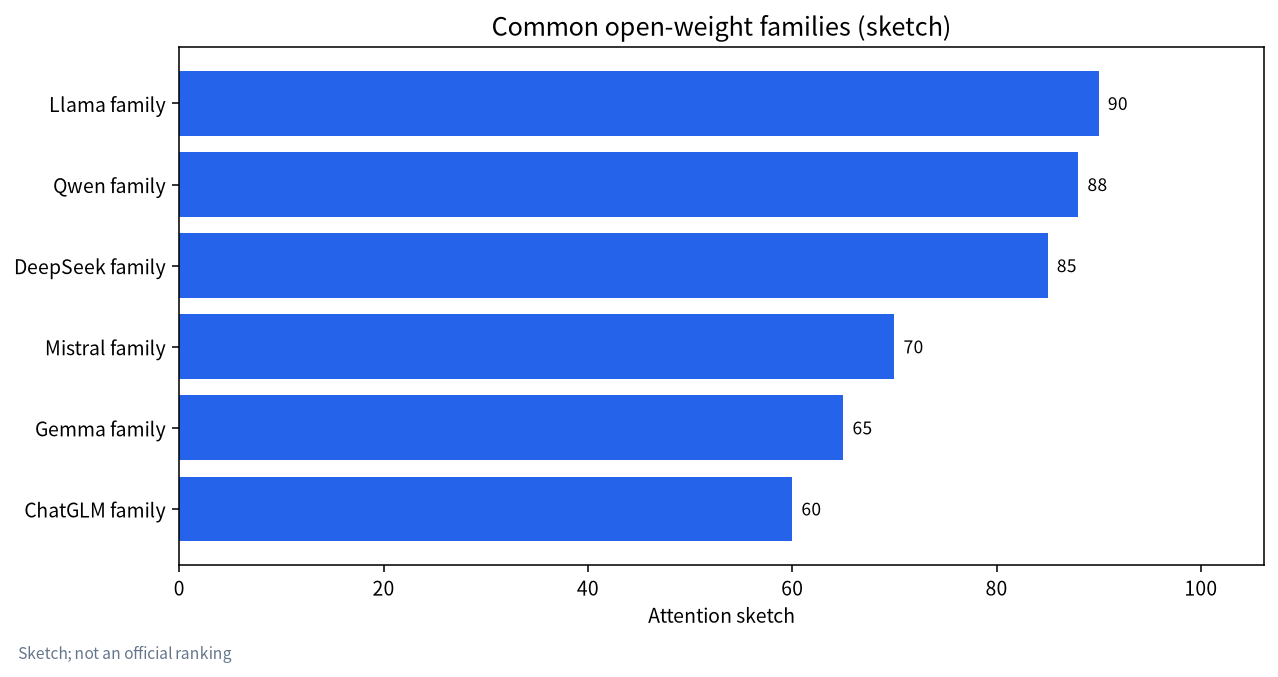
Educational examples—not a podium: Llama-class ecosystems; Qwen-class for many Chinese local deploys (Qwen local, hardware); DeepSeek-class (deploy, install); Mistral, Gemma, ChatGLM lines with their own licenses. Subjective “what works locally” lists: best local models.
Small vs large models
| Axis | Smaller (≈1B–8B) | Larger (≈70B class) |
|---|---|---|
| VRAM | Fits more consumer GPUs | Needs 24GB+, multi-GPU, or aggressive quant |
| Speed | Usually faster | Slower or hungrier |
| Hard reasoning | May lag | Often stronger (not absolute) |
| Ops | Simpler | Heavier weights & updates |
Pick by task and hardware—not by prestige.
Where to download
| Source | Strength | Caution |
|---|---|---|
| Hugging Face Hub | Global model cards | Network/mirror depends on region |
| ModelScope | Often friendlier access in China | Still read licenses |
| Ollama library | One-command quants | Know the quant tag |
| Official GitHub releases | First-party packs | Avoid phishing; verify checksums |
No “cracked full sets” from random drives.
Versus closed APIs
| Axis | Local open weights | Closed API |
|---|---|---|
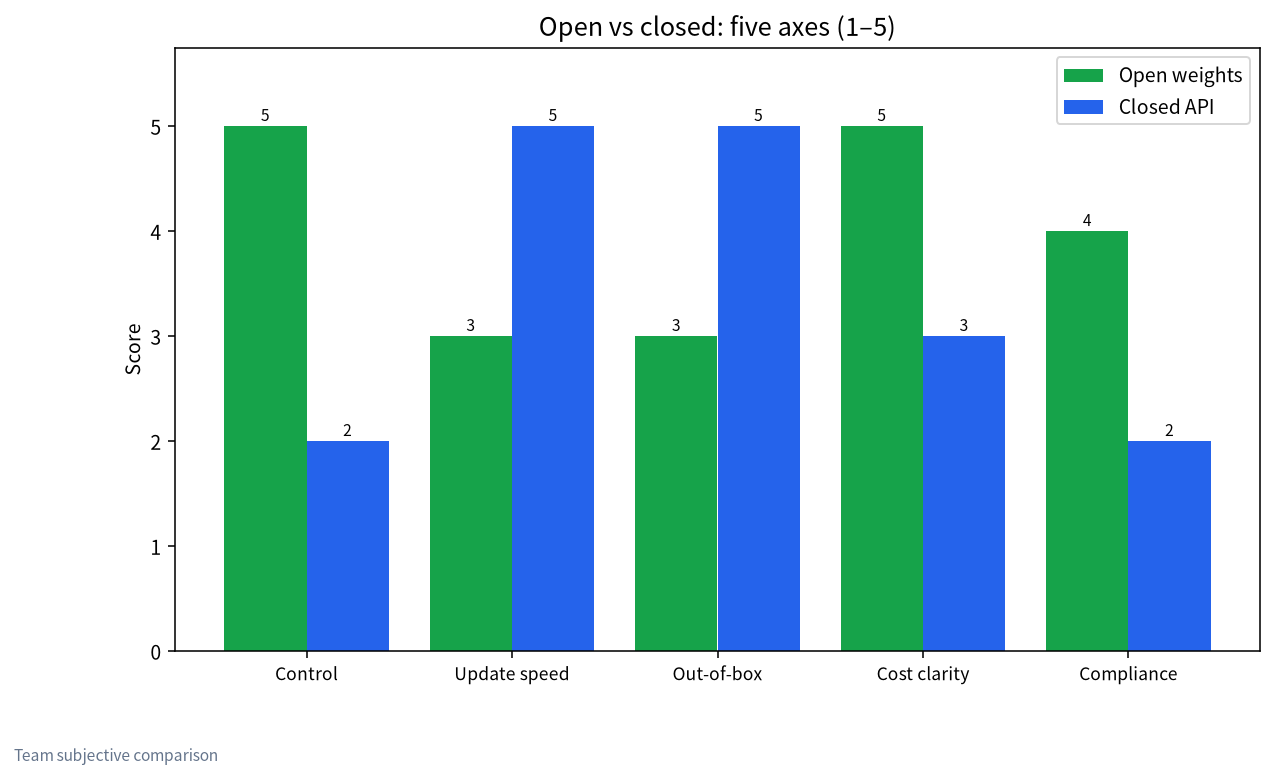
| Control | High | Low |
| Update cadence | You chase upgrades | Vendor ships continuously |
| Out-of-box quality | Uneven | Often smoother |
| Cost clarity | Hardware/power visible | Token bills visible, long-run uncertain |
| Compliance autonomy | Strong, responsibility on you | Vendor terms & regional availability |
Many teams mix: sensitive data local, public tasks on APIs.
Extra notes for China-based teams
Viral “rankings” go stale quickly; do not treat screenshots as procurement truth. Check commercial clauses, whether your launch form needs filings, and residency. Enterprise path: custom private deployment.
What we verified—and what we did not
No proprietary scoreboard; no pirated mirrors; no permanent #1 claims.
A three-day validation instead of a three-month fantasy
Long guides still leave people unsure what to do on Monday morning. Replace fantasy roadmaps with a three-day validation: day one ends with a successful install and one real conversation; day two runs ten authentic tasks and logs failure modes; day three decides whether to add retrieval, change model size, or simply improve prompts. Hardware purchases and fine-tuning plans should follow evidence, not anxiety.
If the same failure repeats—tables break, citations point at the wrong paragraph—fix the process for that failure class before you buy a more expensive GPU. Table issues may need stricter output constraints or post-processing; citation issues usually need chunking and retrieval work. A tiny spreadsheet of failure classes is already a cheap evaluation set.
Responsibility boundaries (worth repeating)
Local deployment reduces the intuitive risk of data leaving your network; it does not finish compliance for you. Pasting customer lists into prompts, fine-tuning on unauthorized repositories, or exposing an intranet API to the public internet are process failures. Write down which data classes may never enter prompts or train sets, who can merge adapters, and how to halt and audit incidents. Tutorials answer “how to run”; charters answer “whether we may run” and “who owns the blast radius.”
For hobbyists, the bar can be light: do not spread others’ private data, do not pursue illegal uses, and do not treat mystery weights as trusted software. For companies, boundaries must be auditable. In both cases, “open” never means “no obligations.”
How to read neighboring articles on this site
If the bottleneck is buying too large or too small a machine, start with budget builds and VRAM math. If knowledge goes stale, read RAG first. If tone and format are unstable, then read LoRA training. If the pain is organizational access control, read enterprise private deployment and the safety checklist. If the pain is licensing, read the open-weight and free-local boundary pieces. Reading by bottleneck beats reading by publish date. When you hit an internal link, open the relevant section instead of only bookmarking the title.
Maintenance after the exciting first weekend
Weights accumulate, logs grow, drivers age. Schedule a monthly hour: delete unused weights, check disk health, confirm backups still restore, and skim upstream security notes. If you treat a local model like a forever-forgotten portable app, the common six-month ending is a full disk and a broken driver after an OS update—followed by the false conclusion that “local AI does not work.” Maintenance is boring; it is also what keeps the shopping and training advice valuable.
Composite anecdotes (anonymized patterns)
We repeatedly see a student laptop with 8GB VRAM chasing a 70B download “because the chart looked cool,” a startup exposing Ollama on 0.0.0.0 “just for the hackathon,” and a department fine-tuning on raw mail exports that still contain personal data. None of these failures required exotic research. They required slowing down at license text, network bind addresses, and data classification. If your project currently matches one of those patterns, pause new downloads until the basics are written down and reviewed by a second person.
A three-day/6 validation instead of a three-month fantasy
Long guides still leave people unsure what to do on Monday morning. Replace fantasy roadmaps with a three-day validation: day one ends with a successful install and one real conversation; day two runs ten authentic tasks and logs failure modes; day three decides whether to add retrieval, change model size, or simply improve prompts. Hardware purchases and fine-tuning plans should follow evidence, not anxiety.
If the same failure repeats—tables break, citations point at the wrong paragraph—fix the process for that failure class before you buy a more expensive GPU. Table issues may need stricter output constraints or post-processing; citation issues usually need chunking and retrieval work. A tiny spreadsheet of failure classes is already a cheap evaluation set.
Responsibility boundaries (worth repeating)
Local deployment reduces the intuitive risk of data leaving your network; it does not finish compliance for you. Pasting customer lists into prompts, fine-tuning on unauthorized repositories, or exposing an intranet API to the public internet are process failures. Write down which data classes may never enter prompts or train sets, who can merge adapters, and how to halt and audit incidents. Tutorials answer “how to run”; charters answer “whether we may run” and “who owns the blast radius.”
For hobbyists, the bar can be light: do not spread others’ private data, do not pursue illegal uses, and do not treat mystery weights as trusted software. For companies, boundaries must be auditable. In both cases, “open” never means “no obligations.”
How to read neighboring articles on this site
If the bottleneck is buying too large or too small a machine, start with budget builds and VRAM math. If knowledge goes stale, read RAG first. If tone and format are unstable, then read LoRA training. If the pain is organizational access control, read enterprise private deployment and the safety checklist. If the pain is licensing, read the open-weight and free-local boundary pieces. Reading by bottleneck beats reading by publish date. When you hit an internal link, open the relevant section instead of only bookmarking the title.
Maintenance after the exciting first weekend
Weights accumulate, logs grow, drivers age. Schedule a monthly hour: delete unused weights, check disk health, confirm backups still restore, and skim upstream security notes. If you treat a local model like a forever-forgotten portable app, the common six-month ending is a full disk and a broken driver after an OS update—followed by the false conclusion that “local AI does not work.” Maintenance is boring; it is also what keeps the shopping and training advice valuable.
Composite anecdotes (anonymized patterns)
We repeatedly see a student laptop with 8GB VRAM chasing a 70B download “because the chart looked cool,” a startup exposing Ollama on 0.0.0.0 “just for the hackathon,” and a department fine-tuning on raw mail exports that still contain personal data. None of these failures required exotic research. They required slowing down at license text, network bind addresses, and data classification. If your project currently matches one of those patterns, pause new downloads until the basics are written down and reviewed by a second person.
A three-day/11 validation instead of a three-month fantasy
Long guides still leave people unsure what to do on Monday morning. Replace fantasy roadmaps with a three-day validation: day one ends with a successful install and one real conversation; day two runs ten authentic tasks and logs failure modes; day three decides whether to add retrieval, change model size, or simply improve prompts. Hardware purchases and fine-tuning plans should follow evidence, not anxiety.
If the same failure repeats—tables break, citations point at the wrong paragraph—fix the process for that failure class before you buy a more expensive GPU. Table issues may need stricter output constraints or post-processing; citation issues usually need chunking and retrieval work. A tiny spreadsheet of failure classes is already a cheap evaluation set.
Responsibility boundaries (worth repeating)
Local deployment reduces the intuitive risk of data leaving your network; it does not finish compliance for you. Pasting customer lists into prompts, fine-tuning on unauthorized repositories, or exposing an intranet API to the public internet are process failures. Write down which data classes may never enter prompts or train sets, who can merge adapters, and how to halt and audit incidents. Tutorials answer “how to run”; charters answer “whether we may run” and “who owns the blast radius.”
For hobbyists, the bar can be light: do not spread others’ private data, do not pursue illegal uses, and do not treat mystery weights as trusted software. For companies, boundaries must be auditable. In both cases, “open” never means “no obligations.”
How to read neighboring articles on this site
If the bottleneck is buying too large or too small a machine, start with budget builds and VRAM math. If knowledge goes stale, read RAG first. If tone and format are unstable, then read LoRA training. If the pain is organizational access control, read enterprise private deployment and the safety checklist. If the pain is licensing, read the open-weight and free-local boundary pieces. Reading by bottleneck beats reading by publish date. When you hit an internal link, open the relevant section instead of only bookmarking the title.
Maintenance after the exciting first weekend
Weights accumulate, logs grow, drivers age. Schedule a monthly hour: delete unused weights, check disk health, confirm backups still restore, and skim upstream security notes. If you treat a local model like a forever-forgotten portable app, the common six-month ending is a full disk and a broken driver after an OS update—followed by the false conclusion that “local AI does not work.” Maintenance is boring; it is also what keeps the shopping and training advice valuable.
Extra verification and reading order
Read this article beside the VRAM, budget-build, and private-deployment guides: confirm workload and VRAM first, then tools and models, and only then training or enterprise governance. Keep key prompts, weight filenames, and eval notes in one place so a two-week retrospective beats a folder of unread bookmarks. If your environment has special compliance rules, follow legal and security counsel; this page is technical education.
The lasting value of local deployment is rarely a single successful demo. It is repeatability, rollback, and explainability. Whether you choose free tools or an enterprise path, keep a change log: which weight changed on which day, who approved an adapter merge, which eval failed. That log makes the next incident an order of magnitude cheaper. If you still do not know where to start, write three real tasks first, then return to the VRAM and build tables as a multiple-choice problem instead of buying hardware on impulse.
FAQ
Which open-source LLMs exist?
Multiple families and sizes; tables above are sketches—trust model cards.
What does open-source LLM mean?
Often open weights; strict OSS also asks about code and data.
Which download sites should I use?
Hugging Face, ModelScope, Ollama library are common; verify license and integrity.
What is an LLM?
A large pretrained general language model for understanding/generation tasks.
Small vs large—what changes?
Capability vs resource cost; choose by workload.
Are open models always safer?
Not automatically. Local control helps, but misconfig and prompt injection still matter.
Discuss a specific model for local use?
Post in the community or email admin@microaione.com with VRAM, language, and commercial intent. Our Shenzhen team can sanity-check license and VRAM bands.
Sources: Hugging Face Hub, ModelScope, Ollama library, our best local models, leaderboard guide.