Uncensored Local LLM: Legal and Compliance Risks for Individuals, Distributors and Companies
Searches about an “uncensored local LLM” hide three different questions. Is it legal to use one on my own computer? What responsibility comes with handing a modified model to other people? Where are the limits when a company builds a product or internal tool on it? This article covers rules and risks only. It gives no method for bypassing safety limits and no prompts or steps that could break them. It is compiled from regulation and licence texts read on 2026-11-04 and is not legal advice; consult a lawyer for your situation. For what “removing restrictions” means technically, see refusal-direction ablation explained; for a fact-check of related news see the DeepSeek V4.1 Flash uncensored-version rumor.
Key points (updated 2026-11-04)
- Whether something is lawful depends on who does what, and to whom: personal use on your own machine, public distribution and serving the public or companies fall under very different rules.
China’s Interim Measures for Generative AI Services apply to services provided to the public in China; R&D and application by companies, research institutions and similar bodies that do not serve the domestic public are outside the Measures, which does not mean other laws stop applying.
China’s AI-generated content labeling measures took effect on 2025-09-01 and forbid maliciously deleting, altering, forging or hiding labels, or providing tools or services for others to do so.
EU obligations for general-purpose AI models have applied since 2025-08-02; a downstream modifier becomes a provider only if the modification significantly changes generality, capabilities or systemic risk, and the compute threshold is only indicative.
Model licences often incorporate an acceptable use policy, and those duties usually travel with a modified model that you redistribute.
Uncensored local LLM: first separate the three roles
The same “uncensored model” carries completely different responsibility depending on who holds it.
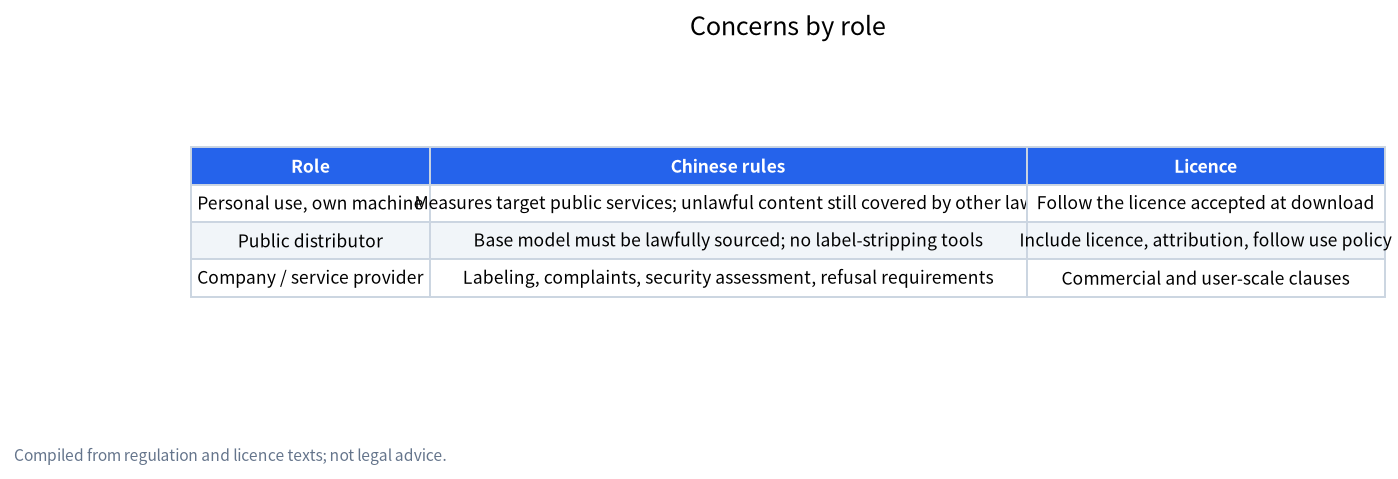
| Role | Typical activity | Chinese rules: concerns | EU rules: concerns | Licence: concerns |
|---|---|---|---|---|
| Personal use on your own machine | Run it locally and offer it to no one | The Measures target services provided to the domestic public; generating or spreading unlawful content is still governed by other laws | Obligations fall on “providers” who make models available on the market; we found no explicit statement on pure personal use, so ask a lawyer | Follow the licence and use policy accepted at download |
| Public distributor | Publish modified weights or tools in a community | A public service or tool may touch the labeling measures and similar rules; the base model should have a lawful source | May become a provider if the modification is significant; the open-source exemption has conditions | Redistribution needs the licence text, attribution and the use policy |
| Company or service provider | Build a product, API or public service | Provider duties under the Measures: labeling, complaints, security assessment and so on | Products falling into other AI Act categories (such as high-risk systems or transparency duties) carry other obligations, not covered here | Commercial terms and user-scale clauses |
What the three roles share: generating or spreading content the law prohibits is not excused by the tool used or by whether the model “has censorship”. Whether a model has refusal behaviour does not decide whether an act is lawful.
China: a few rules worth knowing
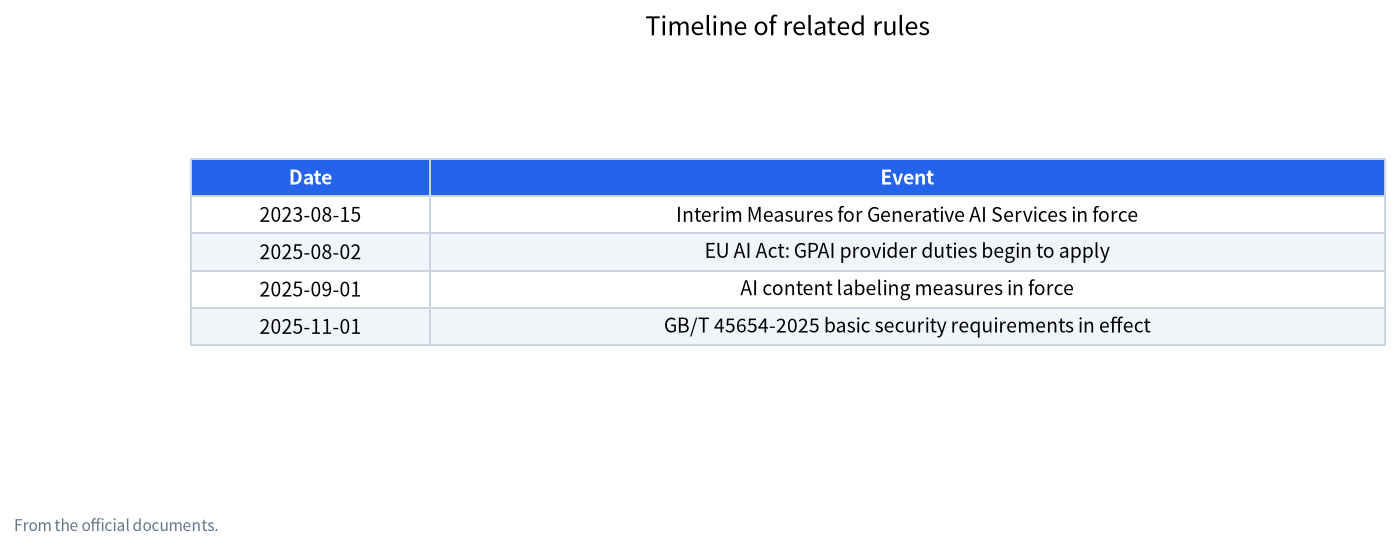
Interim Measures for the Management of Generative AI Services (in force from 2023-08-15). Article 2 applies them to services that use generative AI to provide text, image, audio or video content to the public in mainland China, and says that industry organizations, enterprises, education and research institutions and others that develop or apply the technology without providing services to the domestic public are outside the Measures. Article 4 requires providing and using such services to comply with laws and lists categories of content that must not be generated. Article 7 requires providers to use data and base models from lawful sources. Article 14 requires providers who find unlawful content to stop generation, rectify and report.
Measures for Labeling AI-Generated and Synthesized Content (document 国信办通字〔2025〕2号, in force from 2025-09-01) require relevant service providers to add explicit and implicit labels, and Article 10 says no organization or individual may maliciously delete, alter, forge or conceal labels, or provide tools or services for others to do so. If someone publicly offers a fine-tune or script made specifically to strip labels, this is the first article to look at.
GB/T 45654-2025, Cybersecurity technology: Basic security requirements for generative AI services (in effect from 2025-11-01) is a recommended national standard aimed at service providers. Its clause 5.2 says questions that are clearly extreme or clearly aimed at eliciting unlawful or harmful information should be refused, and other questions should all be answered; clause 6.7 sets requirements for on-device model services, such as a security module, log retention and an update mechanism. In other words, when a model is offered as a service, refusal capability is something that is required, not a feature to strip casually. We expand on this in the enterprise content-safety checklist.
| Rule | Date | Main addressee | Relevance here |
|---|---|---|---|
| Interim Measures for Generative AI Services | In force 2023-08-15 | Providers serving the domestic public | Defines which cases fall in and which R&D uses fall outside |
| EU AI Act: general-purpose model duties | Applying since 2025-08-02 | GPAI providers, including downstream modifiers who meet the test | Open-source exemption and modifier test |
| AI content labeling measures | In force 2025-09-01 | Service providers, distribution platforms, all organizations and individuals | No malicious label removal |
| GB/T 45654-2025 | In effect 2025-11-01 | Generative AI service providers (recommended standard) | Refusals, logs, on-device security module |
Read the table as a map of where to look, not as a statement of how any particular case would be decided; the texts themselves, and a lawyer, decide that.
EU: general-purpose model duties and the downstream modifier
The EU AI Act’s obligations for providers of general-purpose AI (GPAI) models have applied since 2025-08-02. The European Commission’s service desk states that a model released under a free and open-source licence, with public weights, architecture and usage information and without systemic risk, can be exempt from the technical-documentation, downstream-documentation and authorised-representative duties, but must still meet the copyright-policy and training-data-summary duties.
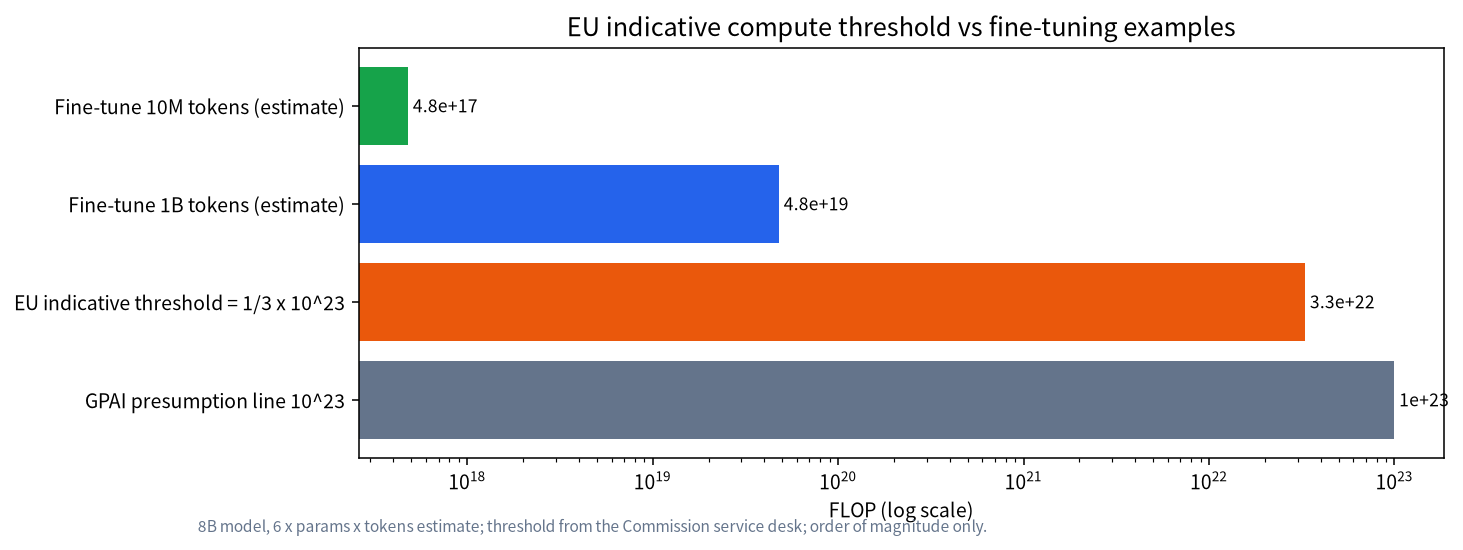
For people who modify someone else’s model, the Commission’s test is that a downstream modifier becomes the provider of the modified model only when the modification significantly changes the model’s generality, capabilities or systemic risk; the indicative criterion is training compute used for the modification above one third of the original model’s training compute. If the modifier cannot know that value, the threshold is replaced: one third of 10^23 FLOP (about 3.3×10^22) for a general-purpose model, or one third of 10^25 FLOP for one with systemic risk.
Worked example. Use the common “6 × parameters × tokens” estimate of training compute (high for methods that update few parameters). Fine-tuning an 8B model on 10 million tokens: 6 × 8×10^9 × 10^7 ≈ 4.8×10^17 FLOP, about 0.0014% of the 3.3×10^22 threshold; on 1 billion tokens: about 4.8×10^19 FLOP, about 0.14% of the threshold. This only conveys orders of magnitude. The threshold is indicative, the real test is whether a “significant change” happens, and we cannot say whether any specific modification would make someone a provider.
Licences: the terms usually follow a modified model
Take the Llama 3.1 Community Licence as an example (we read its public text). If you distribute Llama materials or derivative works, you must include a copy of the agreement and prominently display “Built with Llama” on a related website or product documentation; if you use its outputs to train, fine-tune or improve an AI model that you distribute, the model name must begin with “Llama”; use must comply with applicable law and the Acceptable Use Policy, which is incorporated by reference. Products with more than 700 million monthly active users need a separate licence from Meta. That is one example; Apache-2.0 and other licences differ, so check the base model’s licence and use policy clause by clause before distributing, instead of assuming that a modified model is simply yours.
Common misconceptions
- “Running locally means no legal issue”: local only means you serve no public; it does not permit generating or spreading unlawful content and does not remove licence terms.
- “Hosting the model abroad puts it outside Chinese rules”: Article 20 of the Measures says that when services provided from abroad to the domestic public do not comply, the national cyberspace authority can notify the relevant bodies to take measures.
- “Open source means no obligations”: the EU open-source exemption has conditions, and the copyright-policy and training-data-summary duties are not exempt.
- “It is fine if nobody knows I made it”: the labeling measures forbid malicious label removal, and hiding provenance in a service or distribution setting raises the risk.
- “The risk is only legal, not safety”: a model without guardrails is easier to push into harmful output, and incidents and reputational damage belong in the cost.
Compliance self-check list (not legal advice)
- Am I using it myself, distributing it, or offering a service?
- Is the base model lawfully sourced, and have I read its licence and use policy?
- Do I plan to distribute modified weights or tools, and have I kept the licence text, attribution and naming rules?
- Does the product involve content labeling, logs and a complaint channel?
- Does a public-facing service have input and output checks and incident handling? See private deployment for enterprises and how refusal rates are measured.
- Have I assessed data and privacy? See local LLM privacy.
- When unsure, consult a lawyer first, then act.
How we checked this, and what we did not do
The Interim Measures and the labeling measures were read from the Cyberspace Administration of China’s website; GB/T 45654-2025 from the full standard text; the EU part from the official explanations on the Commission’s AI Act service desk; the Llama 3.1 licence from Meta’s official repository. We have no legal qualification, did not review any specific project’s compliance and do not provide, test or recommend any method or model for bypassing safety limits. Rules change, and this article reflects the versions read on 2026-11-04.
FAQ
Is an uncensored local LLM legal?
There is no single answer; it depends on whether you use it yourself, distribute it or offer a service, and on whether the content you generate and spread is lawful. Whether a model refuses does not itself decide legality.
Must an individual follow the Interim Measures when using it on their own computer?
The Measures target providers serving the domestic public; personal use is not that kind of provision. Generating or spreading unlawful content is still governed by other laws.
What should I watch when publishing a modified model?
Check the base model’s licence and use policy, keep the required attribution and naming, do not offer tools made specifically to remove labels, and assess whether it could count as a service offered to the public.
Does the EU open-source exemption mean I need do nothing?
No. The exemption has conditions, and the copyright-policy and training-data-summary duties still apply; whether you become a provider depends on whether the modification is significant.
Can a company use a model with refusals removed for internal tools?
Internal use may fall outside the Interim Measures but is still subject to data, cybersecurity and other laws, plus licence and sector requirements. Do a risk assessment and design content safety first.
Can this article serve as a legal basis?
No. It is explanatory material compiled from public texts and is not legal advice.
Want to know how to do content safety in an enterprise deployment?
Join the community or email admin@microaione.com; companies can also contact us through the solutions inquiry page.
More in this series: Jailbreak, “po jia” and cracking compared; How jailbreak defenses work in layers. All articles are collected in the LLM Jailbreak and Safety hub.
References: Interim Measures for Generative AI Services (CAC), Measures for Labeling AI-Generated Content (CAC), EU AI Act Service Desk: open-source GPAI models, EU AI Act Service Desk: downstream modifiers, Llama 3.1 licence, GB/T 45654-2025. Read on 2026-11-04.