
Local LLM Appliance Buying Guide: What to Ask Before You Pay (2026)
Note: Market figures in this article come from public media reports (a 2026-10-03 article by 半导体产业纵横 republished on TMTPost, and a 2025 report by The Paper / 澎湃新闻). We relay them with attribution and have not verified any vendor quote ourselves. Prices labelled “reference price” are estimates built from the median of several public October 2026 quotes; they are not a vendor quote, and the actual quote prevails. We do not endorse any vendor here; the goal is to help you ask the right questions.
“How much is a local LLM appliance?” is the most direct question we get, and the hardest to answer directly. The same label covers anything from a desktop box to a seven-figure (RMB) server, and the difference lies in which model it runs, how many people it serves at once, and who maintains it afterwards. This local LLM appliance buying guide walks through the variables behind the price so you know what to ask before you request a quote. If you are not yet sure you need local hardware at all, start with local LLM vs API.
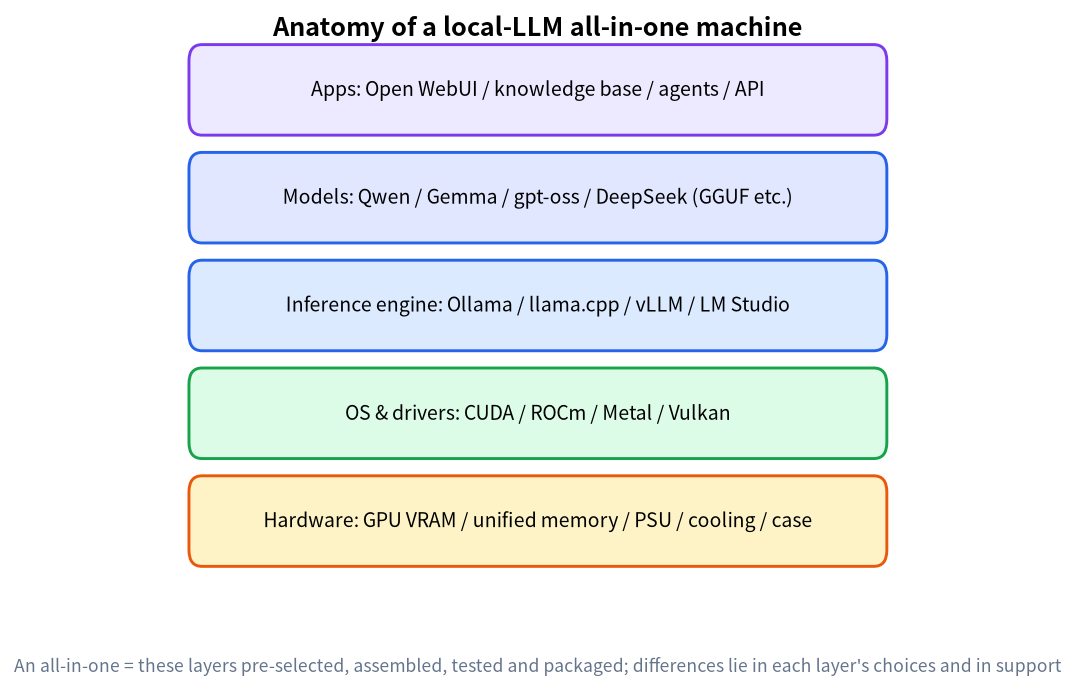
What an all-in-one LLM machine actually is
The TMTPost-republished article defines a large-model all-in-one machine (“一体机”) as a device that integrates AI accelerator hardware (GPUs or domestic Chinese accelerator cards), server hardware, an inference framework, model weights, and supporting operations and application platforms. It is aimed at governments, enterprises and research institutions that want private, on-premises deployment without assembling servers, adapting frameworks and debugging models themselves.
In short, you are buying hardware plus software plus service, not a pile of GPUs. How much of the price is hardware versus software and service largely determines the experience you get later.
Local LLM appliance buying guide: how prices and demand changed from 2025 to 2026
The following is relayed from the two media reports. These are the reports’ claims, not prices we verified:
| When | What the reports say |
|---|---|
| Around Chinese New Year 2025 | DeepSeek R1 took off; 60+ vendors launched DeepSeek appliances; full-size 671B machines were commonly 1.2–1.5 million RMB each; with domestic accelerators, one box often lacked memory, so two were paired, bringing budgets close to 4 million RMB |
| Spring 2025 trade shows | The Paper saw a personal-use “full” model listed at 89,800 RMB, and two-box 671B systems at over a million RMB; the same report says low prices often come from quantisation or distillation |
| Second half of 2025 | The report says full-size boxes stopped selling and smaller vendors’ main orders shifted to 32B and 70B machines |
| 2026 | Most mid-range devices run at most 70B-class models and light “AI BOX” devices are rising; memory, storage and GPU chip prices all rose; full-size boxes are bought mostly by state-owned enterprises and financial institutions with strict compliance needs |
The reasons the article gives for the shrinkage: most users want knowledge-base Q&A and document drafting, for which distilled smaller models suffice, so 671B is overkill most of the time; MoE, distillation and quantisation have matured so the same quality needs fewer parameters; high-end chip supply is constrained; and memory price increases pushed up the cost of running full-size models locally.
The practical lesson: the price range is wide because “what does it run” varies so much. An interviewee in The Paper’s report says 671B and 32B models differ by at least an order of magnitude in hardware needs. So do not ask “how much is an appliance”; ask “which model, at what concurrency”.
Three kinds of “appliance” – do not compare them directly
| Type | Typical form | Best for | Price clue |
|---|---|---|---|
| Enterprise server appliance | Multi-GPU server with a pre-installed model and platform | Organisations with strict compliance and heavy concurrency | The media-reported 2025 full-size price was in the 1.2–1.5 million RMB range; 32B/70B models are cheaper. Reference price (estimated from Oct 2026 median market prices): about 150,000 RMB for a 32B-class machine (low confidence; public sources only give a “from 99,000 to the 200,000 range” summary), about 319,800 RMB for 70B (the median of three candidate prices of 287,500, 319,800 and 348,000 RMB in a June 2025 procurement notice for a 70B-spec DeepSeek appliance; dated), and about 1.35 million RMB for a full 671B machine |
| Desktop or mini AI box | NVIDIA DGX Spark, AMD Ryzen AI Max+ 395 machines, Macs | Individuals, small teams, department pilots | DGX Spark 128GB: US marketplace list $6,950 (per GPUwerk, checked 2026-10-11, listed out of stock; raised twice); China reference price (estimated from Oct 2026 median market prices): DGX Spark/GB10 128GB about 42,500 RMB (median of quotes between 37,000 and 43,800 RMB, 8–30 Oct 2026), an AMD Ryzen AI Max+ 395 128GB mini PC about 24,600 RMB, and Mac Studio (M5 Max) 128GB/1TB at the official 41,749 RMB |
| DIY or custom build | One or more consumer or workstation GPUs plus a host | People who want flexibility on a budget | A used RTX 3090 from about $1,599 in US listings (2026-10-30, volatile); whole-system reference price (estimated from Oct 2026 median market prices): about 14,300 RMB for 24GB (used 3090), 10,900 RMB for 16GB and 65,700 RMB for 32GB (RTX 5090); see Local LLM PC Build |
Mini AI boxes worth knowing
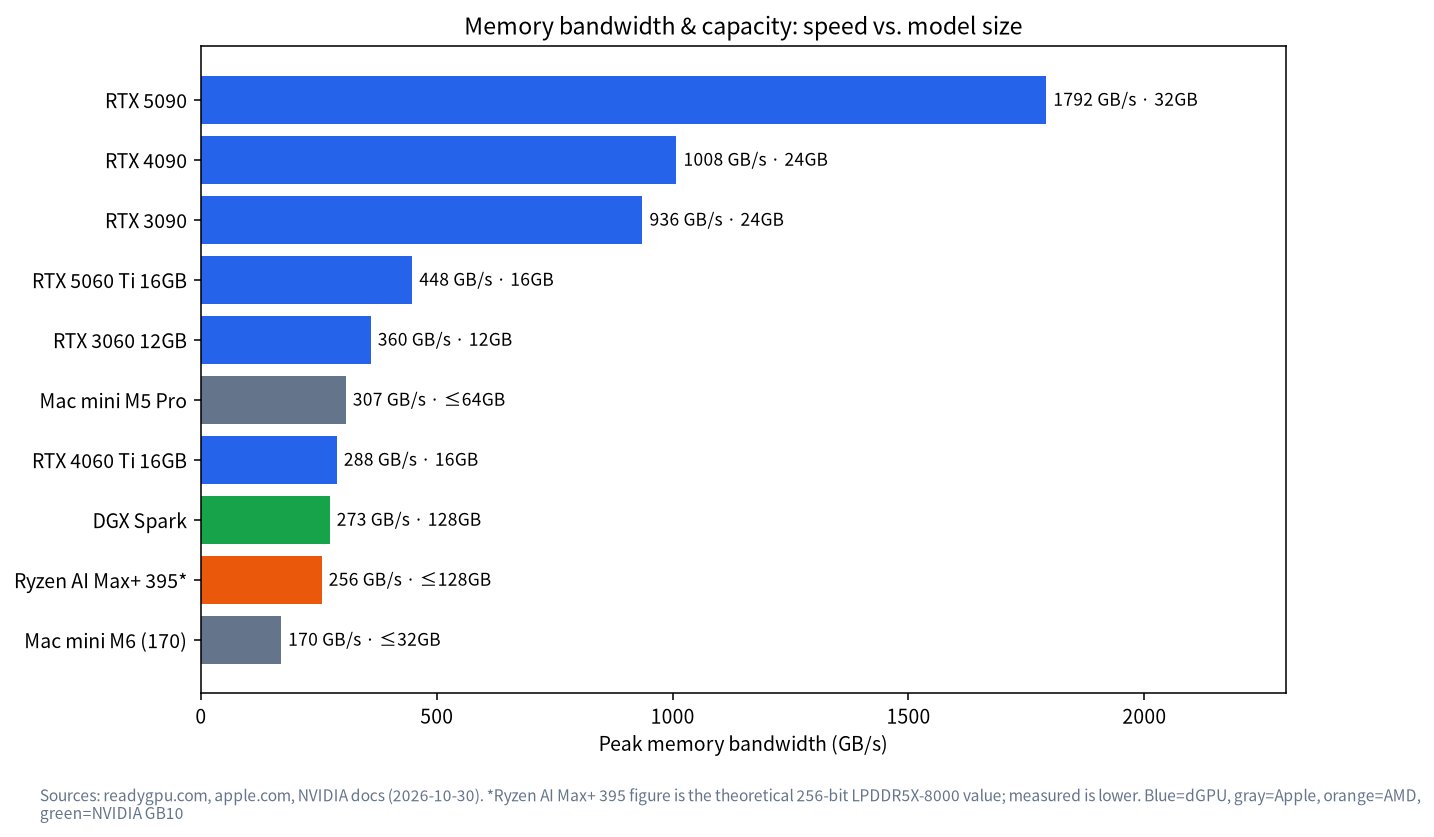
NVIDIA DGX Spark. NVIDIA’s documentation lists 128GB of LPDDR5x unified memory at 273GB/s, 1TB or 4TB NVMe, a bundled 240W power supply, and support for models up to 200B parameters (405B with two linked units). On price, GPUwerk’s page (updated 2026-10-24) reports: $6,950 for the 128GB model on NVIDIA’s US store (checked 2026-10-11, out of stock), up from $4,699 in February 2026 and $3,999 at launch; and a 64GB model going on sale through partners from 23 October 2026 starting at $4,999, per an NVIDIA blog post. That is a third-party page relaying prices that move often, so confirm on NVIDIA’s own pages.
AMD Ryzen AI Max+ 395. Ollama’s GPU documentation lists this chip (gfx1151) among supported AMD devices. Its theoretical memory bandwidth is around 256GB/s and effective bandwidth is lower. China reference price (estimated from Oct 2026 median market prices): about 24,600 RMB for a 128GB mini PC (median of four 128GB models quoted from 21,999 to 27,999 RMB; memory and storage costs have pushed prices up this year). For orientation abroad, the Framework Desktop 128GB is about $3,449 without storage and the GMKtec EVO-X2 128GB/1TB about $3,499.99.
Mac. M5 Max bandwidth is roughly 460–614GB/s depending on GPU core count (see Apple’s spec pages); memory tiers and prices are covered in running local LLMs on a Mac.
These devices share a profile: large capacity, middling bandwidth. They can hold bigger models but usually generate more slowly than a high-end discrete GPU (about 1,008GB/s on an RTX 4090 and 1,792GB/s on an RTX 5090).
Work out concurrency before you talk price
Concurrency is the recurring theme in the coverage. In The Paper’s 2025 report, an industry interviewee says some roughly 100,000-RMB “full” machines supported only one concurrent user, and that a company of about 100 people using an appliance for internal knowledge-base search needs at least 10 concurrent sessions. Those are interviewees’ claims, but the logic holds: concurrency drives memory.
Ollama’s FAQ explains that parallel requests to one model multiply the context size by the number of parallel requests, and required memory scales as OLLAMA_NUM_PARALLEL × context length. A rough estimate:
Total memory ≈ model weights + KV cache per session × concurrent sessions + runtime overhead
Hypothetical example (it shows the method only; based on CanRun’s Q4_K_M, 8K-context estimates, scaled linearly, so real usage will differ):
| Model | Weights | KV per session (8K) | Estimated total at 10 concurrent sessions (weights + KV, excluding ~0.6GB runtime overhead) |
|---|---|---|---|
| Llama 3.1 8B | 4.6GB | 1.1GB | about 15.6GB |
| Llama 3.3 70B | 41.9GB | 2.7GB | about 68.9GB |
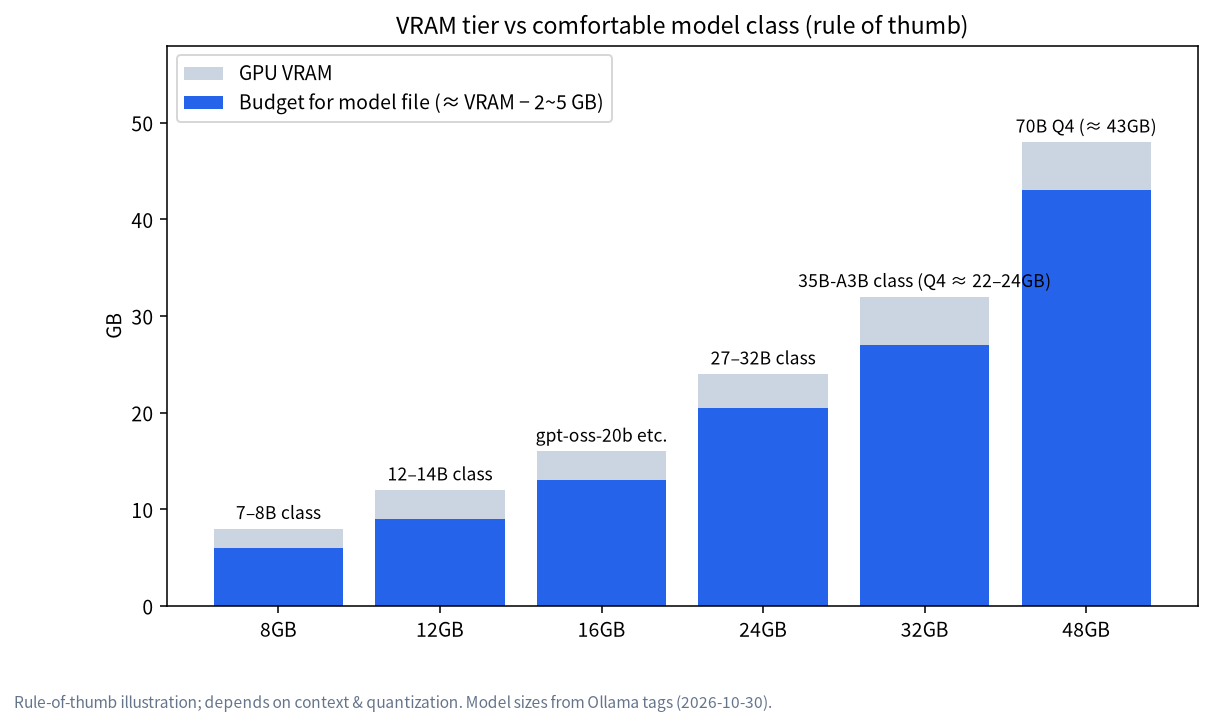
So the same “10 concurrent users” fits a single 24GB card with an 8B model, while a 70B model needs 64GB-plus of unified memory or several cards – and that is before longer contexts. See how to calculate LLM VRAM needs for the full method.
Beyond concurrency: first-token latency and speed
The Paper’s report also notes that concurrency falls further when inputs are long, and one interviewee says about 20 tokens per second is the commonly accepted threshold for a comfortable experience, with 10 tokens per second feeling slow. When you ask for a quote, give the vendor concurrency, context length and acceptable time-to-first-token together; otherwise quotes are not comparable.
10 questions to ask any vendor
This list combines pitfalls named in the media reports with our own judgement:
- Which exact model? Original or distilled? Interviewees in the report say some “DeepSeek appliances” really run a distilled 70B or 32B model; see DeepSeek local deployment.
- What precision? FP8, INT8 and 4-bit differ in quality and hardware needs; a 4-bit “full-size” model can feel noticeably dumber (an interviewee’s remark).
- What concurrency at what context length? Get it in writing.
- How are time-to-first-token and generation speed measured? Insist on a live test with your own tasks.
- Which inference framework and platform? Who tunes it, and can you inspect it?
- How does the model get updated? The reports mention vendors who deliver hardware but offer little follow-up model updating.
- Who owns data security? Isolation, permissions, logging, response time for vulnerability fixes.
- What do the room and power need to be like? Server-class gear has power, cooling and temperature requirements.
- What is the total cost of ownership? The TMTPost article lists power and cooling, operations staff, model version upgrades, inference-framework tuning and fault maintenance as costs buyers often overlook.
- Can you try it first? Test with real workloads before paying.
When a DIY build beats an appliance
If you are an individual or small team with modest concurrency and a limited budget, or you like tinkering and upgrading, building your own is usually more flexible. You choose the GPU by VRAM tier; for example a 24GB card runs 27B–35B models at Q4_K_M, covered in 24GB VRAM local LLM. For budgets and parts lists see local LLM PC build configs and the GPU VRAM guide. The cost is that drivers, cooling, faults and upgrades are your responsibility – which is precisely what appliances charge for.
What we can do – and what we won’t promise
We are a Shenzhen team that builds local-LLM machines: selection, sourcing, assembly and testing. We can translate your concurrency, context length, budget and privacy needs into VRAM and system specs, give you a buildable parts list, and test it on your real tasks before delivery. What we will not do is promise any performance number you have not verified on your own workload. For a configuration and quote that fit your needs, contact us at admin@microaione.com and we will draw up a parts list; this article shows no “success stories” that you could not verify on your own workload, and every price here is a reference price as labelled above.
Frequently asked questions (FAQ)
How much does a local LLM appliance cost?
The range is very wide. Media reports put 2025 full-size 671B enterprise machines at roughly 1.2–1.5 million RMB, while mini AI boxes and DIY builds cost far less, depending on model, concurrency and configuration. At October 2026 median market prices that is roughly 150,000 RMB for a 32B-class machine, 320,000 RMB for 70B and 1.35 million RMB for 671B; about 42,500 RMB for a DGX Spark-class desktop, 24,600 RMB for an AI Max+ 395 mini PC, and about 8,000–66,000 RMB for a DIY build. These are reference prices; the actual quote prevails.
Is an appliance always better than building my own?
No. An appliance’s value is pre-installed software and after-sales support, and you pay for that. Individuals and small teams often do better building their own; organisations should ask whether they have the operations capacity.
Do I need a “full-size” model?
For knowledge-base Q&A and document drafting, the media coverage suggests distilled smaller models are often enough. Whether you need full size depends on your tasks, so test with your own workload first.
How much is a DGX Spark right now?
GPUwerk reports $6,950 on NVIDIA’s US store for the 128GB model (checked 2026-10-11, out of stock) and a 64GB partner model from $4,999 per an NVIDIA blog post. The China reference price (estimated from Oct 2026 median market prices) is about 42,500 RMB for the 128GB model. Prices move quickly, so rely on NVIDIA’s own pages.
What hidden costs should I plan for?
Power and cooling, operations staff, model upgrades, inference-framework tuning and fault maintenance – the TMTPost article names these as the costs most often left out of the budget.
We are a small team. Do we need an appliance?
Estimate concurrency and context first. For a few users, a single 24GB-GPU machine running Open WebUI is often enough; see Open WebUI with Ollama.
Next steps and the community
If you are stuck on choosing, post your headcount, how many people use it at the same time, document length, budget and privacy requirements in the community (join the community) and we and other members will help you estimate. If you want us to work backwards from those numbers to a machine spec, get in touch; we will first help you judge whether you need to buy at all, then talk configuration. There is no obligation. To choose a model for your hardware, see best local LLM models.