Jailbreak Defenses Explained: Alignment Training, Classifiers and Permission Isolation as Layers of Protection
Ask about jailbreak defenses and many people’s first idea is “filter dangerous keywords out of the prompt”. That is the shallowest layer and the easiest to evade. Effective defense is layered: train the model to lean toward refusing harmful requests, check inputs and outputs with independent classifiers at inference time, use permission isolation so that even a fooled model cannot do damage, and add logging, monitoring and continuous red-teaming. This article takes the defender’s view and explains what each layer does, why one layer is not enough, what it costs, how it fails, and uses a probability example to show both the value and the trap of layering. It is part of our LLM jailbreak and safety hub; if you are not yet clear on what a jailbreak is and which attack families exist, read LLM jailbreak explained first. This site publishes no bypass methods, so this piece is defense only.
Key points (updated 2026-11-04)
- There is no silver bullet: stack alignment training, input and output classifiers, permission isolation, monitoring and red-teaming.
Anthropic’s own test: adding Constitutional Classifiers cut jailbreak success on 10,000 synthetic prompts from 86% to 4.4%; the improved classifiers raised refusals on real conversations by about 0.38% and inference compute by about 23.7%.
The value of layering depends on whether layers are independent: three layers each catching 90% miss 0.1% if independent, but could miss 2.5% if strongly correlated (assumed numbers).
For local models no vendor adds an outer filter for you; add guardrails yourself, see Llama Guard and Qwen3Guard local setup.
For apps with tools, restricting permissions is more reliable than blocking prompts: even a manipulated model can only do what it is allowed to do.
The basic idea of jailbreak defenses: why layers are necessary
Defense faces an asymmetry: an attacker needs one workable route, a defender has to cover them all. Wei et al. (2023) described two failure modes of safety training, “competing objectives” and “mismatched generalization” (see our overview article), which means training alone is unlikely to be watertight. Engineering therefore uses defense in depth: every layer is imperfect, but stacked together an attack must beat several at once.
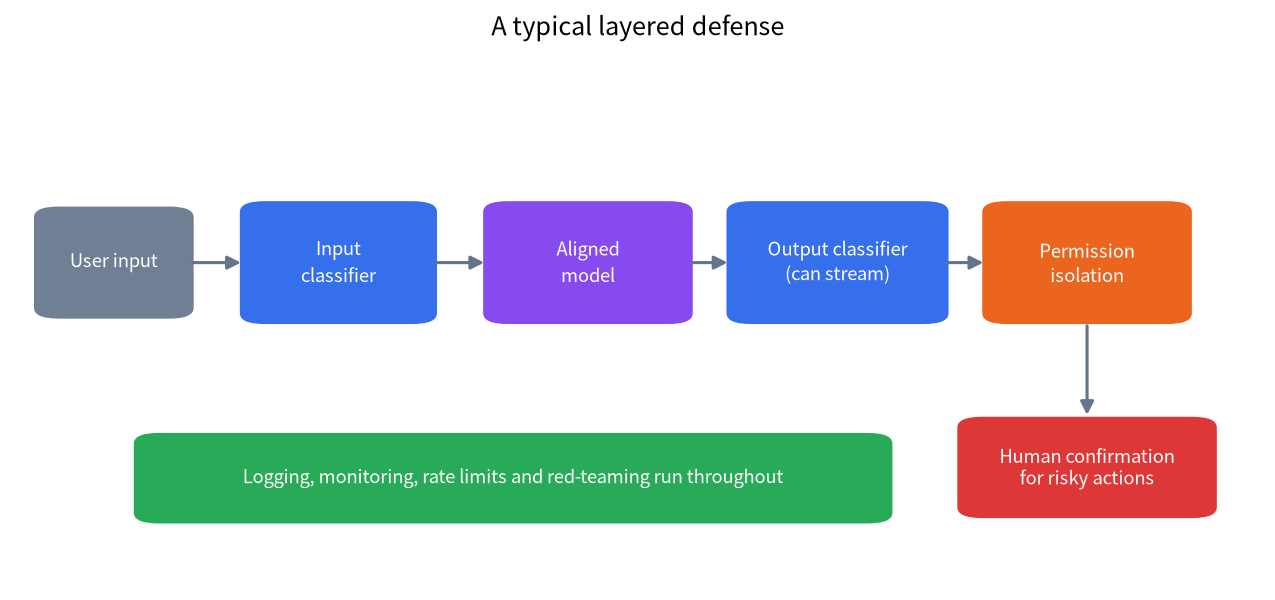
Here is a typical layered structure.
| Layer | What it does | What it can stop | Typical failure | Main cost |
|---|---|---|---|---|
| Training: alignment training | Supervised fine-tuning and preference optimization teach the model to lean toward refusal | Direct harmful requests | A different framing or expression outside the trained distribution | Training cost, possible over-refusal |
| Training: circuit breakers and other representation interventions | Interrupt harmful generation at the level of internal representations | Some attacks insensitive to input form | New attacks may still get through, and capability can suffer | Research stage, needs dedicated training |
| Input classifier | Judges a request before it reaches the model | Obvious violations, known attack patterns | False positives, evasion by rewording | Extra inference and latency |
| Output classifier | Checks the answer before it returns, possibly streaming | Harmful output after a model has been manipulated | Misses; streaming checks may only trigger mid-way | Extra compute, may cut off a legitimate answer |
| System prompt and role limits | States rules before the conversation | Low-effort manipulation | Easily overridden by later input | Nearly zero |
| Permission isolation and least privilege | Limits tools the model can call and data it can reach | Prompt injection, privilege abuse | Misconfiguration, excess permissions | Development and operations effort |
| Monitoring, rate limits and bans | Spot abnormal usage and restrict retries | Large automated attempts | Low-volume careful attacks | Logging and privacy compliance |
| Red-teaming and evaluation | Continuously test with attack sets | Discover new weaknesses | Incomplete coverage | People time |
Training layer: make the model lean toward refusal
Alignment training is the base layer: human or AI feedback teaches the model to lean toward refusing harmful requests while staying useful for harmless ones. Its limit is a finite training distribution; the central finding of jailbreak research is that “say it differently and the defense may not apply”.
Representation-level interventions are a recent research direction. For example Zou et al.’s 2024 circuit breakers aim to interrupt generation when the internal representations lean toward harmful output, rather than relying on refusal wording at the surface. Such methods try to make defense insensitive to the form of the attack input, but they remain in research and early adoption and should not be treated as universal.
The training layer carries an important trade-off: over-refusal. The more conservative the training, the more harmless requests get refused too. So the measure of a defense cannot only be “how many attacks were stopped”; it must include “how many normal requests were hurt”, which is why we urged measuring refusal rates on your own tasks in Does Qwen need jailbreaking for local deployment?
Inference layer: independent classifiers
Restrictions in the training layer sit in the weights, where attackers can probe repeatedly; an independent classifier is a separate set of parameters that can be updated on demand and can guard input and output separately.
An input classifier judges a request before it reaches the main model and suits obvious violations and known attack patterns. An output classifier checks the answer and handles the case where the input looks harmless but the output is harmful. A more advanced approach is streaming checks: the classifier watches as the model generates and stops at once on a violation instead of waiting for the full answer. Anthropic’s Constitutional Classifiers work takes this approach, using a written “constitution” of rules to generate large volumes of synthetic training data for input and output classifiers.
The open-source community has off-the-shelf guard models too, such as Meta’s Llama Guard, Alibaba’s Qwen3Guard (with a streaming variant and three-tier severity labels), and OpenAI’s gpt-oss-safeguard (which judges against a policy you supply at inference time). Their deployment, VRAM needs and selection are covered in the local guardrail tutorial.
Application layer: restricting permissions beats blocking
OWASP lists prompt injection as the number-one risk for LLM applications. For apps with retrieval or tools, the attacker need not “jailbreak” the model; hiding malicious instructions in a web page or document may be enough for the model to obey them. Filtering prompts is unreliable here; what works better is limiting the consequences of being fooled:
- Least privilege: give the model only the tools and data access the task needs, never global keys.
- Human confirmation: require a person to confirm high-risk actions (payments, deletion, sending external messages).
- Isolate untrusted content: mark retrieved external content as data, not instructions, and limit which actions it can trigger.
- Output filtering: stop the model from carrying sensitive data out through links or tool calls.
If a local deployment exposes an interface to others, add authentication and audit logging too; see the local API server guide.
A probability example: the value and the trap of layering
Suppose three layers of defense each stop 90% of attack attempts (numbers chosen by us to illustrate, not measured).
- One layer: 10% get through.
- Three fully independent layers: 0.1 × 0.1 × 0.1 = 0.001, or 0.1%.
- Three correlated layers: if an attack that beats layer one has a 50% chance of also beating layer two, and a further 50% chance of beating layer three, then 0.1 × 0.5 × 0.5 = 0.025, or 2.5%.
| Case | Arithmetic | Share getting through |
|---|---|---|
| One layer | 1 − 0.9 | 10% |
| Three independent layers | 0.1 × 0.1 × 0.1 | 0.1% |
| Three correlated layers (50% carry-over failure) | 0.1 × 0.5 × 0.5 | 2.5% |
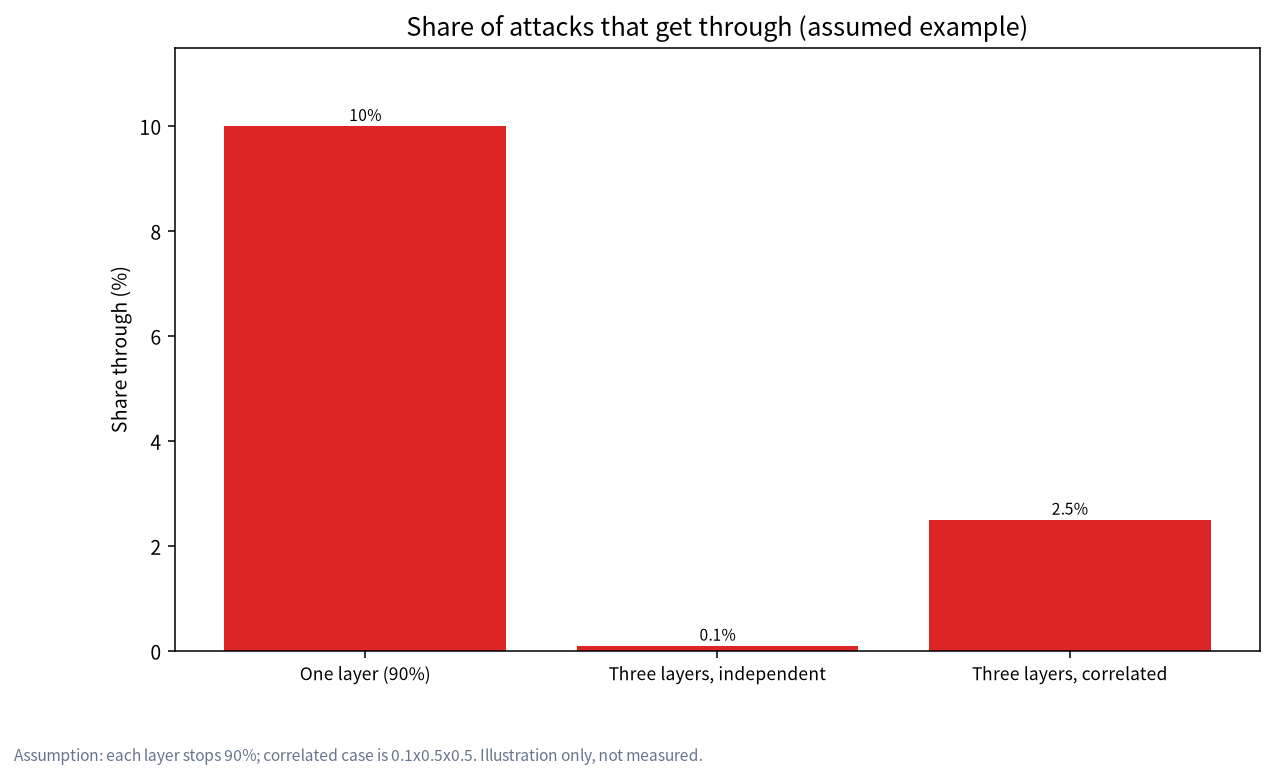
The example shows that layering is worth only as much as the layers are truly independent. If all three use the same training data and the same kind of model they fail in similar places and the stacking gain shrinks. So in engineering you make the layers different: different training data, different models, different mechanisms (rules plus models plus permissions).
The cost of defense: do the arithmetic
Defense is not free. Anthropic’s reported improved classifiers raised refusals on 5,000 real conversations by about 0.38% (a difference that was not statistically significant) and raised inference compute by about 23.7%.
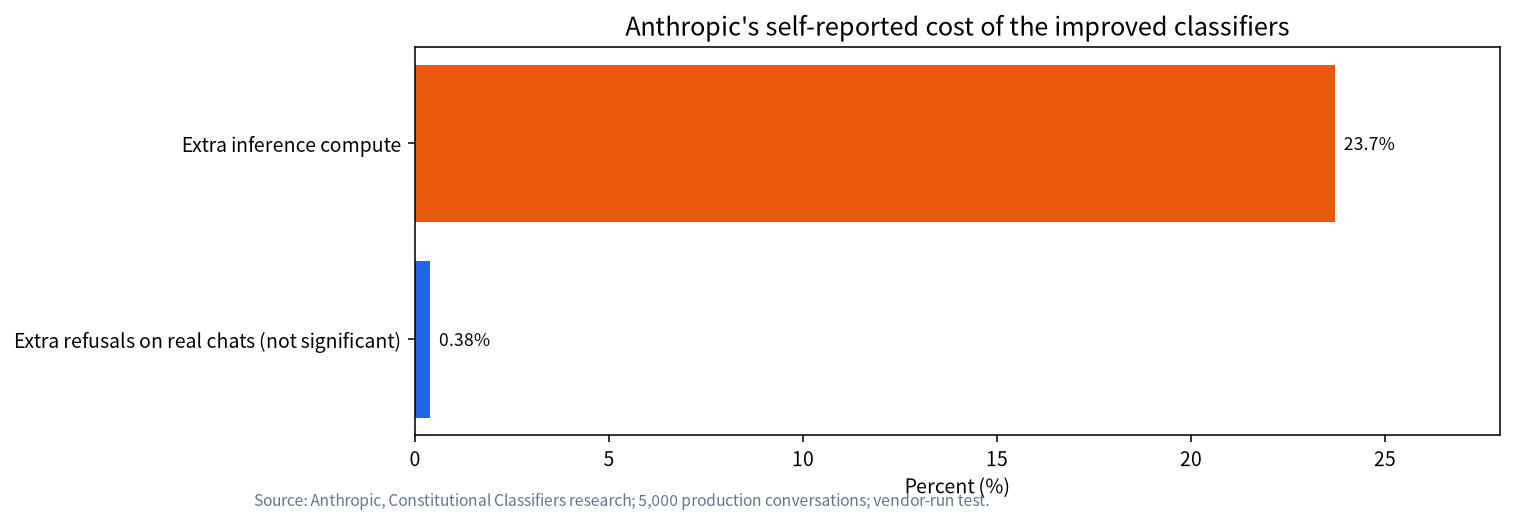
A rough calculation with those two numbers: if your service handles 1 million conversations a month, a 0.38% rise in refusals is about 3,800 extra refusals; a 23.7% rise in compute means a monthly inference bill of ¥1,000 grows by about ¥237. What you weigh is whether that collateral damage and cost are worth it against the risk of one successful jailbreak. For a local deployment the guard model’s overhead can be estimated by parameter count: guarding a 27B main model with a 0.6B guard is about 2.2% of the parameters, with an 8B guard about 30%. That is a rough ratio; real cost depends on input and output length and the implementation.
How to evaluate whether your defense works
- Use public benchmarks: standardized frameworks such as HarmBench measure attack success rate in an isolated environment.
- Measure collateral damage too: use harmless but “sensitive-looking” requests to measure refusal rate.
- Regress continuously: rerun after every update to the model, guardrail or system prompt.
- Run red-teaming: see our local model red-teaming primer.
Do evaluations in a controlled environment with public test sets and use the results only to improve the defense, not to study how to hurt others.
How individuals and small teams can put this in place
- Pick the model first: prefer models with alignment training and safety documentation.
- Add guardrails: when serving others, put one classifier on the input and one on the output.
- Limit permissions: configure tool-using apps with least privilege.
- Keep logs: record blocked requests, mind privacy compliance; see local LLMs and privacy.
- Test regularly: rerun the same evaluation set after each change.
Where model weights have been altered (for example community “uncensored” builds), guardrails matter even more, because the model’s own layer has been weakened; see the refusal-direction ablation explainer. For how offense and defense have evolved, see our short history of LLM jailbreaks.
FAQ
Which single layer is the most effective jailbreak defense?
There is none. For chat apps, alignment training plus input and output classifiers is the foundation; for tool-using apps, least privilege is often more reliable than any prompt filter.
Can keyword filtering on input stop jailbreaks?
Hardly. Keyword filters are easy to evade by rewording and cause false positives; a semantic classifier plus output checks and permission limits is more dependable.
Will adding a classifier make the model dumber?
A classifier is a separate model and does not change the main model’s capability; its cost is latency, compute and possible false blocks. Anthropic’s improved version raised refusals by only about 0.38% in its test, but that holds only under its test conditions.
Do local models need jailbreak defenses?
If only you use it you can keep it simple; once others use it or it connects to business systems, add at least input and output moderation and permission limits.
Is defending against prompt injection the same as defending against jailbreaks?
Not exactly. Jailbreak defense focuses on making the model keep its own safety rules; injection defense focuses on isolating untrusted content and limiting permissions.
How do I know whether the defense has been bypassed?
Through continuous red-teaming, public benchmarks and log monitoring, while also recording false positives so you do not trade away usability for blocking.
Talk to us
If you are designing guardrails for your team’s local model, send the scenario and deployment to the community or email admin@microaione.com and we can work out which layers you need. More related articles are in the LLM jailbreak and safety hub.
References: Anthropic Constitutional Classifiers (arXiv 2501.18837), Zou et al., Circuit Breakers (arXiv 2406.04313), Llama Guard (arXiv 2312.06674), HarmBench (arXiv 2402.04249), OWASP LLM01. Data read on 2026-11-04, Beijing time.
Related in this series: Prompt injection vs jailbreak; Refusal rate benchmarks explained; Enterprise LLM content safety checklist