Eleven v4 Turbo Review: The Best TTS? Versus Qwen-Audio, Gemini TTS and Local Fish Drama 3
Eleven v4 Turbo is ElevenLabs’ real-time speech synthesis model. On the Artificial Analysis Speech Arena (read 2026-11-01) it ranks first with an Elo of 1336. There is one important detail: its interval overlaps with that of Eleven v4 (1334) in second place, so statistically it is a tie, not a clear lead. And the leader costs about $40 per million characters, while several models behind it cost less than half that. This article puts the leaderboard, price, latency and local alternatives together and answers one question for a local-AI reader building a voice assistant or audio content: when is ElevenLabs worth paying for, and when should you use a model you can download?
Verification note: Leaderboard and price data was read from the Artificial Analysis Speech Arena (2026-11-01); ElevenLabs capabilities, latency and character limits come from the models page of its official documentation; Fish Audio Drama 3’s parameters and latency come from its Hugging Face model card (figures measured by the vendor on H200 GPUs). We have not synthesized or listened to audio ourselves and give no subjective audio quality verdicts; costs are our own arithmetic. ElevenLabs’ own subscription pricing is not verified here; all prices are the per-million-character prices listed on the board.
Key takeaways (Updated 2026-11-01)
- Board: Eleven v4 Turbo 1336 (±16), Eleven v4 1334 (±15), statistically tied; Qwen-Audio-3.1-TTS-Plus 1305, Sonic 3.6 1296.
Price: Eleven v4 Turbo about $40 per million characters, v4 about $80; Gemini 3.8 Flash TTS about $16.50, Fish Drama 3 about $15, Kokoro 82M about $0.65.
Local: the strongest open-weights model is Fish Audio Drama 3 (Elo 1278, a 35B MoE with 3B active per token); the vendor measured a median time to first audio of 88.9 ms for one stream on an H200.
The Short Answer: Tied for First, Not the Cheapest
| Rank | Model | Elo | Per 1M characters (USD) | Note |
|---|---|---|---|---|
| 1 | Eleven v4 Turbo | 1336 (±16) | 40 | September 2026, real-time |
| 2 | Eleven v4 | 1334 (±15) | 80 | Within the interval of v4 Turbo |
| 3 | Qwen-Audio-3.1-TTS-Plus | 1305 | 19.3 | — |
| 4 | Sonic 3.6 | 1296 | 49 | — |
| 5 | Gemini 3.8 Flash TTS | 1283 | 16.5 | — |
| 6 | Fish Audio Drama 3 | 1278 | 15 | Highest open weights |
| 9 | Lightning V3.1 Pro | 1266 | — | — |
| 23 | Eleven v3 | 1188 | 100 | Previous generation |
| 62 | Kokoro 82M v1.0 | 1062 | 0.65 | Cheapest on the board |
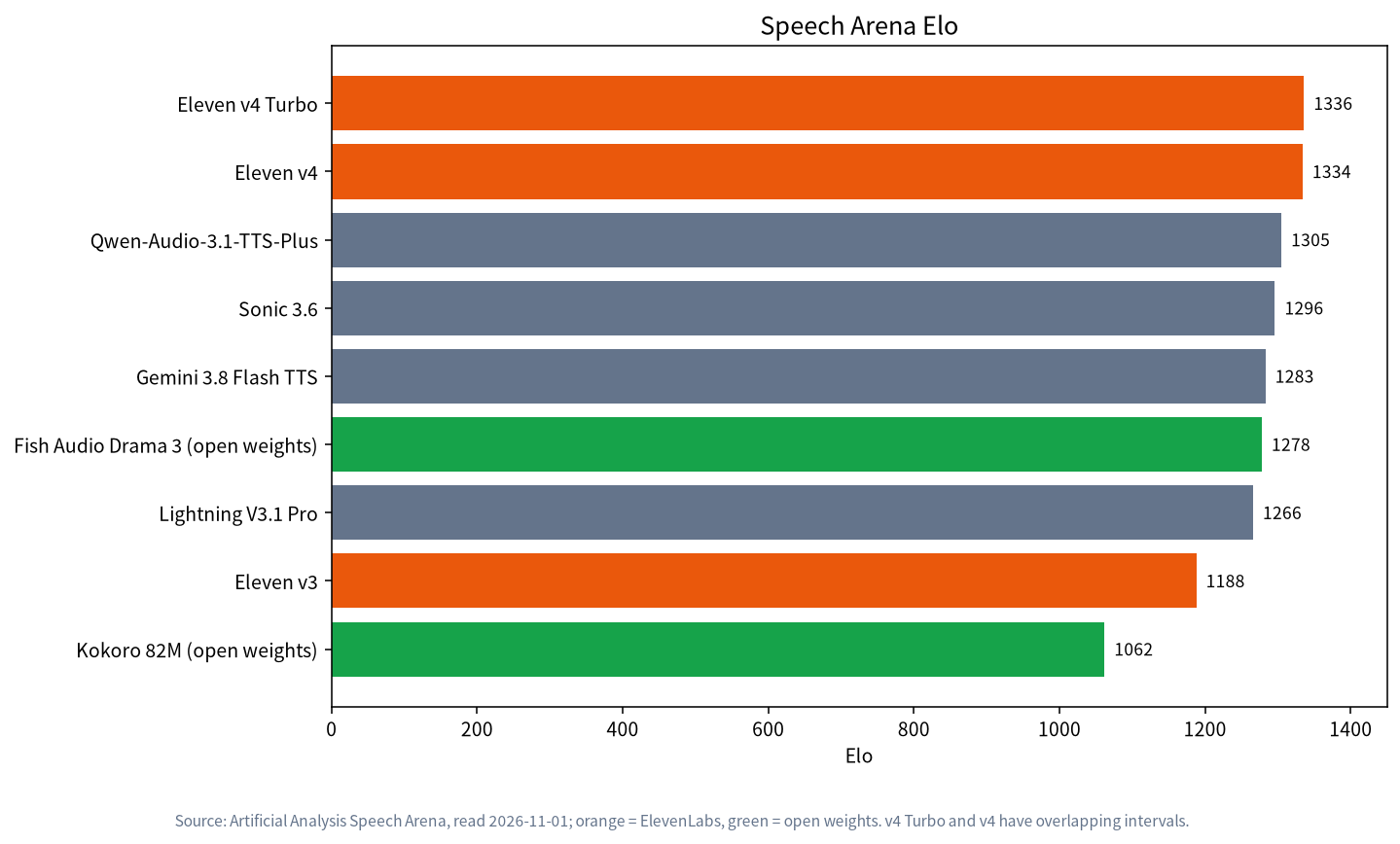
Three points stand out. First, v4 Turbo is only 2 points above v4 against an error of ±15 to ±16, so they are equal in preference; yet v4 Turbo costs half as much and, per the official documentation, is the most expressive real-time model with a median latency of about 100 ms (excluding application and network latency). Second, the prices are the numbers listed by Artificial Analysis; actual billing follows ElevenLabs’ plans. Third, the top six span only 58 points. Under the standard Elo conversion (our assumption), v4 Turbo is preferred in a single vote about 58% of the time against Fish Drama 3, about 54% against Qwen-Audio-3.1-TTS-Plus, and about 83% against Kokoro.
What ElevenLabs’ Documentation Says About v4 Turbo
From the official models page: Eleven v4 Turbo targets real-time synthesis with a median latency of about 100 ms, 90+ languages, high-fidelity voice cloning and audio tags for fine control, and is reached through the Text to Dialogue websocket. For contrast, Eleven v4 has a 10,000-character limit per request and suits audiobooks and character voices; Flash v2.5 has about 100 ms latency, 32 languages, up to 40,000 characters per request and a 50% lower API price. The documentation also notes that Flash v2.5 leaves text normalization off by default (numbers, dates, phone numbers) and Enterprise customers can enable it, so be careful when reading out phone numbers.
Cost: A Voice Agent and an Audiobook
Two worked examples at board prices (our arithmetic, ignoring plan differences and retries).
Example one: a voice agent. ElevenLabs’ load-test example assumes about 150 characters per TTS call. Assume 10 turns per call and 10,000 calls a month, 15 million characters in total:
| Option | Per 1M characters | Monthly cost (15M characters) |
|---|---|---|
| Eleven v4 Turbo | $40 | about $600 |
| Gemini 3.8 Flash TTS | $16.5 | about $247.50 |
| Fish Audio Drama 3 (board price) | $15 | about $225 |
| Kokoro 82M (board price) | $0.65 | about $9.75 |
Example two: a 500,000-character audiobook.
| Option | Cost |
|---|---|
| Eleven v4 | about $40 |
| Eleven v4 Turbo | about $20 |
| Qwen-Audio-3.1-TTS-Plus | about $9.65 |
| Fish Audio Drama 3 (board price) | about $7.50 |
| Kokoro 82M (board price) | about $0.33 |
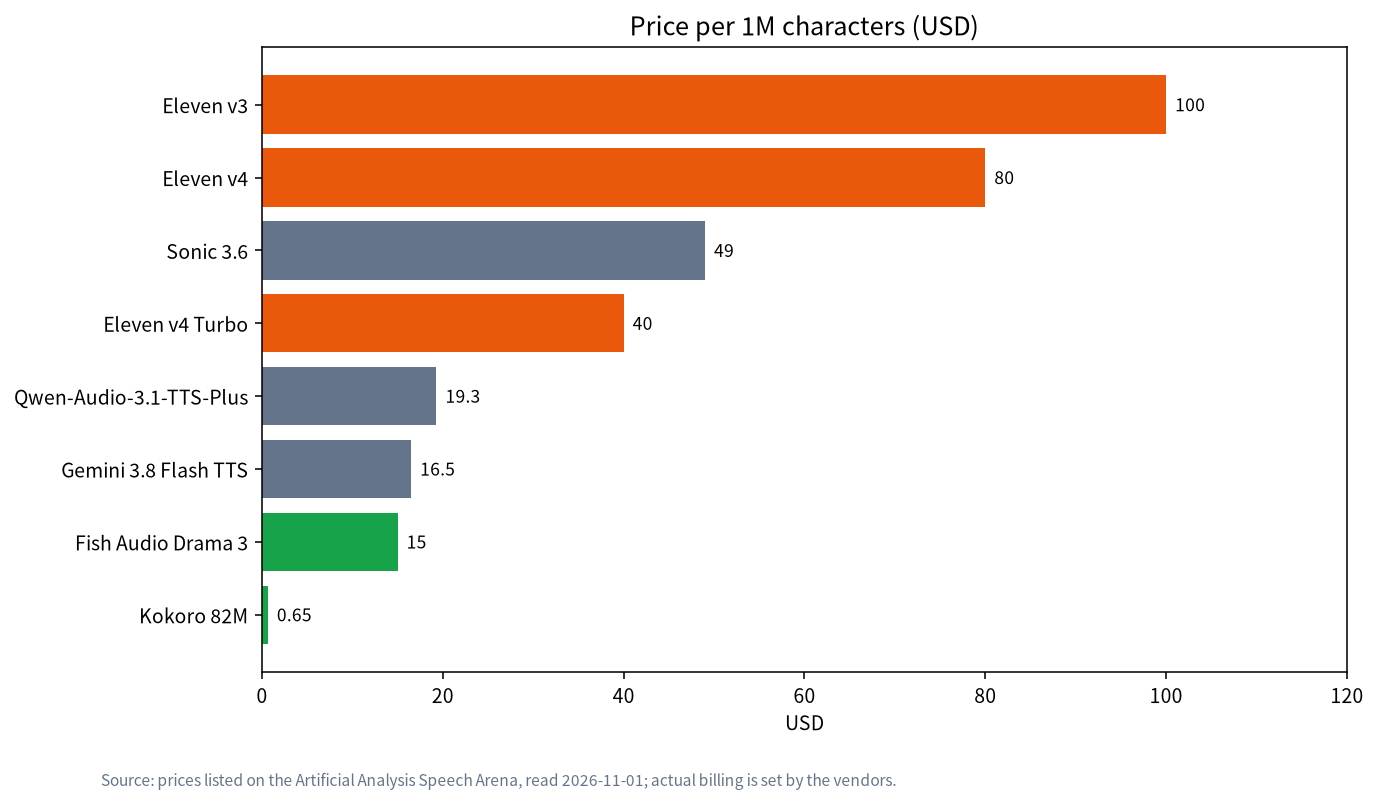
The conclusion: for one-off audio content the cost gap is small and you should pick on quality; for a voice agent that runs continuously the price accumulates monthly and you must trade quality against price.
What You Can Run Locally: Fish Audio Drama 3 and Kokoro
| Model | Size and features | Measured data | Notes |
|---|---|---|---|
| Fish Audio Drama 3 | 35B-parameter MoE with 3B active per token; FP8 experts, the rest in bf16; up to 16 characters in one text; voice cloning and natural-language control | Vendor, on one H200: single-stream time to first audio p50 88.9 ms, real-time factor 0.131; at 16 streams p50 210.1 ms; at 64 streams p50 450.9 ms and p95 1,020.1 ms | Fish Audio Community License, read the commercial terms yourself; the model card gives no minimum VRAM and we do not assume one |
| Kokoro 82M v1.0 | A small 82-million-parameter model | Board Elo 1062, about $0.65 per million characters (board price) | Tiny, but 274 points behind the leader |
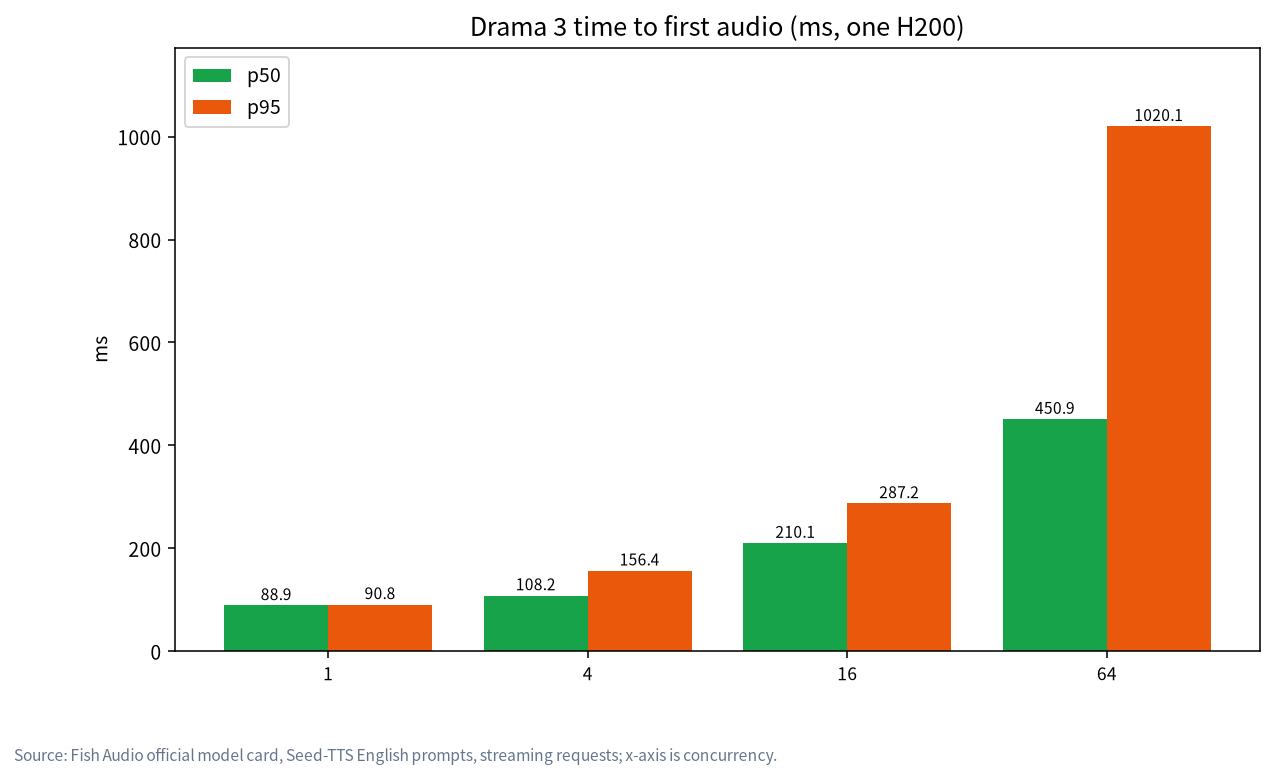
Drama 3’s model card says it is supported on SGLang-Omni and vLLM-Omni, and that placing the vocoder on a second GPU raises throughput by about 72% and cuts median time to first audio by 37% at 256 streams. Those are H200-class numbers; we found no official data for Drama 3 on consumer GPUs, so we draw no conclusion there. For deployment of this kind of service see vLLM and SGLang introduction and the local LLM API server guide; for hardware see RTX PRO 6000 workstation. If your text is private, the benefits of local synthesis are covered in local AI and privacy.
How to Read the Board: Arena, Intervals and “Sound”
The Speech Arena has listeners blind-pick between two syntheses of the same text and computes an Elo from the results. Two things to remember when reading such a board. First, it measures overall preference, not specific metrics: it will not tell you whether a model misreads phone numbers, handles Chinese polyphonic characters or drifts on long text. Second, the intervals decide whether a rank is reliable: v4 Turbo is ±16 and v4 is ±15, so the two intervals overlap completely and treating their order as fact is not rigorous. For more on reading leaderboards see how to read model benchmarks.
The Latency Budget of a Real-Time Voice Agent
In a voice agent the responsiveness a user feels is the sum of several stages: speech recognition turns speech into text, a large language model writes the reply, speech synthesis reads it out, plus network transport. TTS time to first audio is only one stage, so a vendor’s “about 100 ms” is not the time until the user hears sound. ElevenLabs’ documentation is explicit that the figure is a median and excludes application and network latency. In practice, if your LLM takes several hundred milliseconds to emit its first word, shaving TTS from 100 ms to 50 ms gains little; what helps more is streaming the LLM output and synthesizing sentence by sentence, so the first sentence starts playing while the model is still writing the rest.
Concurrency limits also decide how many streams you can serve: the ElevenLabs documentation lists concurrency limits per plan and gives a rule of thumb that a limit of 5 can support roughly 100 simultaneous voice broadcasts, because audio is generated much faster than it plays. Before launch we suggest running your own load test following the documentation’s “simulate users, not raw requests” approach.
Choosing by Scenario
| Scenario | Suggestion | Reason |
|---|---|---|
| Real-time voice support or assistant | Eleven v4 Turbo, or the cheaper Gemini 3.8 Flash TTS | The former is first on the board with about 100 ms latency; the latter costs under half and ranks fifth |
| Audiobooks and character voices | Eleven v4 or Qwen-Audio-3.1-TTS-Plus | v4 allows 10,000 characters per request; the latter costs about a quarter of v4 |
| Multi-character audio drama | Fish Audio Drama 3 | Up to 16 characters in one text, deployable locally |
| Data cannot leave your machine | Fish Audio Drama 3 or Kokoro 82M | Open weights |
| Ultra-cheap prompts and alerts | Kokoro 82M | About $0.65 per million characters on the board, but 274 points behind the leader |
Practical Considerations for Local Deployment
Open weights do not mean cheap. Drama 3 is a 35B-parameter MoE and the vendor’s data comes from an H200, so running it yourself calls for server-class GPUs rather than gaming cards; and to keep time to first audio steady under high concurrency, the vendor even describes placing the vocoder on a second GPU. When you count cost, include GPU rental, electricity and operations time: if you synthesize only a few million characters a month, the board’s $15 per million characters means a total bill under a hundred dollars and self-hosting is almost certainly not cheaper; the reasons to self-host should be data retention, custom voices and offline operation, not saving money.
Test It Yourself: How to Compare TTS Models
We have not listened to these models; here is a procedure you can run directly.
- Prepare 30 passages: 10 Chinese news items, 10 English dialogues, 5 with numbers and dates (phone numbers, amounts) and 5 emotional lines.
- Fix the output format: the same sample rate and loudness normalization.
- Intelligibility: transcribe the synthesized audio with one speech recognition model and compute the word error rate; this does not rely on subjective judgment.
- Blind preference: shuffle the clips, ask five listeners to pick pairwise and tally win rates.
- Latency: record time to first audio (from sending the request to the first audio chunk) at your real concurrency and take p50 and p95.
- Numbers and proper nouns: count mistakes on phone numbers, dates and brand names separately.
- Cost: cloud by characters, local as GPU rental or depreciation plus electricity divided by characters synthesized.
Hello, your order 20261101-0087 has shipped and should arrive on November 3 in the afternoon,
total $1,299.50. To change the address, reply "change" within two hours.
[laughs] Thanks for your patience, and have a great day! 您好,感谢您的耐心等待。
Common Mistakes
- Reading “first place” as a clear lead. v4 Turbo is 2 points ahead of v4 with overlapping intervals.
- Using board prices as your bill. Actual billing follows the vendor’s plans.
- Ignoring normalization of numbers and dates. Flash v2.5 does not normalize by default and may misread phone numbers.
- Extrapolating H200 latency to consumer GPUs. Drama 3’s figures apply to an H200.
- Listening to English samples only. If your users speak Chinese, blind-listen with Chinese text.
Related Reading
- Local LLM API server
- vLLM and SGLang introduction
- RTX PRO 6000 workstation
- ElevenLabs Scribe v2 speech recognition comparison
- Local AI and privacy
FAQ: Eleven v4 Turbo
Is Eleven v4 Turbo the best TTS model?
On the Artificial Analysis Speech Arena it ranks first at 1336, but its interval overlaps with Eleven v4 (1334), so statistically they are tied.
How much does Eleven v4 Turbo cost?
The board lists about $40 per million characters; Eleven v4 about $80. Actual billing follows ElevenLabs.
What is its latency?
ElevenLabs’ documentation states a median latency of about 100 ms, excluding application and network latency.
Is there a TTS I can run locally?
Yes. The strongest open-weights entry is Fish Audio Drama 3 (1278), for which the vendor measured a median time to first audio of 88.9 ms on an H200; there is also the tiny Kokoro 82M (1062).
Can Drama 3 be used commercially?
It uses the Fish Audio Community License; read the license file for the commercial terms, as this article draws no conclusion.
Which is the best value?
Qwen-Audio-3.1-TTS-Plus (1305, about $19.30) and Gemini 3.8 Flash TTS (1283, about $16.50) are the board’s “close to first and much cheaper” options.
Talk With Us
Choosing a speech synthesis stack for a product? Join the community or email admin@microaione.com.
References: Artificial Analysis Speech Arena, ElevenLabs documentation: models, Hugging Face: fishaudio/drama-3.