Claude Opus 5.5 vs GPT-6 Astra and Gemini 4 Carbon: Is It the Best Closed Model?
People keep asking whether Claude Opus 5.5 is “the best closed model” right now, and the question needs splitting in two. If you mean the strongest general model you can actually buy through an API or a subscription today, independent leaderboards and the vendor’s own benchmarks mostly agree that it is. If you mean the highest overall score of any closed model, the answer is no, because Artificial Analysis lists Gemini 4 Carbon one point higher, though Carbon has not been opened to everyone. This article puts independent leaderboards, vendor-reported benchmarks, list prices and our own cost arithmetic side by side, compares Opus 5.5 with GPT-6 Astra, the GPT-6.1 family and Gemini 4 Carbon, and then answers the question local-LLM readers care about: it cannot run locally, so what open model replaces it and how big is the gap?
Verification note: Leaderboard figures were read from Artificial Analysis on 2026-11-01. Benchmark scores and prices come from Anthropic’s launch and pricing pages (launch dated 2026-09-22) and from the official DeepSeek and OpenAI pages. “Vendor-reported” means published by the model’s maker, possibly with a different harness from third parties. Cost figures are our own arithmetic on list prices, not billing records. We did not run these benchmarks ourselves, so we give no self-measured scores, only a test method you can reproduce at the end.
Key takeaways (Updated 2026-11-01)
- On the Artificial Analysis Intelligence Index, Opus 5.5 (max) scores 58 and Gemini 4 Carbon scores 59, but Carbon is limited to selected users, so Opus 5.5 is among the highest-scoring models you can actually use.
List price is $4 per million input tokens and $20 per million output tokens, with cache reads at $0.20; by our arithmetic, a high cache hit rate cuts a coding-agent bill to about 39% of the uncached figure.
It is closed, with no weights to download. The strongest open-weights alternative in this article, DeepSeek V4.1 Flash 1017, scores 32 on the same index, a large gap, but at roughly one-sixteenth of the per-task cost.
The Short Answer: Is It the Best Closed Model?
For “best publicly available model”, the evidence says yes, with three qualifiers. First, Artificial Analysis ranks Gemini 4 Carbon first at 59, and Opus 5.5 (max, with fallbacks) second at 58; in an article dated 2026-10-28 the site says Carbon has only been rolled out to selected users. Second, on the Artificial Analysis Coding Agent Index, Claude Code with Opus 5.5 (max) scores 62, ahead of Carbon through the Antigravity CLI at 59. Third, Opus 5.5 is weaker on factual reliability: on the site’s hallucination-rate measure, Opus 5.5 (max) sits near 50% against roughly 11% for Carbon.
Our position is therefore: Opus 5.5 is one of the strongest closed models you can buy today for coding and agent work, not a clean sweep. That statement is accurate now and will not be overturned by next month’s new leaderboard row.
Independent Leaderboard: Index, Cost and Speed
The table comes from the Artificial Analysis model leaderboard (2026-11-01). “Cost per task” is the site’s estimated average over its own test suite; thinking levels differ between rows, so you cannot turn it directly into your own bill.
| Model (setting) | Intelligence Index | Cost per task | Note |
|---|---|---|---|
| Gemini 4 Carbon (high) | 59 | not captured | Selected users only |
| Claude Opus 5.5 (max, with fallback) | 58 | $10.04 | About 97 tokens/s, 1M context |
| Claude Opus 5.5 (xhigh) | 57 | $6.05 | Lower setting, much cheaper |
| GPT-6 Astra (max) | 57 | $6.24 | OpenAI flagship |
| GPT-6.1 Sol (max) | 55 | $1.27 | Far cheaper per task |
| Claude Sonnet 5.5 (max) | 54 | not captured | Smaller sibling |
| GPT-6.1 Terra (max) | 51 | $0.96 | $1 / $5 per million tokens |
| Claude Opus 5.5 (medium) | 48 | $2.45 | Near the default effort |
| DeepSeek V4.1 Flash 1017 (Max, open) | 32 | $0.60 | Open weights, about 175 tokens/s |
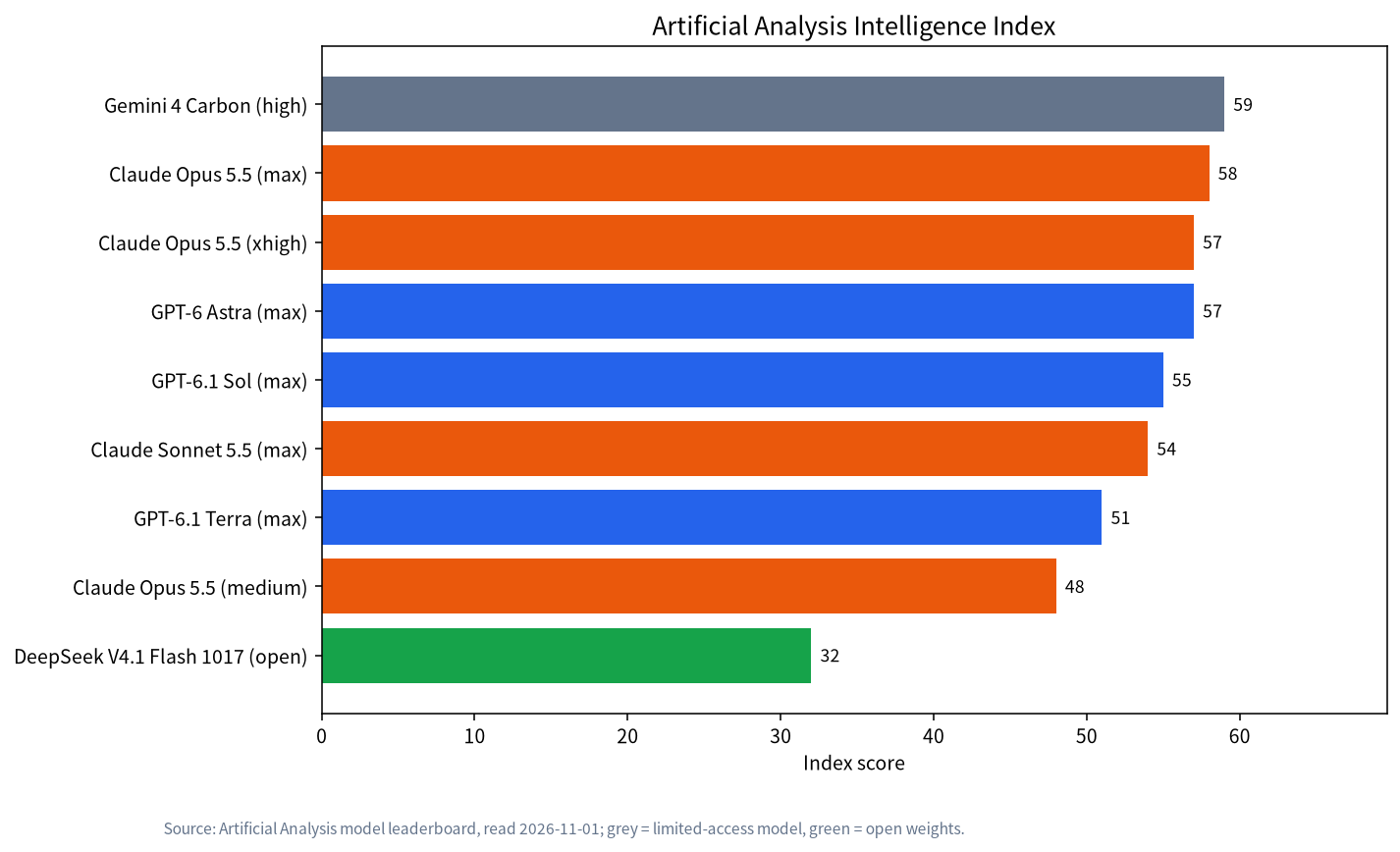
Two cautions when reading it. First, thinking level moves the result enormously: dropping Opus 5.5 from max to medium takes the index from 58 to 48 and the per-task cost from $10.04 to $2.45, so the setting you choose matters more for your bill than the model name. Second, GPT-6.1 Sol appears at 55 points and about $1.27 per task, which shows that “strongest” and “best value” are different models. For a longer explanation of how to read such boards, see our benchmark reading guide.
Vendor-Reported Benchmarks: Strong, With Caveats
Anthropic’s launch page reports Opus 5.5 at 66.4% on Terminal-Bench 4.0, 54.4% on FrontierCode v1.1, 57.8% on CursorBench 4.0, 1846 Elo on GDPval-AA v2.1 and 81.8% on OSWorld 2.1 (a partial-score variant). The table below picks the two benchmarks where all four models can be put side by side.
| Benchmark (vendor-reported) | Opus 5.5 | Fable 5.1 | Opus 5 | GPT-6 Astra |
|---|---|---|---|---|
| Terminal-Bench 4.0 | 66.4% | 55.8% | 52.3% | 57.9% |
| FrontierCode v1.1 (main set) | 54.4% | 50.3% | 48.0% | 53.3% |
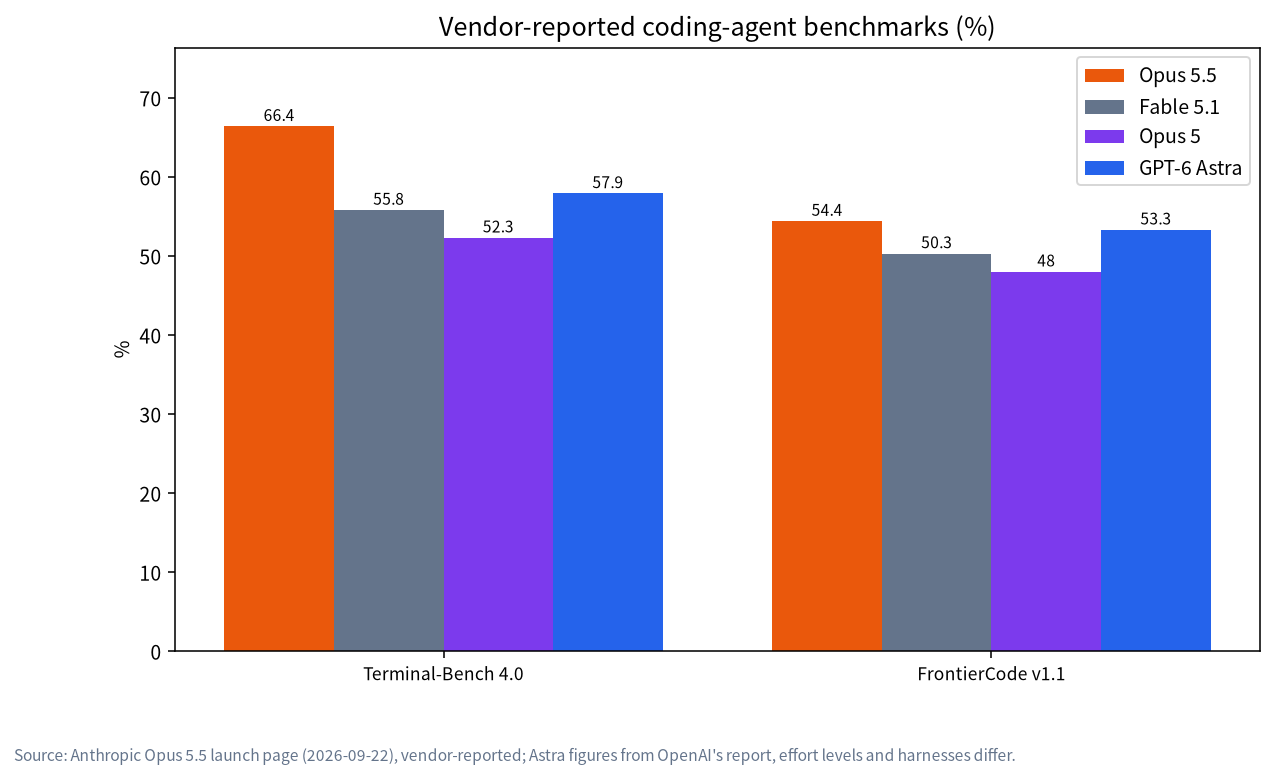
There are several caveats. In Terminal-Bench the Opus 5.5 figure is at xhigh effort, while the GPT-6 Astra figure is taken from OpenAI’s own report. Anthropic says Opus 5.5 runs with production safeguards, so sensitive tasks such as some cybersecurity work may be routed to an earlier model such as Opus 4.8, which may lower its scores. Astra leads elsewhere: AutomationBench (Astra 41.4%, Opus 5.5 40.0%) and Terminal-Bench-Science 0.1 (Astra 64.6%, Opus 5.5 58.7%). Anthropic itself writes that at this capability level benchmark margins are a less reliable guide to real-world differences. Treat vendor scores as a direction, treat third-party boards as a cross-check, and then test on your own tasks.
Price and Cost: A Repeatable Worked Example
Opus 5.5’s list price is $4 per million input tokens, $20 per million output tokens, $0.20 per million cache reads and $5 per million cache writes. Anthropic also sells a fast mode of up to about 2.5 times the speed at $8 input and $40 output.
Here is one assumed workload: a coding agent making 1,000 requests of 20k input and 1k output tokens each, so 20 million input and 1 million output tokens in total. We compare three models, with DeepSeek at off-peak prices ($0.15 per million on a cache miss, $0.003 on a hit, $0.60 output) and GPT-6.1 Terra at $1 input, $0.05 cached and $5 output.
| Scenario | Opus 5.5 | GPT-6.1 Terra | DeepSeek V4.1 Flash (off-peak) |
|---|---|---|---|
| No caching | $100.00 | $25.00 | $3.60 |
| 80% of input served from cache | $39.20 | $9.80 | about $1.25 |
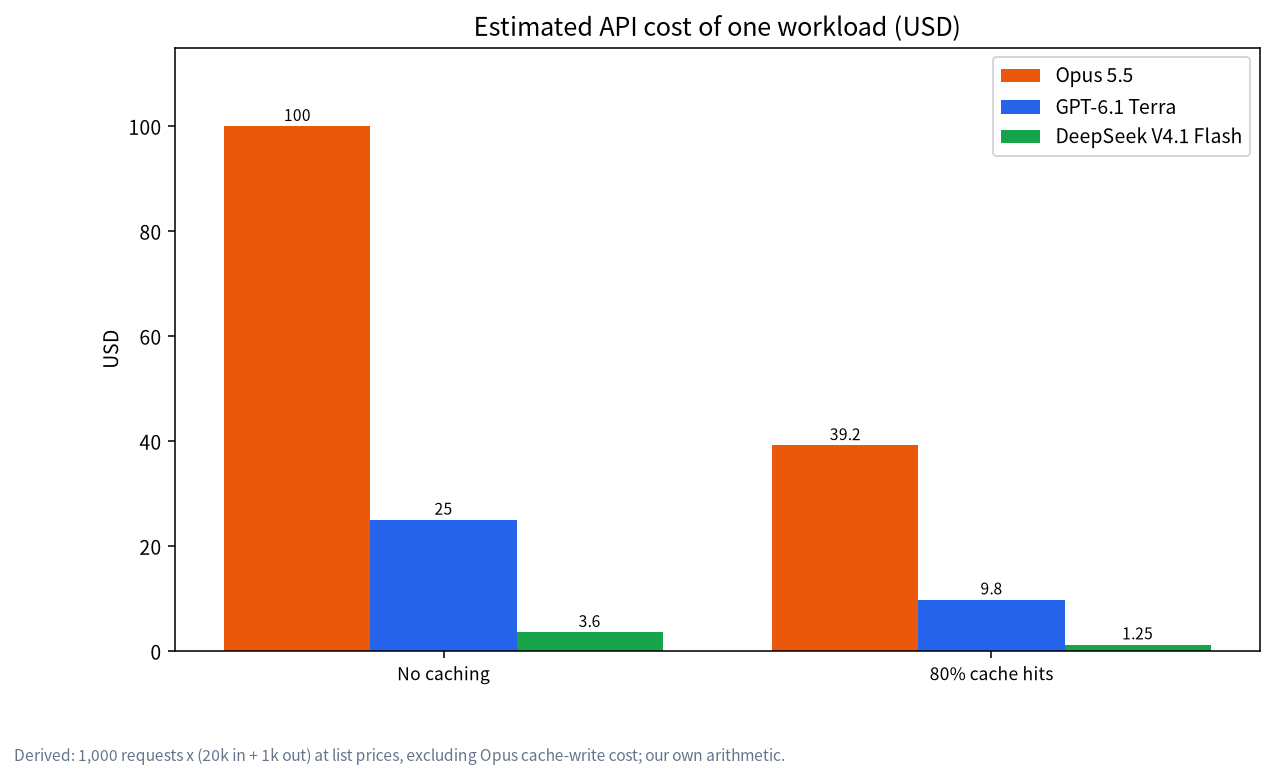
This is our own arithmetic. The Opus “cached” row leaves out the $5-per-million cost of first writing the cache, so a real bill would be a little higher, and output quality differs between the models, so cheap does not mean better value. The example makes two points only: caching has an outsized effect on agent workloads, and the same job can cost an order of magnitude more or less depending on the model.
For Local Readers: A Closed Model Cannot Run on Your GPU
Opus 5.5 has no open weights. You cannot download it or run it on your own card. It is available through Anthropic’s API, AWS, Google Cloud and Microsoft Azure, with a zero-data-retention option, but your inputs still leave your machine, which is a hard constraint for confidential code or strict compliance. Our pieces on local versus cloud APIs and local LLM privacy cover that trade-off.
If you need something you can deploy yourself, one of the strongest open-weights options on the same leaderboard is DeepSeek V4.1 Flash 1017: MIT-licensed and 32 on the Artificial Analysis index against Opus 5.5’s 58, a gap of 26 points. In DeepSeek’s own table it scores 77.0 on DeepSWE v1.1 against 74.0 for Opus 5, which suggests the gap on specific software tasks can be smaller than the headline index implies; note that DeepSeek compares against Opus 5, not Opus 5.5. Running it locally takes 128GB or more of combined memory even at very aggressive quantization, so it is not a single-consumer-GPU model. A practical route is a hybrid: keep sensitive code on a local model and send only the hardest tasks to Opus 5.5. See also our local coding assistant setup and enterprise private deployment guide.
Choosing by Scenario: Who Should Use What
The table turns the evidence above into a decision aid. It is our judgement from the leaderboard, price and limits discussed above, not a measured result.
| Your scenario | Better fit | Why |
|---|---|---|
| Complex coding agents, cross-file refactors | Opus 5.5 (xhigh or max) | First on the Artificial Analysis Coding Agent Index, ahead on vendor benchmarks |
| Bulk, repetitive, price-sensitive jobs | GPT-6.1 Sol or Terra | Index 55 and 51 at about $1.27 and $0.96 per task |
| Question answering where hallucination hurts | Test Gemini 4 Carbon first, if you can get access | Hallucination rate about 11% on the board, against about 50% for Opus 5.5 |
| Confidential code that must stay in-house | A local open-weights model | Any closed API sends inputs off the machine |
| Very small budget, lower ceiling acceptable | DeepSeek V4.1 Flash 1017 via API or locally | $0.15 per million input and $0.60 per million output off-peak |
The main lesson is not to make one model do everything. A common and effective pattern is routing: send easy tasks to a cheap setting and escalate to Opus 5.5 only when a task fails or carries high risk. That keeps total cost under control while keeping the strongest model as a safety net. If your team already runs a local server, you can make the local model the first stage and escalate based on the failure rate; our local coding assistant guide shows how to wire that up.
Test It Yourself: A Reproducible Method
We did not run Opus 5.5 benchmarks ourselves. Here is a method you can follow to compare it with other models on your own work.
- Prepare six tasks: two real bugs from your repositories with unit tests, one refactor across 10 files, one information-extraction job on a 30-page document, one multi-step task that needs tool calls, and one question that invites hallucination (ask about an API that does not exist).
- Use identical prompts for every model, for example “The repo is at /repo; pytest must pass; read the code before editing; summarize the change in three sentences.”
- Fix the effort setting and record it. Do not compare different effort levels directly.
- Record four metrics: first-attempt pass rate (pass@1), total tokens, wall-clock time and the final bill.
- Run each task at least three times and take the median, to avoid one lucky run.
- Score the hallucination task separately: does the model admit it does not know, or invent a function?
You are a coding agent. The repository is at /repo.
Goal: make the failing tests pass without editing the test files.
Steps: read the relevant files, propose a plan, edit, then run pytest.
When done, output only: 1) files changed 2) why 3) remaining risks.
Common Mistakes
- Treating “first on the leaderboard” as “right for me”. Boards measure average tasks; yours may be heavier on code, long documents or Chinese text.
- Comparing models but not effort settings. The same model at max and medium can differ several-fold in cost.
- Ignoring caching. In agent workloads cache reads often dominate; leaving caching off overstates cost badly.
- Mixing vendor and third-party numbers. Harnesses and effort levels in Terminal-Bench style results are not the same.
- Forgetting where your data goes. A closed API means inputs leave your machine, so check compliance first.
Related Reading
- Local deployment vs cloud API
- How to read LLM benchmark leaderboards
- Best open models to run locally
- DeepSeek V4.1 Flash 1017 locally
- A local coding assistant setup
FAQ: Claude Opus 5.5
Is Claude Opus 5.5 the best closed model right now?
Among publicly available models it is one of the strongest on independent boards, and it leads the Artificial Analysis Coding Agent Index. Gemini 4 Carbon scores one point higher on the overall index, but only for selected users.
How much does Claude Opus 5.5 cost?
List price is $4 per million input tokens and $20 per million output tokens, with cache reads at $0.20. Your bill depends on cache hit rate and effort level.
Can Claude Opus 5.5 run locally?
No. It has no open weights and is only available through APIs and cloud platforms. For local use, consider open-weights models such as DeepSeek V4.1 Flash 1017, accepting different capability and hardware needs.
How much better is Opus 5.5 than GPT-6 Astra?
On the Artificial Analysis index it is 58 against 57 at max effort, within noise. On vendor-reported coding benchmarks Opus 5.5 leads, but Astra is ahead on AutomationBench and others, so it depends on your task.
Why does the cost of the same model vary so much?
Because of the effort setting. Opus 5.5 at max costs about $10.04 per task and scores 58, while at medium it costs about $2.45 and scores 48.
Should an individual developer use Opus 5.5?
If your tasks are complex, mistakes are expensive and you can use caching well, it is worth trying. For routine work a cheaper setting or model is usually enough; test with your own tasks first.
Talk With Us
Choosing models for a team, or deciding which tasks should stay local? Join the community or email admin@microaione.com.
References: Anthropic: Claude Opus 5.5 launch page, Anthropic pricing, Artificial Analysis model leaderboard, Artificial Analysis: Gemini 4 Carbon article, DeepSeek API pricing.