ElevenLabs Scribe v2 Review: The Best Speech Recognition? Versus Whisper, Nemotron and Voxtral
Scribe v2 is ElevenLabs’ speech recognition model, and its documentation calls it a state-of-the-art model. But on Artificial Analysis’ AA-WER v2 (read 2026-11-01) Scribe v2 posts a word error rate of 2.2%, ranking fourth, behind Fun-Realtime-ASR-preview (1.7%), MAI-Transcribe-2 (2.0%) and Voxtral Small Transcribe 3 (2.1%). So “best ASR” does not hold on that board; “top tier” is the accurate description. Its real selling points are features (speaker diarization, keyterm prompting, entity detection, 90+ languages) rather than one error rate. This article sets the board against the features, works out the transcription cost per thousand hours of audio, and shows local readers the models they can actually download: Nemotron 3.5 Transcribe, Voxtral Small, Whisper and Parakeet.
Verification note: The board, prices and speeds were read from the Artificial Analysis speech-to-text board (2026-11-01). AA-WER v2 combines AgentTalk (50%), VoxPopuli-Cleaned (25%) and Earnings22-Cleaned (25%) and is English-centric. Scribe v2’s features come from the models page of the ElevenLabs documentation; the documentation and ElevenLabs’ marketing pages disagree on a few figures (90+ versus 99 languages, 1,000 versus 100 keyterms, 65 versus 56 entity types, 32 versus 48 speakers), and we follow the documentation throughout. Nemotron 3.5 Transcribe’s data comes from its Hugging Face model card (NVIDIA’s own measurements). We have not run any speech recognition model ourselves; costs are our arithmetic.
Key takeaways (Updated 2026-11-01)
- AA-WER: Fun-Realtime-ASR-preview 1.7%, MAI-Transcribe-2 2.0%, Voxtral Small Transcribe 3 2.1%, Scribe v2 2.2% (fourth).
Price: Scribe v2 about $3.67 per 1,000 minutes, roughly $220 per 1,000 hours; MAI-Transcribe-2 about $1.67 per 1,000 minutes.
Local: among open-weights models Nemotron 3.5 Transcribe and Voxtral Small both score 2.8%; Nemotron is 34B total with about 4.3B active, with a reference deployment on one 80GB H100 and an NVFP4 variant that lists the RTX 5090.
The Short Answer: Top Tier, Not First
| Rank | Model | AA-WER (lower is better) | Per 1,000 minutes (USD) | Note |
|---|---|---|---|---|
| 1 | Fun-Realtime-ASR-preview | 1.7% | 2.82 | Preview |
| 2 | MAI-Transcribe-2 | 2.0% | 1.67 | — |
| 3 | Voxtral Small Transcribe 3 | 2.1% | 4.00 | — |
| 4 | Scribe v2 | 2.2% | 3.67 | Speed factor about 74.4x |
| 5 | Voxtral Mini Transcribe 3 | 2.2% | 3.50 | — |
| 6 | Grok Voice Transcribe | 2.3% | 1.67 | Speed factor about 182.8x |
| — | StepAudio 3 ASR | 2.5% | 6.67 | — |
| — | Gemini 3.5 Transcribe | 2.6% | 5.00 | — |
| — | GPT Transcribe (OpenAI) | 3.3% | 4.50 | — |
| — | Whisper Large v3 (hosted by fal) | 4.1% | — | Open weights |
| — | Parakeet TDT 0.6B V3 | 4.5% | — | Open weights, speed factor about 638x |
| — | Nova-3 | 5.2% | — | — |
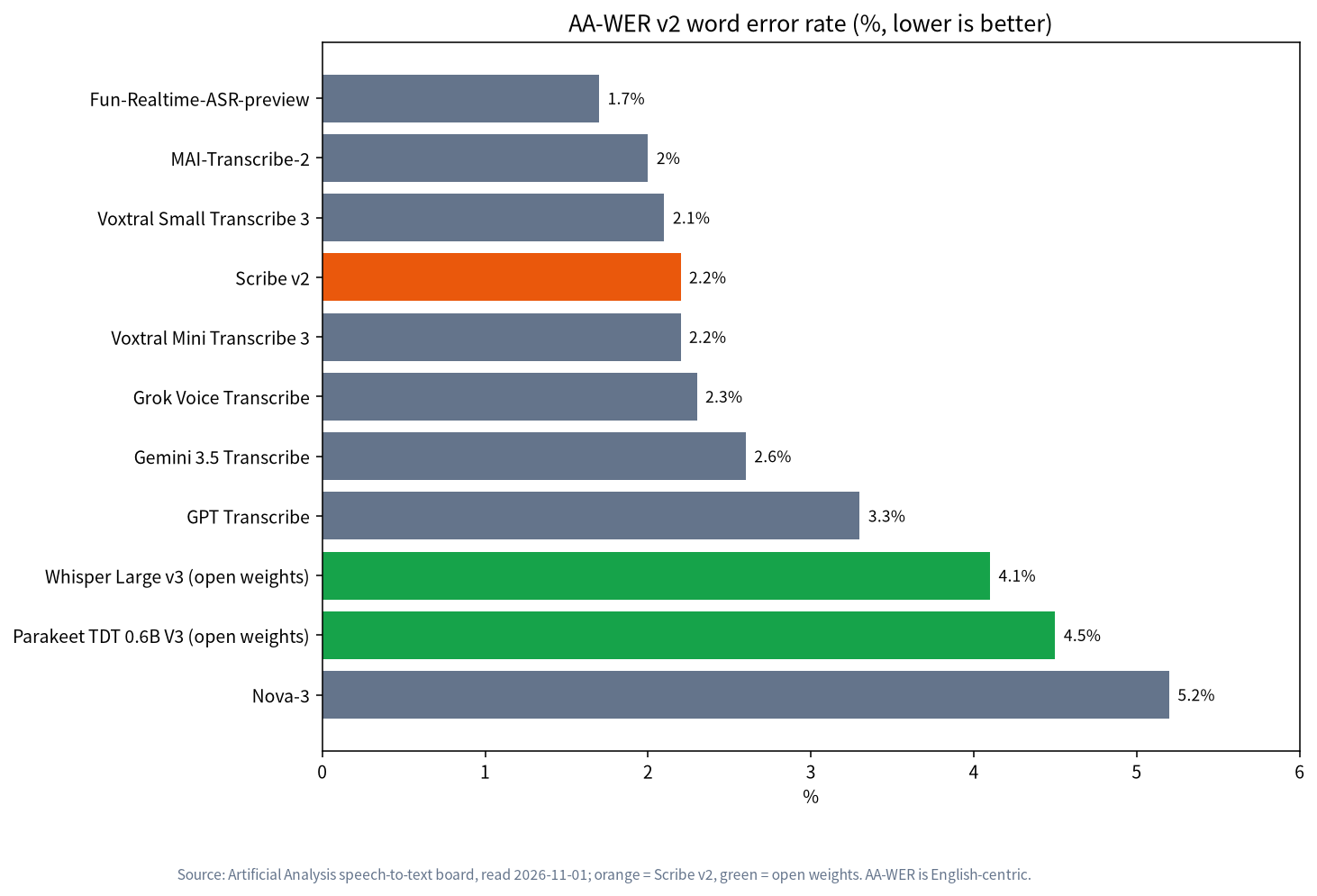
The top five are only 0.5 percentage points apart; in plain numbers, per 10,000 words Fun-Realtime makes about 170 errors, Scribe v2 about 220 and Whisper Large v3 about 410. The 50-error gap per 10,000 words between first place and Scribe v2 is, in many businesses, smaller than the difference between having speaker diarization and not, or being able to prompt for proper nouns. One caveat: AA-WER is English-centric and does not measure Chinese, so for Chinese-speaking readers the board is only a reference.
What the Documentation Says About Scribe v2
From the models page: Scribe v2 supports 90+ languages, keyterm prompting of up to 1,000 terms, entity detection with 65 types, diarization of up to 32 speakers, word-level timestamps, dynamic audio tagging and transcript editing by natural-language instruction. Scribe v2 Realtime targets live use with a median time to committed transcript of about 150 ms. Scribe v2 Medical targets clinical audio, with the documentation claiming 35% fewer transcription errors on clinical audio than Scribe v2, the same price and API, and HIPAA eligibility with zero-retention mode. Note that the marketing pages are worded differently, for example 99 languages, so for procurement decisions rely on the documentation and your own tests.
Cost: What 1,000 Hours of Audio Costs
At board prices (our arithmetic, 1,000 hours is 60,000 minutes, excluding plan discounts, retries and storage):
| Service | Board price (per 1,000 minutes) | Per 1,000 hours |
|---|---|---|
| Grok Voice Transcribe | $1.67 | about $100.20 |
| MAI-Transcribe-2 | $1.67 | about $100.20 |
| Fun-Realtime-ASR-preview | $2.82 | about $169.20 |
| Scribe v2 | $3.67 | about $220.20 |
| Voxtral Small Transcribe 3 | $4.00 | about $240.00 |
| GPT Transcribe | $4.50 | about $270.00 |
| Whisper turbo (hosted by Groq) | $0.67 | about $40.20 |
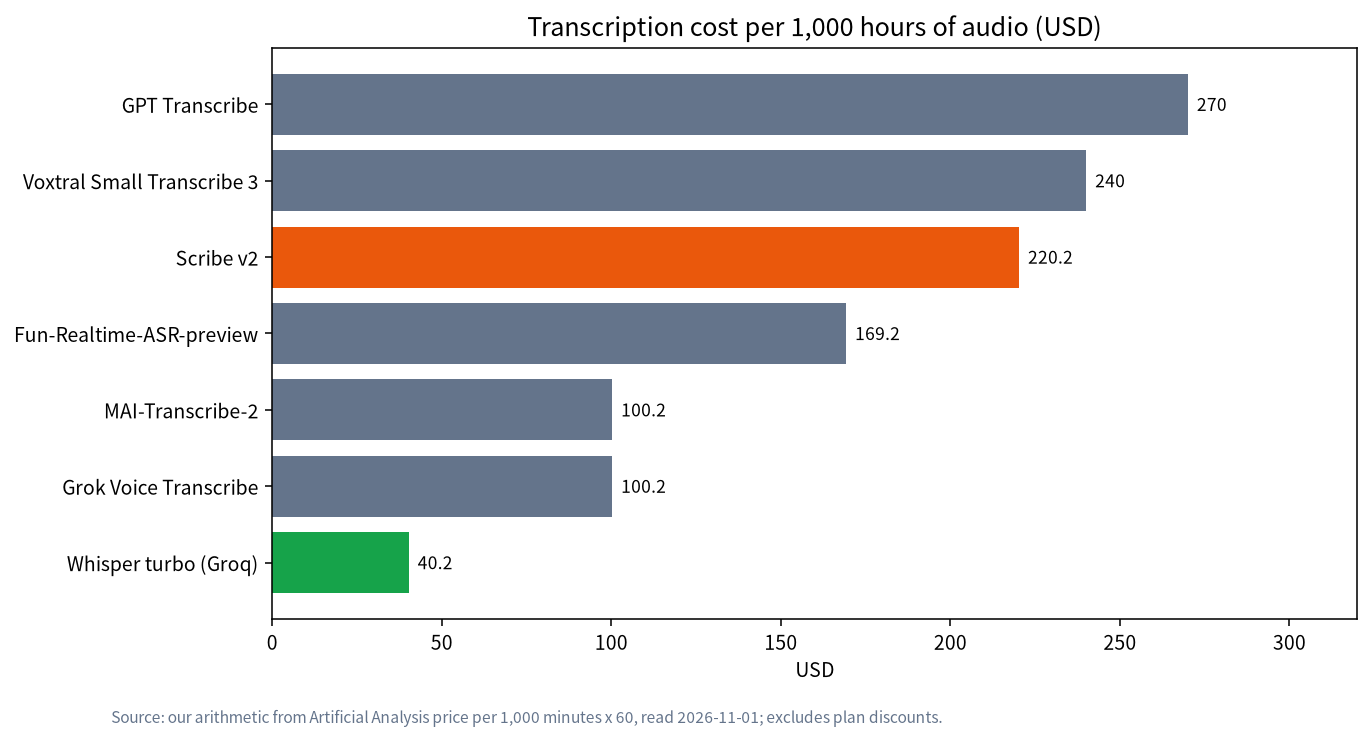
If you transcribe only tens of hours of meetings a month, any provider costs a few dollars and you should pick on accuracy and features. If you have thousands of hours of call-center recordings a month, the price gap becomes a real budget item, and it makes sense to tier: cheap or local models for ordinary recordings, and Scribe v2 for important recordings that need diarization or proper-noun prompting.
What You Can Run Locally
| Model | AA-WER (board) | Size and hardware | License and notes |
|---|---|---|---|
| Nemotron 3.5 Transcribe | 2.8% | 34B total, about 4.3B active; BF16, FP8 and NVFP4 precisions; reference deployment on one 80GB H100; the NVFP4 variant lists the RTX 5090 and DGX Spark | OpenMDW-1.1; 40 languages; an offline model, not a real-time streaming service; recordings up to about 1 hour |
| Voxtral Small (Mistral) | 2.8% | About 24B | We did not verify whether the open release and the API model “Voxtral Small Transcribe 3” are the same model |
| Whisper Large v3 | 4.1% (hosted by fal) | We did not read hardware data for it in this research | Open weights |
| Parakeet TDT 0.6B V3 | 4.5% | 0.6B parameters, board speed factor about 638x | The fastest tier |
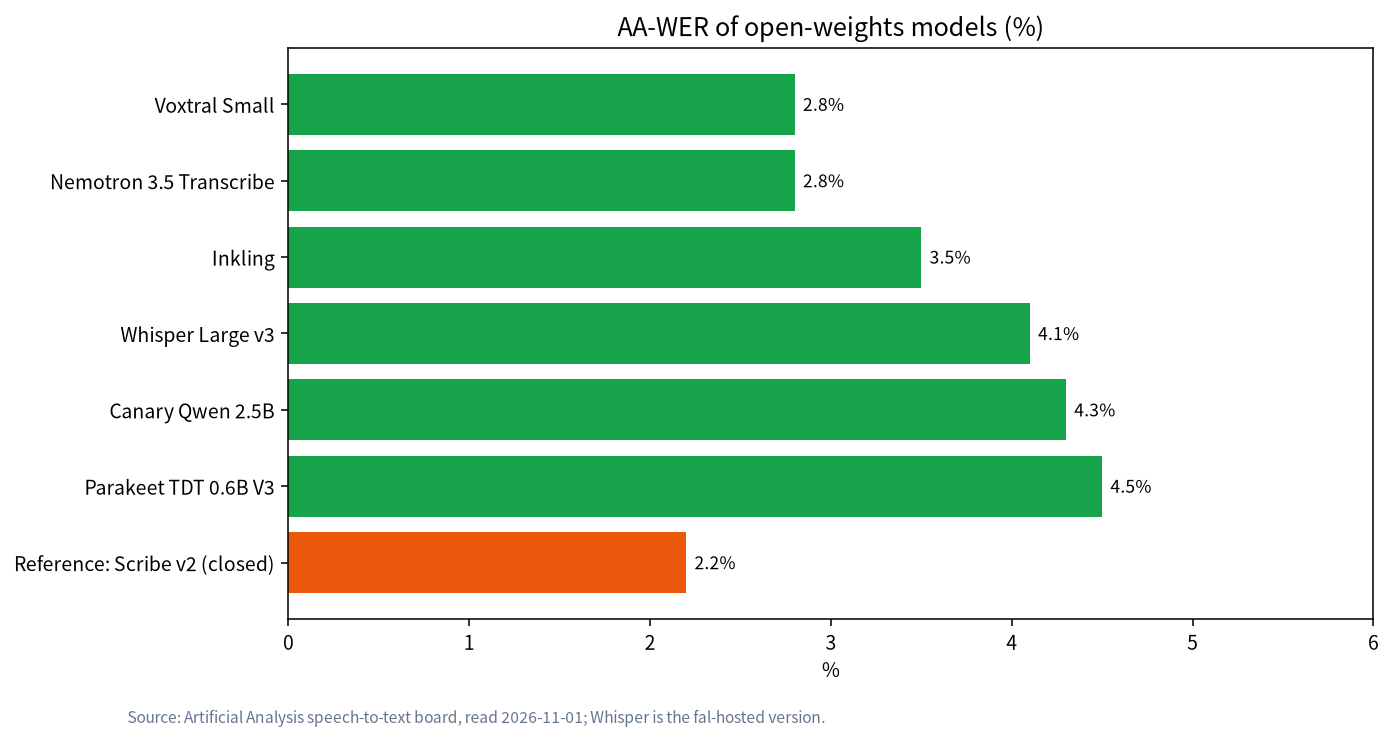
The Nemotron 3.5 Transcribe model card (NVIDIA’s own measurements) reports a mean word error rate of 4.71% on the nine-dataset English Open ASR leaderboard, a different evaluation from AA-WER that should not be mixed with it; 10.98% on long-form audio; and 4.62% on multilingual. In its language matrix Mandarin is listed as “Supported”, the lowest tier, which may need fine-tuning, while English, German, French, Spanish, Japanese and others rank higher; Mandarin’s FLEURS character error rate is 8.62%. Chinese-language readers should therefore test on their own recordings before adopting it. The vendor also says that in NVIDIA’s NIM one RTX PRO 6000 Blackwell Server Edition GPU can transcribe up to 2,238 seconds of audio per second (NVFP4 with speculative decoding), but those optimizations are not yet in the open release, whose vLLM integration is expected to be about two times slower. For hardware see RTX 5090, 4090 and 3090 compared and RTX PRO 6000 workstation; for deployment see vLLM and SGLang introduction. For private recordings the value of local transcription is covered in local AI and privacy.
What AA-WER Actually Measures
AA-WER v2 combines three datasets by weight: AgentTalk at 50%, and VoxPopuli-Cleaned and Earnings22-Cleaned at 25% each. The first leans toward spoken language related to voice agents, the other two are parliamentary speech and earnings calls. “Cleaned” means the reference texts were cleaned so that the error rate reflects recognition rather than labeling differences. The mix suits English customer-service and finance scenarios, but it does not represent accented, noisy or code-switched real recordings, and it does not cover Chinese. So when two models differ by 0.1 to 0.3 percentage points, do not treat the order as fact; compare them on your own audio. For how to read this kind of board see how to read model benchmarks.
Real-Time Versus Offline: The Form Matters More Than the Model
Speech recognition comes in two forms. Real-time (streaming) recognition emits text as people speak and suits voice assistants and live captions; Scribe v2 Realtime has a median time to committed transcript of about 150 ms. Offline (batch) recognition waits for the whole recording and suits meeting minutes, interviews and call-center QA; it is usually more accurate and easier to combine with diarization and long audio. Nemotron 3.5 Transcribe is explicitly an offline model with recordings up to about one hour; if you need text as people speak, it is not the right pick and you should look for a dedicated streaming model. Many teams do both: a streaming model for responsiveness during the call, then an offline model to re-transcribe afterwards for a more accurate archive.
Choosing by Scenario
| Scenario | Suggestion | Reason |
|---|---|---|
| English finance calls needing speakers and proper nouns | Scribe v2 | Up to 32 speakers, up to 1,000 keyterms |
| Budget-sensitive bulk English transcription | MAI-Transcribe-2 or Grok Voice Transcribe | Board price about $1.67 per 1,000 minutes |
| English where the lowest board error rate matters | Fun-Realtime-ASR-preview | AA-WER 1.7%, but a preview release |
| Data cannot leave your machine | Nemotron 3.5 Transcribe or Voxtral Small | Open weights, 2.8% on the board |
| Fastest batch processing | Parakeet TDT 0.6B V3 | Board speed factor about 638x, but 4.5% error |
| Mostly Chinese | Test every option on your own recordings first | The board does not measure Chinese; Nemotron’s Mandarin tier is Supported |
After Transcription: Plug in a Local LLM
Speech recognition is usually only the first stage of a pipeline. The transcript can go to a local LLM for summaries, action items or translation, so that ASR and LLM both run on your machine and neither audio nor text leaves it. In practice, start an OpenAI-compatible service as described in building a local LLM API server and feed the transcript in sections. Long recordings produce long transcripts, so split by topic or time, summarize each part and then merge, to avoid exceeding the context window. Compared with the cloud, the cost of this local pipeline is mainly the GPU and electricity; for the general framework on cloud versus local read local versus cloud API.
Test It Yourself: A Speech Recognition Method
We have not run these models; here is a procedure you can follow directly.
- Collect three hours of your own real recordings: about 45 minutes each of quiet single speaker, multi-person meeting, telephone noise and mixed Chinese-English speech.
- Prepare a human-corrected reference transcript: this is the prerequisite for computing word error rate; use character error rate for Chinese.
- Normalize consistently: strip punctuation and case differences and unify number formats before scoring.
- Score by scenario: count proper nouns, numbers and personal names separately.
- Test diarization: on multi-speaker recordings, measure the share of speaker-change errors.
- Measure speed and cost: record waiting time and the bill for cloud; for local record processing time per hour of audio, VRAM and electricity.
- Test stability: use recordings over an hour and check for repetition, truncation or hallucinated text.
Common Mistakes
- Reading “the vendor says state of the art” as “first on the board”. On AA-WER Scribe v2 is fourth.
- Inferring Chinese quality from an English board. AA-WER is English-centric and Nemotron’s Mandarin tier is only “Supported”.
- Mixing numbers from different evaluations. Nemotron’s 4.71% and AA-WER’s 2.8% are different tests.
- Looking only at word error rate. Diarization and keyterm prompting often matter more to the business.
- Ignoring differences between marketing pages and documentation. Use the documentation’s feature figures.
Related Reading
- Local LLM API server
- vLLM and SGLang introduction
- RTX PRO 6000 workstation
- Eleven v4 Turbo speech synthesis comparison
- Local AI and privacy
FAQ: Scribe v2
Is Scribe v2 the best speech recognition model?
On AA-WER v2 its word error rate is 2.2%, fourth, behind Fun-Realtime-ASR-preview (1.7%), MAI-Transcribe-2 (2.0%) and Voxtral Small Transcribe 3 (2.1%).
How much does Scribe v2 cost?
The board lists about $3.67 per 1,000 minutes, roughly $220 per 1,000 hours. Check ElevenLabs for actual billing.
How many languages does Scribe v2 support?
The documentation says 90+ and the marketing page says 99; the two disagree, so rely on the documentation.
Is there a speech recognition model I can run locally?
Yes. Nemotron 3.5 Transcribe and Voxtral Small both score 2.8% on the board; Whisper Large v3 and Parakeet are older but easier to deploy.
Which should I use for Chinese?
AA-WER is English-centric and does not measure Chinese. Nemotron lists Mandarin at the lowest “Supported” tier, so test on your own recordings first.
Can Nemotron 3.5 Transcribe be used in real time?
No. The vendor states it is an offline model, and its internal chunking does not make it a streaming service.
Talk With Us
Building local transcription? Join the community or email admin@microaione.com.
References: Artificial Analysis speech-to-text board, ElevenLabs documentation: models, Hugging Face: NVIDIA Nemotron 3.5 Transcribe.