
Local LLM vs API: How to Decide Based on Usage, Privacy and Budget
Note: this article doesn’t sell either side. On cost we give no specific API prices, because they change constantly; every worked example uses hypothetical numbers to show the method, so plug in prices you look up yourself. Conclusions from papers and third-party articles are references only, with sources at the end. The legal and compliance remarks are not legal advice.
“Should I run my own model or just call an API?” is the second most common question in our community, after “which GPU?”. The answer isn’t “local is always better” or “API is always cheaper.” The choice of local LLM vs API depends on your usage, how sensitive your data is, what model quality you need, your budget and whether you want to maintain things yourself. This guide gives you a checklist you can fill in and says plainly when going local doesn’t pay. If the basics are new, start with what is a local LLM.
The Short Version: Most People End Up Hybrid
The analyses we read agree on the broad picture:
- An academic cost study of on-premise deployment (arXiv:2509.18101) finds that break-even depends on model size: possibly a few months for small models, around two years for medium ones and as long as five for larger ones. It sees on-premise as viable mainly for very high volume (the paper’s order of magnitude is 50 million tokens a month or more) or strict data-residency needs, and it recommends hybrid strategies for mid-scale organisations: sensitive workloads local, burst traffic in the cloud.
- PromptQuorum’s hardware guide (2026-10-17) offers a rule of thumb for individuals: light users under 100,000 tokens a month pay a few dollars for a cloud API with no hardware, while heavy users above 10 million tokens a month may break even locally in 6 to 12 months. That is one third-party’s rough claim, not a universal result.
- Break-even points differ enormously between sources because they assume different model sizes, utilisation rates and API prices. So don’t borrow someone else’s number; do your own arithmetic.
Local LLM vs API: Five Dimensions, One at a Time
| Dimension | Favours local when | Favours API when |
|---|---|---|
| Usage | Steady, heavy daily calls keep the hardware busy | Low or bursty use leaves the hardware idle |
| Privacy and compliance | Data can’t leave your premises: customer records, internal documents | Content isn’t sensitive, or the provider meets your compliance needs |
| Model quality | An open model already does the job | You need the strongest or newest proprietary model |
| Budget shape | You accept an upfront cost and want predictable spend | You want no upfront cost and pay per use |
| Operations | You’re happy to maintain drivers, updates and backups | Nobody has time, or wants to |
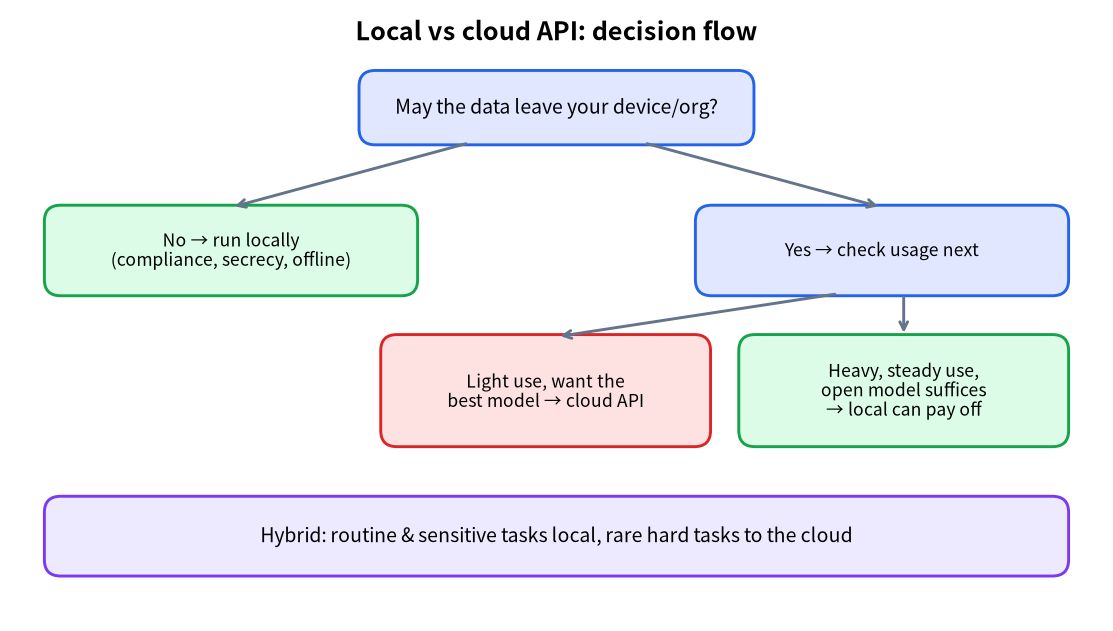
How to use the table: pick the column closer to you in each row. If you picked local on privacy, it often outweighs the other rows. If you picked API on model quality, don’t force a local setup just to save money.
Usage: Do the Arithmetic
Cost comes down to spreading a fixed cost. An API bills per use, while hardware depreciates whether or not you use it. Calculate it like this:
- Local monthly cost = hardware price divided by months of expected use, plus monthly electricity, plus the value of your maintenance time.
- API monthly cost = monthly tokens divided by 1,000, times the price per 1,000 tokens (input and output priced separately).
- Compare the two, and ask how busy the hardware will really be.
Hypothetical example (to show the method only): suppose a local machine costs 20,000 yuan and you expect to use it for 36 months, about 556 yuan a month, plus 50 yuan of electricity, roughly 606 yuan in all. If your API spend is 100 yuan a month, local costs far more and the API wins. If your API spend would be 1,500 yuan a month, local at about 606 yuan is clearly cheaper, provided the machine can do your tasks and you haven’t counted your own maintenance time. Replace these numbers with real ones: China-market reference system prices, estimated from Oct 2026 median market prices (the actual quote prevails), are about 7,900 RMB for an entry build, 10,900 RMB for 16GB, 14,300 RMB for 24GB (used RTX 3090) and 65,700 RMB for 32GB (RTX 5090); see Local LLM PC Build. API prices should come from the provider’s own site.
Three things to keep in mind:
- Utilisation. If the hardware is idle most of the time, the cost per token is high.
- Hidden costs. Electricity, cooling, your time, failures and backups all count.
- Capability gap. If the local model can’t do your task, cheap doesn’t matter.
Privacy and Compliance: Don’t Mythologise It, Don’t Ignore It
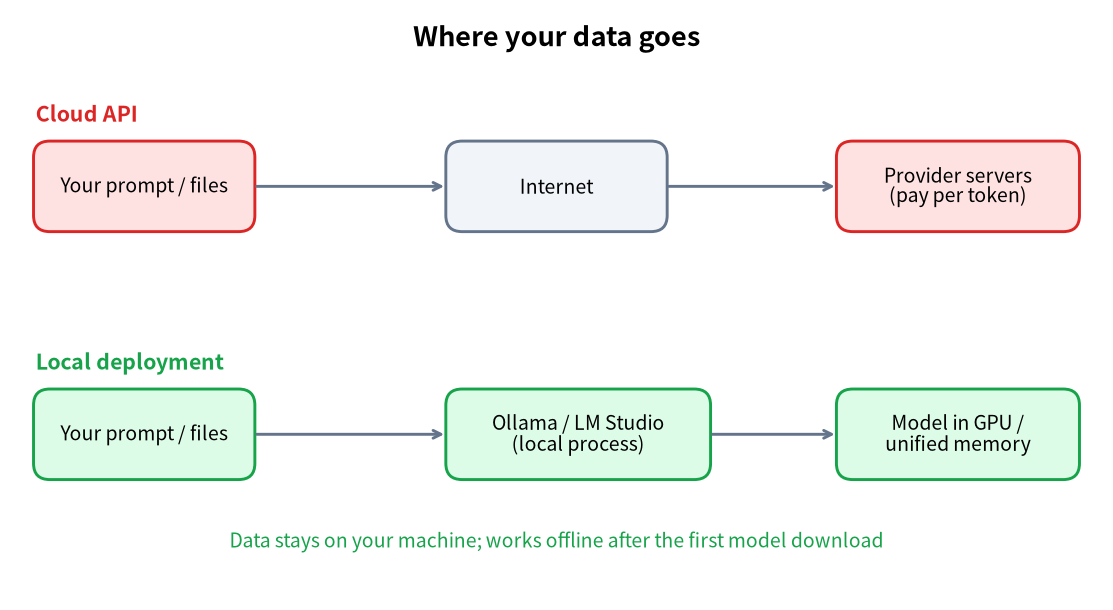
The strongest argument for local is that data never leaves your machine. If you handle customer records, internal documents, or medical or financial data you may not send to third parties, local is often the only option. Two caveats apply:
- “Local” doesn’t mean the whole chain is local. Open WebUI’s docs warn that local inference does not make separately configured cloud tools, extraction or embedding services local, and that picking a cloud model sends your prompt and included context to that provider.
- Ollama has cloud tags. Its library lists tags with a
-cloudsuffix (for example gpt-oss 20b-cloud and 120b-cloud) that run in the cloud, not on your machine. If privacy matters, check that you are calling a local tag.
On compliance, PromptQuorum’s guide notes that China has applied AI-generated-content labelling measures and the national standard GB 45438-2025 since September 1, 2025, and argues that running open-weight models locally avoids API-based compliance exposure for internal enterprise use. That is one third party’s view; whether your own business is compliant is a question for your legal team or the regulator, and we offer no legal advice.
Model Quality: Is an Open Model Good Enough?
Local deployment limits you to open-weight models you can download and fit in memory; see best local LLMs for choices. An API can offer the provider’s newest and strongest models, but they can also change under you and you don’t control the version. For most everyday Q&A, writing, summarising and code completion, an open model that fits your VRAM is enough; for the hardest reasoning and long-chain tasks you may still want a stronger cloud model. We have no comparative evaluation of our own, so the most reliable method is to run your own 10 real tasks through both.
Beyond Cost: Control, Latency and Reliability
Money isn’t the only axis. With an API, the provider decides which model version you get, when it is retired, what rate limits apply and when the service is down; you gain zero maintenance but give up control. With a local model, you run exactly the weights you tested until you choose to change them, and your assistant keeps working without an internet connection, which matters on a plane, in a factory or during a provider outage. The price is that you own the failures: a driver update that breaks the GPU, a disk that fills up, a power cut. Latency is similar: a local model removes the network round trip, but a busy local GPU can still queue requests, and a large hosted model may generate faster than your hardware can. Measure both with your own prompts before counting latency as a win for either side.
Five Questions to Answer Before Buying Hardware
Before you spend anything on a machine, write down honest answers to these:
- What are the three tasks I will actually run every week, and how many tokens does each use?
- Which of those tasks involve data that must not leave my premises?
- Did a small local model handle a sample of those tasks acceptably, using my own prompts?
- Who will maintain the machine, update it and restore it when something breaks?
- If the numbers say an API is cheaper, would I still want local for privacy or control, and is that worth the premium?
If you can’t answer the first question yet, you aren’t ready to buy; run an API trial for a month and come back with data.
The Hybrid Option
In practice many people end up hybrid:
- Sensitive, repetitive, high-volume work goes local, such as internal document Q&A and batch summarising.
- The hardest tasks escalate to the cloud, such as complex reasoning.
- One interface covers both. Open WebUI can connect Ollama, OpenAI-compatible APIs and other back ends at once, so local and cloud models sit in one dropdown; see our Open WebUI and Ollama guide.
You don’t need to choose once and forever. Validate the need with an API first, then migrate the steady, repetitive tasks to local over time.
A Practical Path
| Phase | What to do | How to judge |
|---|---|---|
| 1. Trial | Use an API or a small model on your current PC to learn what you really need | Is the need sustained? |
| 2. Record | Log a month or two of token volume, task types and privacy needs | Is usage steady? Which tasks can’t leave? |
| 3. Estimate | Use the method above with real prices | Is the payback period acceptable? |
| 4. Buy | Choose a VRAM tier by task; see the VRAM calculator guide and PC build configurations | Buy enough, not everything at once |
| 5. Go hybrid | Local for steady work, cloud for the hard problems | Review regularly and adjust |
If you’d rather not build a machine yourself, our local LLM appliance buying guide covers the pros and cons of ready-made systems.
Common Misconceptions
- “Local always saves money.” Idle hardware is expensive per token, especially for light users.
- “APIs are unsafe, so I must go local.” It depends on your data, your compliance needs and your agreement with the provider. Remember that local setups need backups, access control and updates too.
- “Once I own a high-end GPU I’m done spending.” Electricity, cooling and your time are costs, and new models may make you want more VRAM.
- “The gap between open and proprietary models is negligible.” Whether there is a gap on your task is something you must test.
FAQ
Is a local LLM always cheaper than an API?
No. With light usage and idle hardware an API is cheaper; with heavy, steady usage local may be. Use the method above with real prices.
How many tokens a month justify going local?
Sources differ widely. PromptQuorum suggests individuals above 10 million tokens a month may break even in about 6 to 12 months, while the arXiv study puts the economic sweet spot at organisations processing tens of millions of tokens a month or more. Treat both as rough references.
Does a local LLM really keep my data private?
Inference runs on your machine, but if you also configure cloud models, cloud search or cloud embeddings, the corresponding data goes to those services. Check the actual call path.
Can local models replace the newest proprietary ones?
For many everyday tasks perhaps; for the hardest reasoning perhaps not. Compare on your own tasks.
Can I start with an API and switch later?
Yes, and it’s the route we recommend. Use an API to validate the need and record your usage, then decide whether to invest in hardware.
What should a small business choose?
First ask whether the data may leave your premises, then look at volume and operations capacity. Most small businesses suit a hybrid: sensitive tasks local, the rest on an API.
Next Steps and Community
If you’re torn, post your rough monthly use cases, data sensitivity and budget range in our community (join the community) and we’ll work through the numbers with you. We source, assemble and test local-LLM machines in Shenzhen; if the numbers say local suits you, we can help configure one, and if they say an API fits better, we’ll tell you that too. Start with a conversation about your needs; there is no obligation to buy.