Enterprise Custom LLM and Private Local Deployment Guide
“Enterprise custom LLM plus private local deployment” is easy to put on a slide and hard to land. The blockers are usually ownership, data residency, pilot metrics, and rollback—not the absence of a 70B model. This article turns customization into executable levels, outlines a pilot-to-department sequence, budget bands, and a checklist, and points to our deeper enterprise private deployment, private training guide, and content safety checklist.
Verification notes. Budget figures are team ranges, not commercial quotes. Technical paths reflect common 2026-11 engineering practice; vendor features follow contracts and docs. We do not resell appliances or cloud GPUs.
Key takeaways (updated 2026-11-05)
- Customization ≠ pretraining: prompts / RAG / LoRA / pretrain—climb only as needed.
Private deployment fails first on access control, audit, evaluation, and corpus quality—not on GPU brand.
Pilots need numeric metrics (schema success, citation precision, human spot checks), not “smarter.”
- Appliance vs DIY: all-in-one comparison.
Enterprise custom LLM private local deployment ladder
Customization ladder
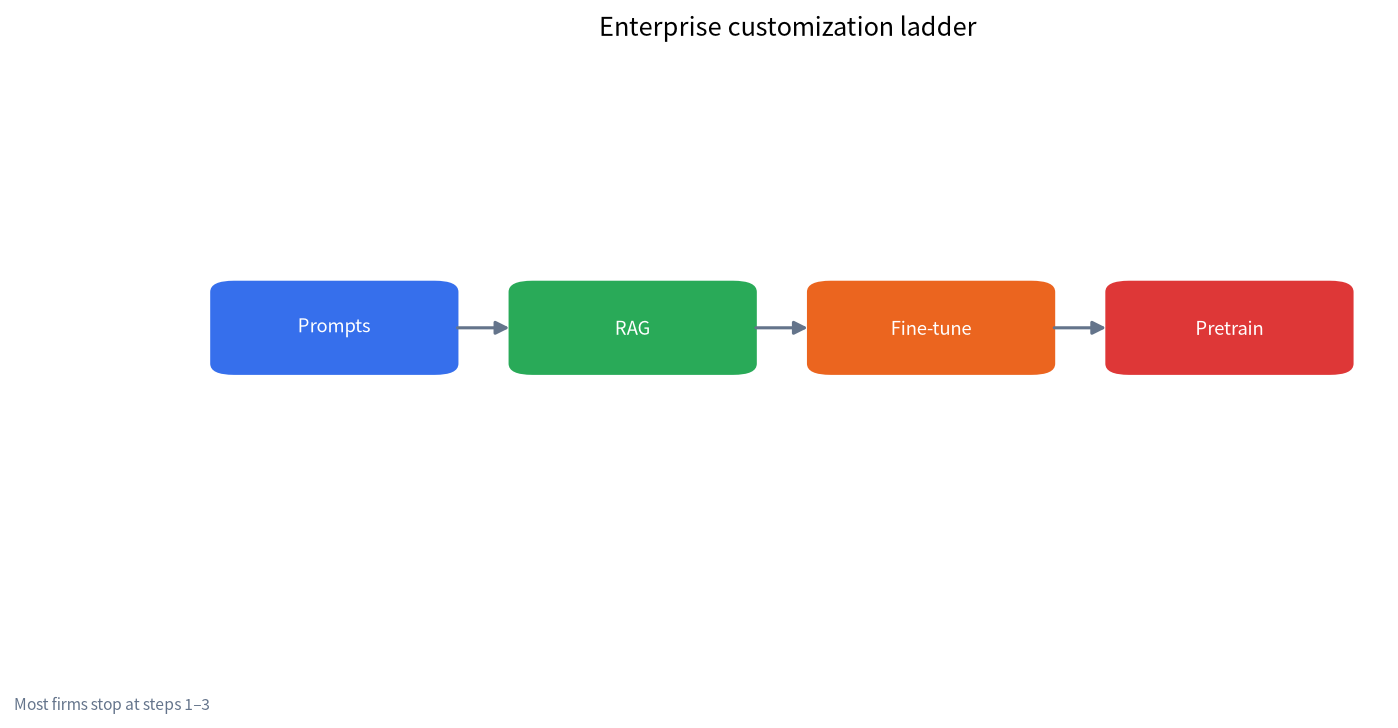
| Level | What you change | Compliance focus | Typical deliverable |
|---|---|---|---|
| 1 Prompts & rules | System prompts, templates, tool switches | Secrets inside prompts | Prompt pack + regressions |
| 2 RAG | Parse, chunk, retrieve, cite | Document authorization & redaction | Knowledge base + cited Q&A |
| 3 Fine-tuning | LoRA/QLoRA for tone/format | Train-set rights + eval | Adapter versions + report |
| 4 Pretraining | Own base model | Massive corpus compliance | Rarely a first project |
In serious private-deployment plans, most teams should deepen level 2 before dreaming about level 4. Policies change weekly; retraining cannot keep up.
Landing sequence: no “full platform” on day one
- Pick one painful scenario (draft replies, policy Q&A, read-only coding assistant on internal docs).
- Define success metrics and kill criteria.
- Classify data: what must never leave the premises vs what may sit on a private cloud.
- Choose inference stack and hardware/appliance (budget builds).
- Ship access control and audit before onboarding a second department.
Hiring, buying GPUs, fine-tuning 70B, swapping UIs, and integrating ten systems in parallel is how budgets evaporate.
Budget bands (illustrative)
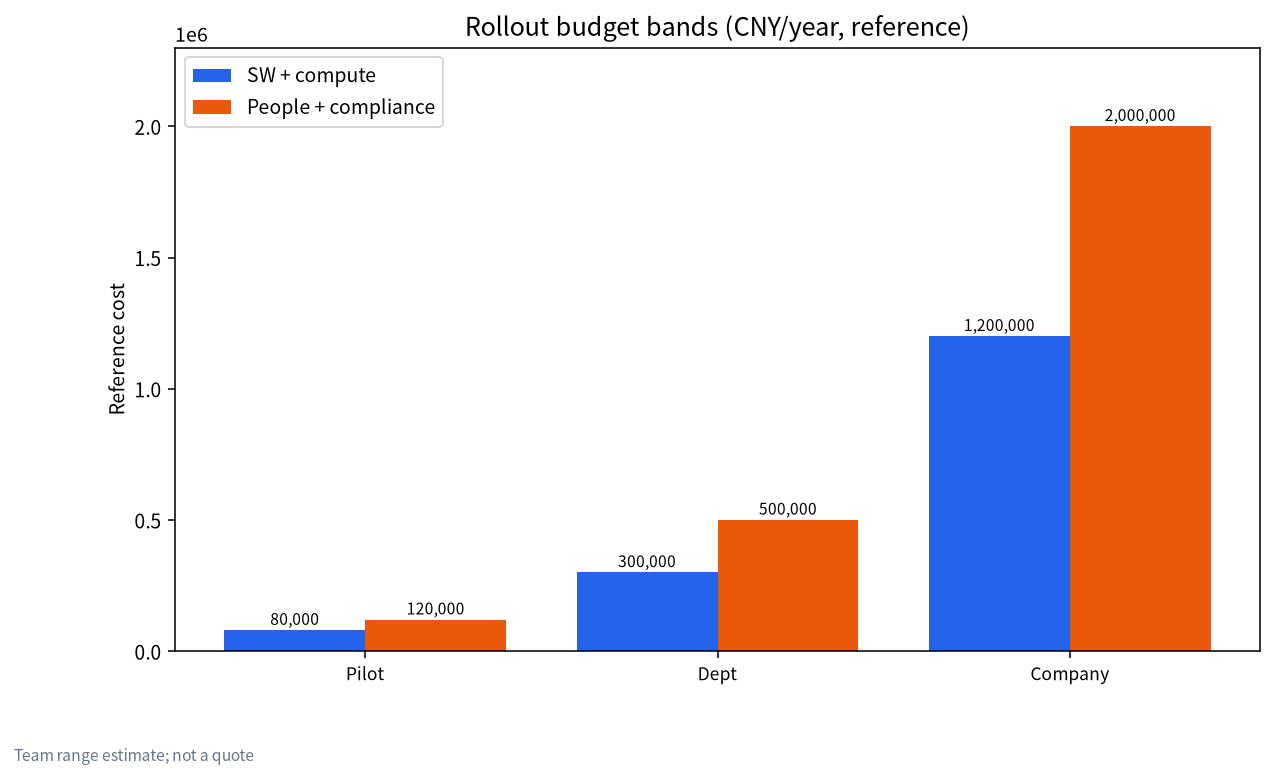
| Stage | Goal | Cost shape | People |
|---|---|---|---|
| Pilot | Demoable, measurable | Clean-up and consulting often dominate | One business owner + engineer |
| Department | Stable service, ACL, backups | Compute/storage rise; on-call appears | Dedicated or rotation |
| Company | Multi-dept governance | Platform, compliance, procurement dominate | Virtual team / platform group |
The GPU line item is only part of the story; labeling, access cleanup, and legal review often cost more.
Access, audit, evaluation
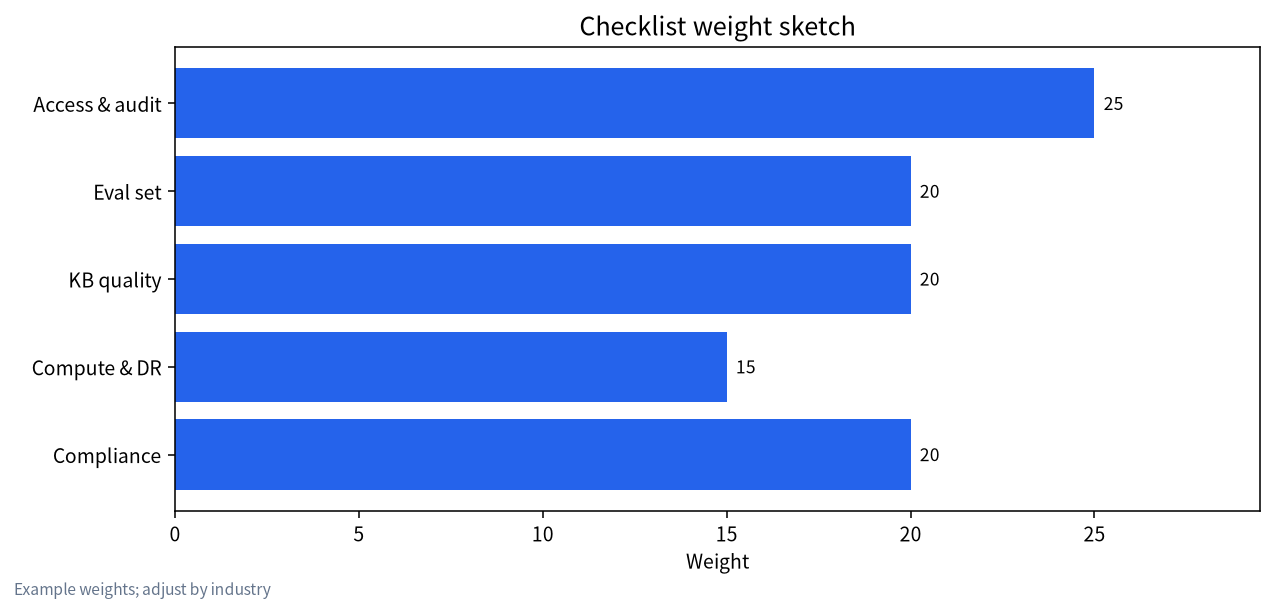
- Access: per user, role, and corpus slice.
- Audit: retention of sensitive prompts/answers under policy.
- Evaluation: pre-launch and weekly smoke; mandatory regression after fine-tunes (training guide).
- Security engineering: defenses against prompt injection—see injection vs jailbreak and the safety checklist. No attack recipes here.
Procurement shapes
| Shape | Fits | Watch-outs |
|---|---|---|
| On-prem DIY | Strong control, existing ops | Needs people |
| Appliance | Faster time-to-power | Lock-in, upgrades, licenses (appliance article) |
| Private cloud GPUs | Elastic training/peaks | Key management & residency |
| Hybrid | Local daily inference + rented peaks | Rent vs buy |
A 90-day sketch
Weeks 1–2: scenario, metrics, data inventory, one-page legal. Weeks 3–5: minimal RAG + ACL. Weeks 6–8: internal test, freeze eval set, backup drill. Weeks 9–12: decide on fine-tuning and expansion; write the retrospective.
Common failure modes
- No business owner—only a tech hobby.
- Treating a warm demo as production readiness.
- Blaming model size for a garbage scanned corpus.
- Ignoring licenses (open-source LLM guide).
- Trying to replace an entire contact center in one go.
What we verified—and what we did not
No signed commercial proposals; no certification of a specific appliance brand; security sections discuss governance and defense only.
A three-day validation instead of a three-month fantasy
Long guides still leave people unsure what to do on Monday morning. Replace fantasy roadmaps with a three-day validation: day one ends with a successful install and one real conversation; day two runs ten authentic tasks and logs failure modes; day three decides whether to add retrieval, change model size, or simply improve prompts. Hardware purchases and fine-tuning plans should follow evidence, not anxiety.
If the same failure repeats—tables break, citations point at the wrong paragraph—fix the process for that failure class before you buy a more expensive GPU. Table issues may need stricter output constraints or post-processing; citation issues usually need chunking and retrieval work. A tiny spreadsheet of failure classes is already a cheap evaluation set.
Responsibility boundaries (worth repeating)
Local deployment reduces the intuitive risk of data leaving your network; it does not finish compliance for you. Pasting customer lists into prompts, fine-tuning on unauthorized repositories, or exposing an intranet API to the public internet are process failures. Write down which data classes may never enter prompts or train sets, who can merge adapters, and how to halt and audit incidents. Tutorials answer “how to run”; charters answer “whether we may run” and “who owns the blast radius.”
For hobbyists, the bar can be light: do not spread others’ private data, do not pursue illegal uses, and do not treat mystery weights as trusted software. For companies, boundaries must be auditable. In both cases, “open” never means “no obligations.”
How to read neighboring articles on this site
If the bottleneck is buying too large or too small a machine, start with budget builds and VRAM math. If knowledge goes stale, read RAG first. If tone and format are unstable, then read LoRA training. If the pain is organizational access control, read enterprise private deployment and the safety checklist. If the pain is licensing, read the open-weight and free-local boundary pieces. Reading by bottleneck beats reading by publish date. When you hit an internal link, open the relevant section instead of only bookmarking the title.
Maintenance after the exciting first weekend
Weights accumulate, logs grow, drivers age. Schedule a monthly hour: delete unused weights, check disk health, confirm backups still restore, and skim upstream security notes. If you treat a local model like a forever-forgotten portable app, the common six-month ending is a full disk and a broken driver after an OS update—followed by the false conclusion that “local AI does not work.” Maintenance is boring; it is also what keeps the shopping and training advice valuable.
Composite anecdotes (anonymized patterns)
We repeatedly see a student laptop with 8GB VRAM chasing a 70B download “because the chart looked cool,” a startup exposing Ollama on 0.0.0.0 “just for the hackathon,” and a department fine-tuning on raw mail exports that still contain personal data. None of these failures required exotic research. They required slowing down at license text, network bind addresses, and data classification. If your project currently matches one of those patterns, pause new downloads until the basics are written down and reviewed by a second person.
A three-day/6 validation instead of a three-month fantasy
Long guides still leave people unsure what to do on Monday morning. Replace fantasy roadmaps with a three-day validation: day one ends with a successful install and one real conversation; day two runs ten authentic tasks and logs failure modes; day three decides whether to add retrieval, change model size, or simply improve prompts. Hardware purchases and fine-tuning plans should follow evidence, not anxiety.
If the same failure repeats—tables break, citations point at the wrong paragraph—fix the process for that failure class before you buy a more expensive GPU. Table issues may need stricter output constraints or post-processing; citation issues usually need chunking and retrieval work. A tiny spreadsheet of failure classes is already a cheap evaluation set.
Responsibility boundaries (worth repeating)
Local deployment reduces the intuitive risk of data leaving your network; it does not finish compliance for you. Pasting customer lists into prompts, fine-tuning on unauthorized repositories, or exposing an intranet API to the public internet are process failures. Write down which data classes may never enter prompts or train sets, who can merge adapters, and how to halt and audit incidents. Tutorials answer “how to run”; charters answer “whether we may run” and “who owns the blast radius.”
For hobbyists, the bar can be light: do not spread others’ private data, do not pursue illegal uses, and do not treat mystery weights as trusted software. For companies, boundaries must be auditable. In both cases, “open” never means “no obligations.”
How to read neighboring articles on this site
If the bottleneck is buying too large or too small a machine, start with budget builds and VRAM math. If knowledge goes stale, read RAG first. If tone and format are unstable, then read LoRA training. If the pain is organizational access control, read enterprise private deployment and the safety checklist. If the pain is licensing, read the open-weight and free-local boundary pieces. Reading by bottleneck beats reading by publish date. When you hit an internal link, open the relevant section instead of only bookmarking the title.
Maintenance after the exciting first weekend
Weights accumulate, logs grow, drivers age. Schedule a monthly hour: delete unused weights, check disk health, confirm backups still restore, and skim upstream security notes. If you treat a local model like a forever-forgotten portable app, the common six-month ending is a full disk and a broken driver after an OS update—followed by the false conclusion that “local AI does not work.” Maintenance is boring; it is also what keeps the shopping and training advice valuable.
Composite anecdotes (anonymized patterns)
We repeatedly see a student laptop with 8GB VRAM chasing a 70B download “because the chart looked cool,” a startup exposing Ollama on 0.0.0.0 “just for the hackathon,” and a department fine-tuning on raw mail exports that still contain personal data. None of these failures required exotic research. They required slowing down at license text, network bind addresses, and data classification. If your project currently matches one of those patterns, pause new downloads until the basics are written down and reviewed by a second person.
A three-day/11 validation instead of a three-month fantasy
Long guides still leave people unsure what to do on Monday morning. Replace fantasy roadmaps with a three-day validation: day one ends with a successful install and one real conversation; day two runs ten authentic tasks and logs failure modes; day three decides whether to add retrieval, change model size, or simply improve prompts. Hardware purchases and fine-tuning plans should follow evidence, not anxiety.
If the same failure repeats—tables break, citations point at the wrong paragraph—fix the process for that failure class before you buy a more expensive GPU. Table issues may need stricter output constraints or post-processing; citation issues usually need chunking and retrieval work. A tiny spreadsheet of failure classes is already a cheap evaluation set.
Responsibility boundaries (worth repeating)
Local deployment reduces the intuitive risk of data leaving your network; it does not finish compliance for you. Pasting customer lists into prompts, fine-tuning on unauthorized repositories, or exposing an intranet API to the public internet are process failures. Write down which data classes may never enter prompts or train sets, who can merge adapters, and how to halt and audit incidents. Tutorials answer “how to run”; charters answer “whether we may run” and “who owns the blast radius.”
For hobbyists, the bar can be light: do not spread others’ private data, do not pursue illegal uses, and do not treat mystery weights as trusted software. For companies, boundaries must be auditable. In both cases, “open” never means “no obligations.”
Extra verification and reading order
Read this article beside the VRAM, budget-build, and private-deployment guides: confirm workload and VRAM first, then tools and models, and only then training or enterprise governance. Keep key prompts, weight filenames, and eval notes in one place so a two-week retrospective beats a folder of unread bookmarks. If your environment has special compliance rules, follow legal and security counsel; this page is technical education.
The lasting value of local deployment is rarely a single successful demo. It is repeatability, rollback, and explainability. Whether you choose free tools or an enterprise path, keep a change log: which weight changed on which day, who approved an adapter merge, which eval failed. That log makes the next incident an order of magnitude cheaper. If you still do not know where to start, write three real tasks first, then return to the VRAM and build tables as a multiple-choice problem instead of buying hardware on impulse.
FAQ
What is the first step for enterprise custom LLMs and private deployment?
Scenario + metrics + data classification, then usually RAG—not pretraining.
Must a private deployment include fine-tuning?
No. Knowledge problems prefer RAG; fine-tuning stabilizes format and tone.
Should we buy the biggest GPU first?
No. Prove the scenario, size VRAM from concurrency/context, rent peaks.
Can an appliance replace an internal platform team?
It shortens driver/hardware time; it does not replace ACL, eval, or corpus governance.
How do we avoid shadow IT?
Reuse SSO, logging, and procurement; name an owner and maintenance windows.
How is this different from hobby local models?
Compliance, audit, SLA, and purchasing—not only the inference engine.
Want a path review?
Post in the community or email admin@microaione.com with industry, residency constraints, pilot scenario, and headcount. Our Shenzhen team can map you to the ladder and checklist and label estimates.
For governance context see OWASP LLM Top 10 and the NIST AI RMF.
Sources: public industry reports (use the latest editions), OWASP Top 10 for LLM Apps, our enterprise private deployment, content safety checklist.