What Is an LLM All-in-One Appliance? How It Compares With a DIY Build (Definition, Standard, Six-Step Selection, 3-Year Cost Example)
Over the past year, “DeepSeek all-in-one machine” has become a popular purchasing phrase for government offices, hospitals, schools and small companies in China, and the prices run from a few thousand dollars to well over a hundred thousand, which makes the market hard to judge. What is an LLM all-in-one appliance? In short, it is a delivered bundle in which server hardware, inference software, an open-weight model and one or two business applications are pre-installed together, usually to run inside the buyer’s own server room. This article uses public, authoritative material to explain the definition and architecture, then puts the appliance and a DIY build side by side: when the appliance is the less stressful choice, when building your own is cheaper, and which questions to ask a vendor before you sign.
How we checked this: the definition and selection process come from the China Academy of Information and Communications Technology (CAICT) report on LLM all-in-one machines (2025). Standard details come from China’s national standards information platform. Weight sizes come from the Ollama library. Price references come from the press reports and median prices collected in our buying guide (reference prices are estimated from October 2026 market medians; real quotes govern). The three-year cost is a worked example and the electricity price and labour rate are assumptions. We have not tested any appliance and we have no customer cases we can publish.
Key points (updated 2026-11-04)
- CAICT defines an LLM all-in-one machine as a “highly integrated system that provides large-model application capability,” usually deployed on the buyer’s premises, combining hardware, software, models and vertical applications to lower the barrier to deployment.
GB/Z 252-2026, “Artificial intelligence – Technical requirements for large-scale model all-in-one machine,” was published on 2026-08-27. It is a guidance technical document, not a mandatory standard, and works as a reference for your requirements list.
An appliance buys you convenience and a single accountable party; a DIY build buys flexibility and a lower price. Using our RTX 5090 workstation reference configuration (65,737 CNY), a three-year example comes to about 74,900 CNY, a figure any appliance quote can be compared against.
- The weights of “full DeepSeek 671B” are 404 GB even at the default quantization, so a 128 GB desktop cannot hold them. Treat a quote that does not state quantization and concurrency with caution.
What is an LLM all-in-one appliance, and what does it contain
CAICT’s 2025 report defines an LLM all-in-one machine as a highly integrated system that provides large-model application capability, usually deployed privately, that packages the complex components an AI application needs and offers a simplified, efficient and secure environment to deploy and run it. The core idea is deep integration and co-optimisation of hardware, software, models and vertical applications. In plain words: it is not a graphics card and not a piece of software, but a pre-assembled whole: server, inference engine, model, management console and applications.
The report splits the technical architecture into four layers: hardware, software, model and application. The hardware layer provides compute (general-purpose GPUs or various NPUs), storage (NVMe SSDs for ordinary persistent storage) and networking. The software layer connects hardware to applications. The model layer holds open or in-house models. The application layer delivers scenario features such as document drafting, customer service and knowledge-base Q&A.
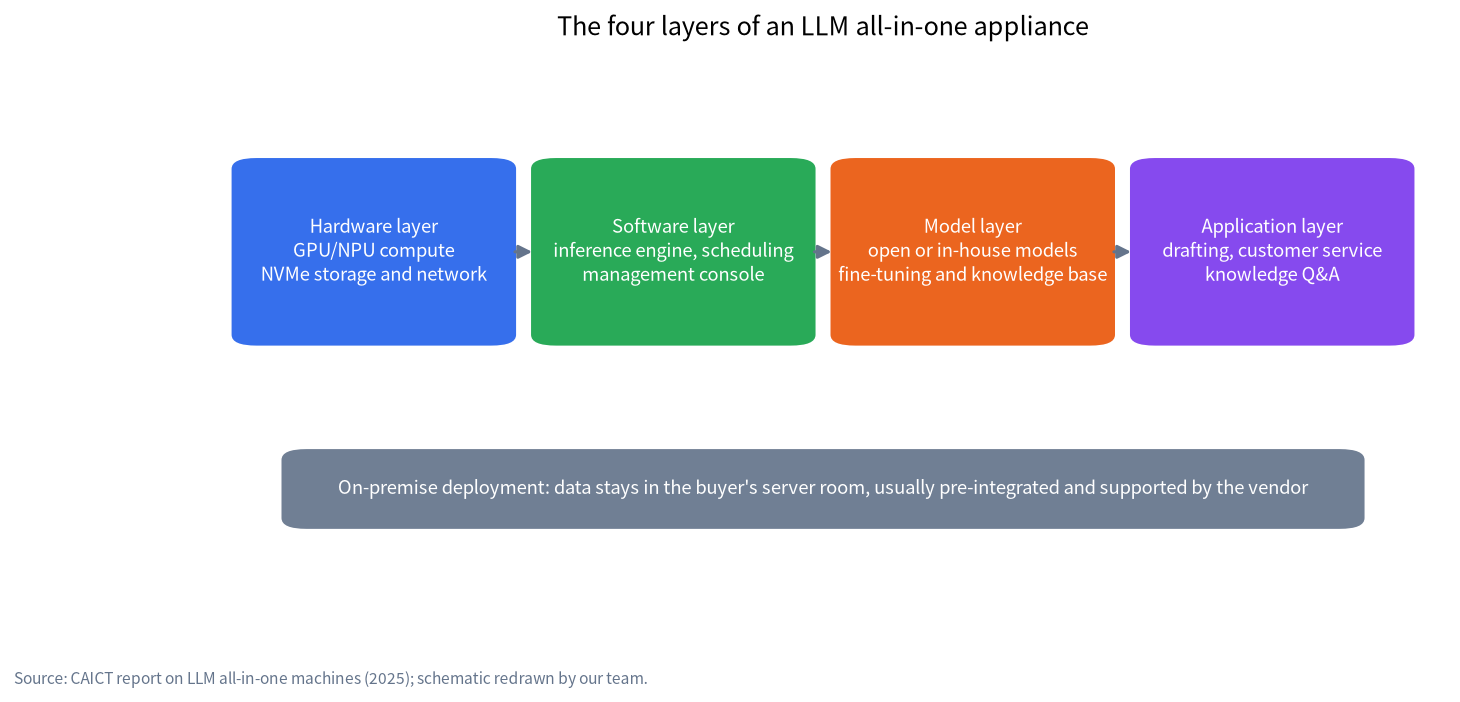
The report also lists the claimed value: simpler deployment and operations, system-level efficiency from co-design, stronger data security and compliance because data stays on the premises, and easier customisation with your own data. It also notes that many vendors offer subscription or leasing models, which turn one large purchase into operating expense.
A national guidance document now exists: GB/Z 252-2026
China’s national standards information platform lists “Artificial intelligence – Technical requirements for large-scale model all-in-one machine” (GB/Z 252-2026) as published on 2026-08-27, with status “current” and category “guidance technical document.” It is administered by the national information technology standardization committee (TC28), executed by its AI subcommittee, and drafted by organisations including the China Electronics Standardization Institute, Alibaba Cloud, Huawei, Inspur, JD Technology and T-Head.
Two cautions. First, a GB/Z document is not mandatory; it provides technical reference. Second, we have not obtained the full text, so we do not paraphrase specific clauses here. A practical use is to ask each vendor which requirements of GB/Z 252-2026 the product meets, which it does not, and whether a third-party test exists, and turn that into a column in your quotation sheet.
An LLM appliance versus a DIY build: one table
“DIY” here means buying a GPU or unified-memory machine yourself and installing the OS, inference software and interface (see our local deployment guide). The difference is not benchmark scores. It is who is responsible, how fast it goes live, and how it is upgraded later.
| Item | LLM appliance | DIY build | Cloud API |
|---|---|---|---|
| What you receive | Machine plus pre-installed model and platform | Parts or a machine; software installed by you | No hardware, pay per use |
| Time to go live | Vendor deploys, usually quicker (per contract) | Depends on your skills; the first time often takes days | Same day |
| Upfront cost | High, varies widely with specification | Medium, can start from a few thousand dollars | Almost none |
| Where data goes | Stays in your server room | Stays in your server room | Sent to a third party |
| Responsibility | Vendor handles deployment and after-sales, scope per contract | You | Provider |
| Flexibility | Bound to the vendor software stack; swapping models depends on support | High; change models and tools freely | Limited by the API |
| Localisation and compliance | Domestic chips and OS can be specified for regulated sectors | Depends on the parts you pick | Depends on the provider |
| Fits | No ops staff, strict compliance, enough budget | Technical staff, tight budget, changing needs | Non-sensitive data, low volume |
If you are an individual or a small team who only wants to try things, you usually do not need an appliance. Start with large-memory mini PCs and sharing one local model in a small team. For the local-versus-cloud trade-off, see local deployment or cloud API.
Six selection steps according to the CAICT report
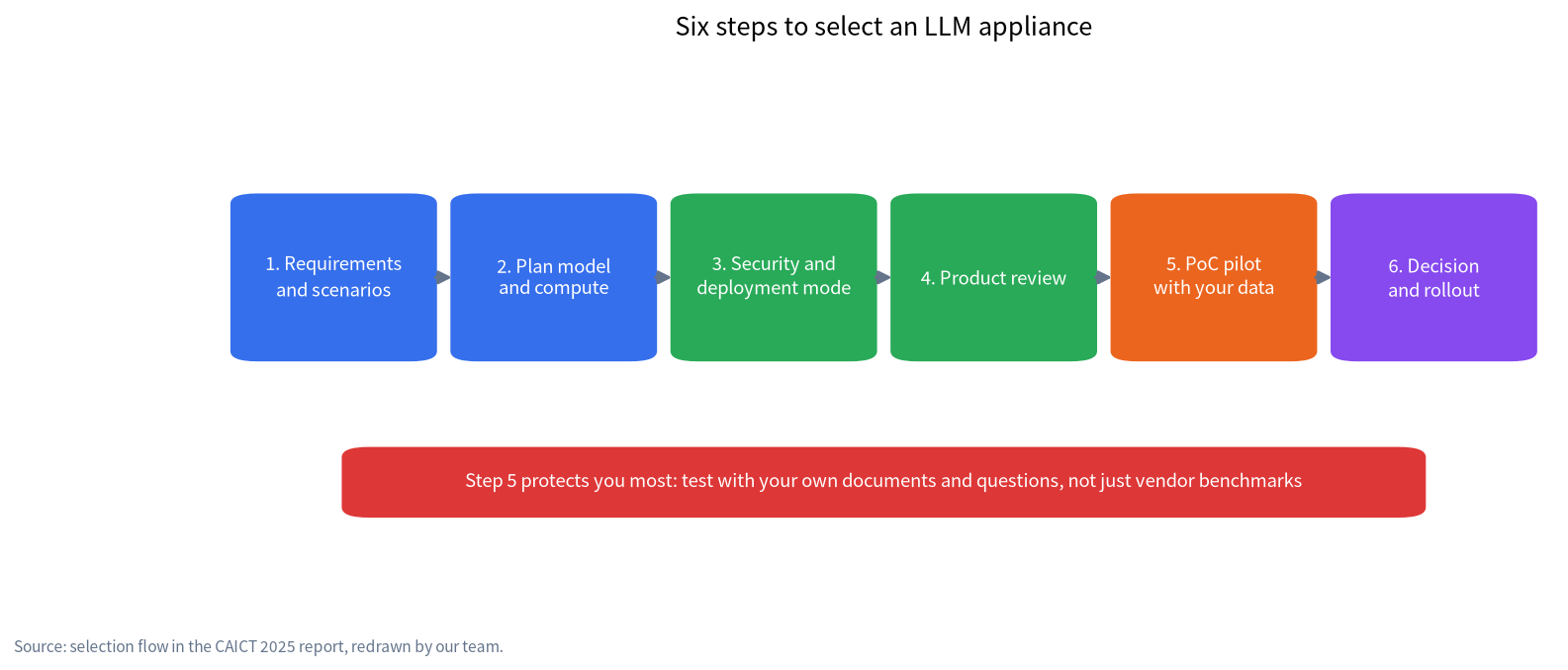
The report summarises the selection process in six steps. We redrew it and added what you should prepare at each step.
| Step | What the report says | What you should prepare |
|---|---|---|
| 1. Requirements and scenarios | Decide training or inference, and customer service, document drafting or image recognition; assess concurrency, real-time needs and throughput | Three concrete business questions, expected users and simultaneous users |
| 2. Plan model and compute scale | Pick model type and size first, then GPU model and count, CPU, memory, storage, rack and network; leave room for peak concurrency and expansion; watch domestic-hardware compatibility in government, finance and energy | A minimum model size and a requirement for at least 30% expansion headroom |
| 3. Security, compliance, deployment mode | Sensitive data usually means fully on-premise; check access control, encrypted storage, audit logs and firewall policy; confirm domestic hardware and software support | A data classification list and sector compliance requirements |
| 4. Product research and capability review | Examine throughput, concurrency and latency, plus toolchain, pre-built apps and support | Ask vendors for performance data on the same basis |
| 5. Testing and pilot | Run a proof of concept or small pilot covering function, performance and compatibility tests | Use your own real documents and questions |
| 6. Decision and rollout | Sign, go live, train staff, hand over operations, keep evaluating benefit and review expansion | Acceptance criteria and a review process |
Step 5, a proof of concept with your own data, is the most protective step in the whole flow. Many configurations that look great on a benchmark sheet fall apart on your company’s 200-page PDFs.
“Full DeepSeek” appliances: compute the weights before reading the quote
“DeepSeek appliance” and “full version” are the most abused phrases in marketing. The report notes that DeepSeek’s open models reached results close to closed models and lowered the cost of adoption, which is part of why appliances appeared in large numbers in 2025. But how big a machine does “full” need? A simple calculation answers much of it.
According to the Ollama library’s deepseek-r1 tags page, the default 671B file is 404 GB, Q8 is 713 GB, and FP16 is 1.3 TB. That is weights only, before KV cache, the operating system and concurrency.
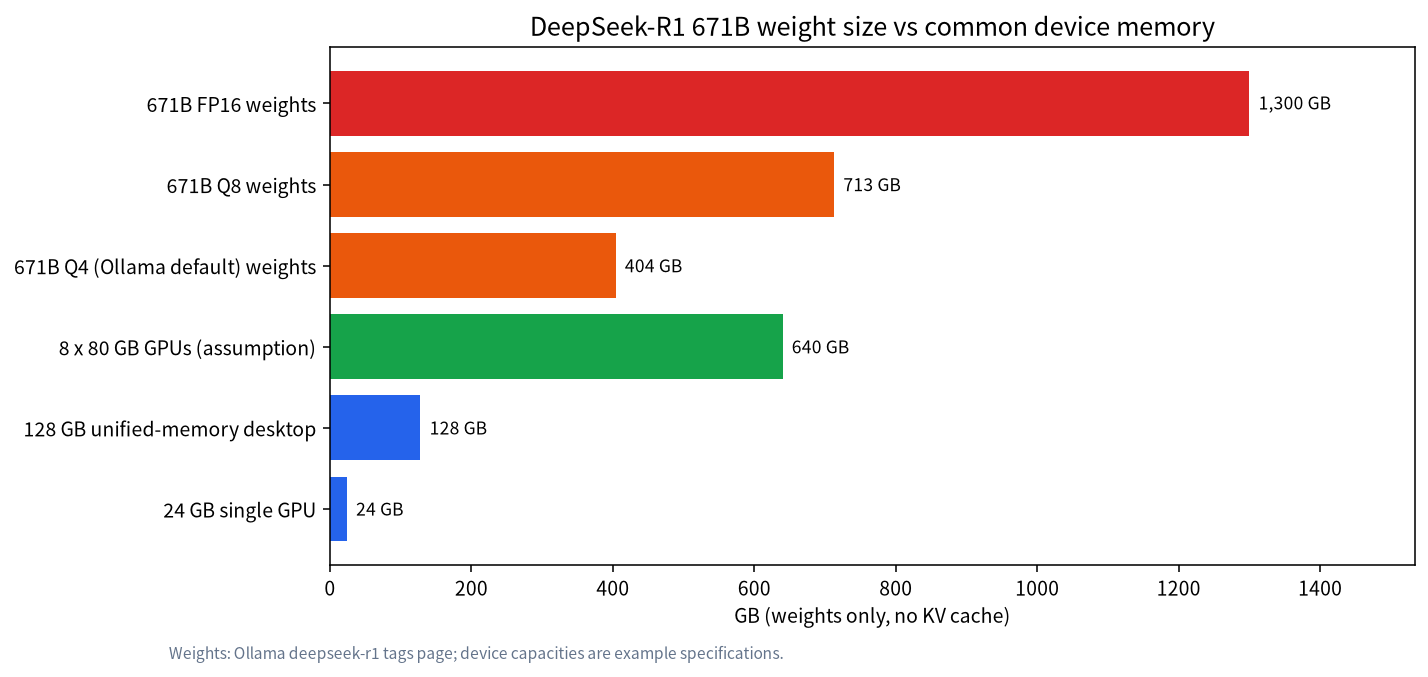
You can use these numbers to test claims directly:
- A desktop with 128 GB of unified memory, such as a DGX Spark-class box, cannot hold even one third of the 404 GB weights. What it runs is a distilled or smaller model, not 671B.
- If a quote says “supports full DeepSeek 671B,” ask which quantization (Q4, Q8 or native precision), how many concurrent users, what context length and how much total GPU memory.
- Press reports from 2025 put full-671B enterprise machines in the range of 1.2 to 1.5 million CNY, while The Paper reported that very low prices often come from quantization or distillation, so sticker prices cannot be compared directly (more in our buying guide).
Three-year cost: a worked example
The example below uses a DIY build. Its purpose is to give you a formula you can fill with your own numbers, not to price any appliance.
DIY three-year total = hardware + three years of electricity + deployment and maintenance labour.
- Hardware: our reference RTX 5090 32 GB workstation configuration is about 65,737 CNY (reference price; real quotes govern).
- Electricity: assume 0.45 kW average draw, 8 hours a day and 0.8 CNY per kWh (all assumptions). Three years use 0.45 x 8 x 365 x 3 = about 3,942 kWh, roughly 3,154 CNY.
- Labour: assume 40 hours of setup and tuning at 150 CNY per hour, about 6,000 CNY (an assumption; if you have in-house staff this is an opportunity cost).
- Total: 65,737 + 3,154 + 6,000 = about 74,891 CNY.
So if an appliance’s three-year total quote, including warranty and service, is at or below this scale for comparable specifications, building it yourself has no pure-cost advantage. If it is far higher, ask what the difference buys: more GPU memory, higher concurrency, domestic-hardware compatibility, on-site staff, or only brand premium. The value of the formula is that it turns “is it expensive?” into “what does the extra money buy?”
Ten questions to ask the vendor
- Which model, which quantization and which context length are pre-installed?
- What are the performance numbers on the same basis: concurrency, time to first token, tokens per second, and under what test conditions?
- How much GPU or unified memory in total, is that the sum across cards, and how much is left for KV cache at full load?
- Can the model be changed? Does another open model need an extra licence fee?
- Who updates software and models, how often, and is it charged?
- Where does data live, are logs and audit enabled by default, and how are permissions tiered?
- Against GB/Z 252-2026 or sector rules, what is met and is there a third-party test report?
- How long is the warranty, what is the fault response time, and is a spare unit provided?
- After the contract ends, can the device run independently of the vendor?
- May you run a PoC with your own data first, and are the pass criteria written into the contract?
Hidden costs and common mistakes
- Comparing only the sticker price. Electricity, server room, networking, backup storage, software subscriptions and staff all count; see enterprise private deployment.
- Treating “it runs” as “it serves many people.” More concurrent users mean more KV cache; size for the peak.
- Ignoring the pace of change. Open models update quickly; ask how upgrades are done and what they cost.
- Believing “domestic is always better” or “imported is always better.” Judge by sector compliance, software ecosystem and after-sales capability.
- No exit plan. A contract that does not cover data migration and standalone operation can lock you in.
What we checked and what we did not do
The definition, selection process and architecture come from the CAICT report. The standard number, date, category and drafters come from the national standards platform. Weight sizes come from Ollama’s deepseek-r1 tags page. Prices come from public reports and the median figures we compiled, and the three-year cost is a worked example built on assumptions. We have not tested any appliance, have not obtained the full text of GB/Z 252-2026, and do not offer unverified customer cases.
FAQ
What is a train-and-infer LLM all-in-one machine, and should I buy one?
Marketing often says LLM all-in-one appliances are “leading AI change”; in practice they bundle hardware, software, and support for inference (sometimes training). A train-and-infer LLM all-in-one machine can be a turnkey fit—but compare three-year cost and upgrade paths with DIY.
What does “LLM all-in-one machine” mean?
It is a delivered bundle of server hardware, inference software, a model and applications, usually deployed in the user’s own server room. CAICT’s definition stresses “highly integrated” and “private deployment.”
How is an LLM appliance different from an ordinary AI server?
An ordinary server provides compute only; you install software and models. An appliance comes with the model, inference software and a management interface pre-installed and tuned to shorten time to go live.
Can a DeepSeek appliance really run the full 671B?
It depends on the configuration. At Ollama’s default quantization the 671B weights alone are 404 GB, so a machine without matching GPU memory can only run smaller versions. Ask the vendor to state quantization, concurrency and total GPU memory.
Is GB/Z 252-2026 mandatory?
No. A GB/Z document is guidance, not a mandatory standard, and can serve as a reference for purchase requirements.
Should a small company buy an appliance?
Not necessarily. Run a pilot on one workstation or a large-memory mini PC first, confirm the business value, then decide. Do not make a heavy one-off investment while requirements are unclear.
Is DIY cheaper than an appliance?
Usually on hardware, but you must count your own time, operations skills and risk. Putting your own quote into the three-year formula in this article is more reliable than going by feel.
Want to know whether you need an appliance?
Join the community or email admin@microaione.com with your user count, simultaneous users, document types, budget and compliance requirements. Our Shenzhen team can help configure a setup; we judge whether you need to buy at all before talking about configuration, and we will not offer cases or performance promises we have not verified.
References: CAICT: LLM all-in-one machine application research report (2025, Chinese), National standards information platform: GB/Z 252-2026, Ollama: deepseek-r1 tags, TMTPost: all-in-one LLM machines are shrinking, The Paper: the DeepSeek appliance market, NVIDIA: DGX Spark hardware overview.