Refusal Direction Ablation (Abliteration) Explained: From the Arditi Paper to OBLITERATUS
Discussion of the “uncensored” releases of DeepSeek V4.1 Flash 1017 tends to stop at a refusal rate, and rarely explains how such a model is made. The technique behind them is refusal direction ablation, called abliteration in the community: find one direction inside the model that is associated with refusing, then remove it from the weights. This article covers concepts and evidence only; it gives no operational steps for harmful use. We explain what the original paper found, how the mathematics works, what KL divergence means, what the side effects are, and how the method differs from fine-tuning, DPO and prompt jailbreaks. For a concrete case, compare our explainer on DeepSeek V4.1 Flash 1017 Obliterated.
Key takeaways (Updated 2026-11-01)
- Arditi et al. (2024, arXiv:2406.11717) found, across 13 open-source chat models of up to 72B parameters, that refusal is mediated by a one-dimensional direction: erase it and the model stops refusing, add it and even harmless requests are refused.
The method takes the difference between mean activations on harmful and harmless prompts as the direction, then uses weight orthogonalization so the model’s writing matrices can no longer produce that component. No retraining is needed.
KL divergence measures how far the modified model’s next-token distribution is from the original. The OBLITERATUS release reports 0.1305 nats against a budget of 0.5. A small KL does not mean “quality is unchanged”.
- Compared with fine-tuning or DPO the method is cheap and one-shot, but side effects can only be found by evaluation. The paper’s conclusion also shows that safety fine-tuning of open-weight models is brittle, so deployers need their own guardrails.
What the Original Paper Found
Arditi, Obeso, Syed, Paleka, Panickssery, Gurnee and Nanda published “Refusal in Language Models Is Mediated by a Single Direction” in June 2024. According to the abstract, chat models are fine-tuned for instruction following and safety so that they comply with harmless requests and refuse harmful ones. Across 13 popular open-source chat models of up to 72B parameters, the authors found that refusal is mediated by a one-dimensional subspace. For each model there is a direction such that erasing it from the residual-stream activations stops the model refusing harmful instructions, while adding it makes the model refuse even harmless ones. From this they built a white-box jailbreak that disables refusal with minimal effect on other capabilities, and they analyzed how adversarial suffixes suppress the propagation of the refusal-mediating direction. Their conclusion is that the finding highlights the brittleness of current safety fine-tuning and shows how an understanding of model internals can be used to control behavior.
Two things should be kept apart. The paper is mechanistic interpretability research, aimed at understanding why safety behavior is so fragile. Turning it into a ready-made tool is later community engineering. FailSpy’s abliterator is a Python library for models supported by TransformerLens, with activation caching and a built-in refusal direction calculation; Maxime Labonne’s blog post “Uncensor any LLM with abliteration” introduced the workflow to a wider audience. OBLITERATUS is another open-source tool that automates the pipeline and records evaluation metadata with the result.
How Refusal Direction Ablation Works: The Concept
The idea can be understood in three steps.
Step one: collect activations. Prepare two groups of prompts, one that the model tends to refuse and one of ordinary requests. Run the model on them and read the residual-stream activation vectors at a chosen layer and token position. For the DeepSeek release discussed here, the metadata shows 256 harmful and 256 harmless prompts used to find the direction, with a further 50 of each held for evaluation.
Step two: find the direction. The simplest approach is difference in means: subtract the mean harmful activation from the mean harmless one (or the reverse) and normalize to a unit vector r̂. Intuitively, r̂ points toward “this request looks like one to refuse”. Other OBLITERATUS presets extract several directions with SVD, whereas the failspy preset used for this model takes one.
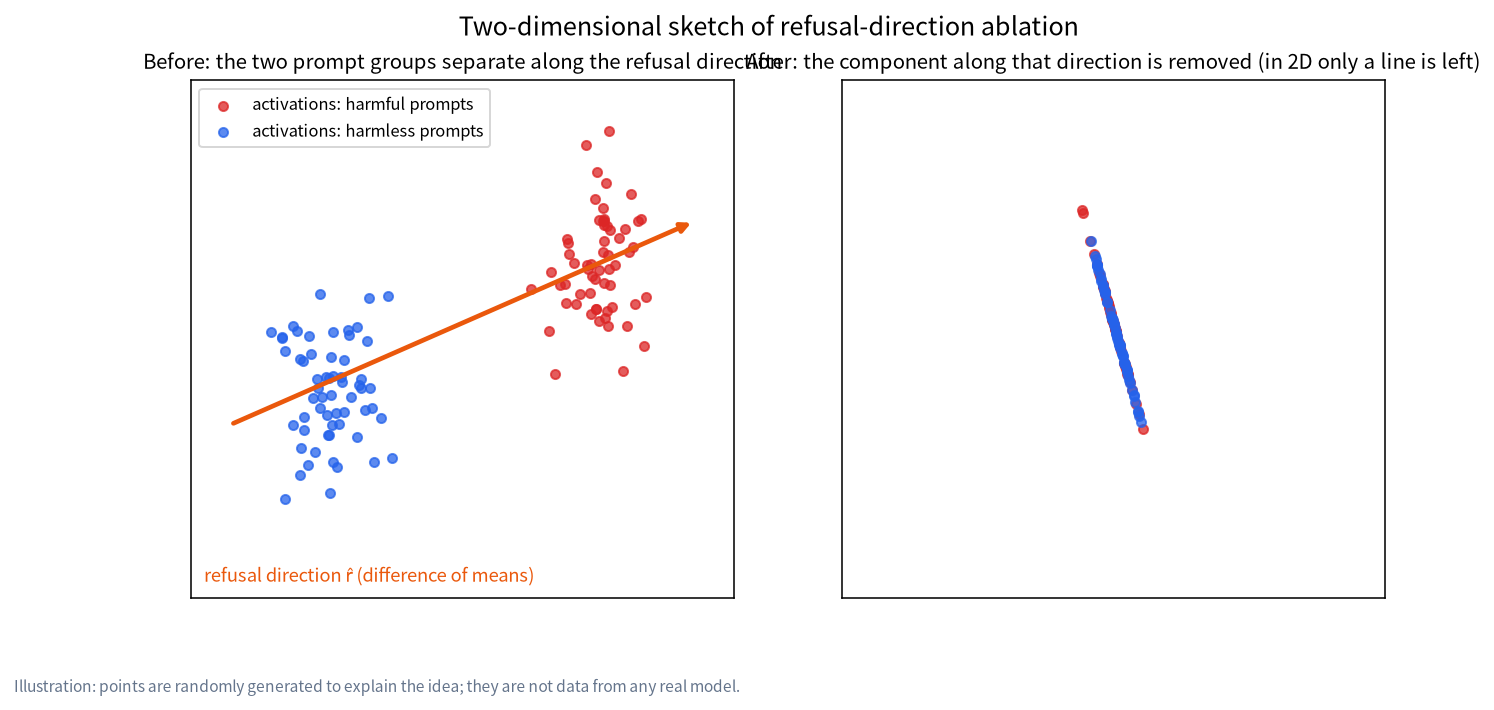
Step three: ablate. There are two equivalent implementations. Inference-time ablation replaces each activation x with x′ = x − r̂r̂ᵀx at every layer and position, removing its projection on r̂. Weight orthogonalization instead edits every matrix W that writes into the residual stream (attention output projections, feed-forward output projections, the embedding matrix) as W′ = W − r̂r̂ᵀW, so whatever it outputs is orthogonal to r̂. After this edit the architecture and the inference procedure are unchanged and no runtime support is needed; only the weights differ.
For mixture-of-experts (MoE) models more matrices need handling, because each expert has its own output projection. According to the metadata, this release targets “all”, selects every layer except the first, leaves the router unprojected (project_router is false) and does not preserve norms. To see why MoE models are large in the first place, read our guide to MoE models for local use.
The OBLITERATUS Pipeline and This Release’s Settings
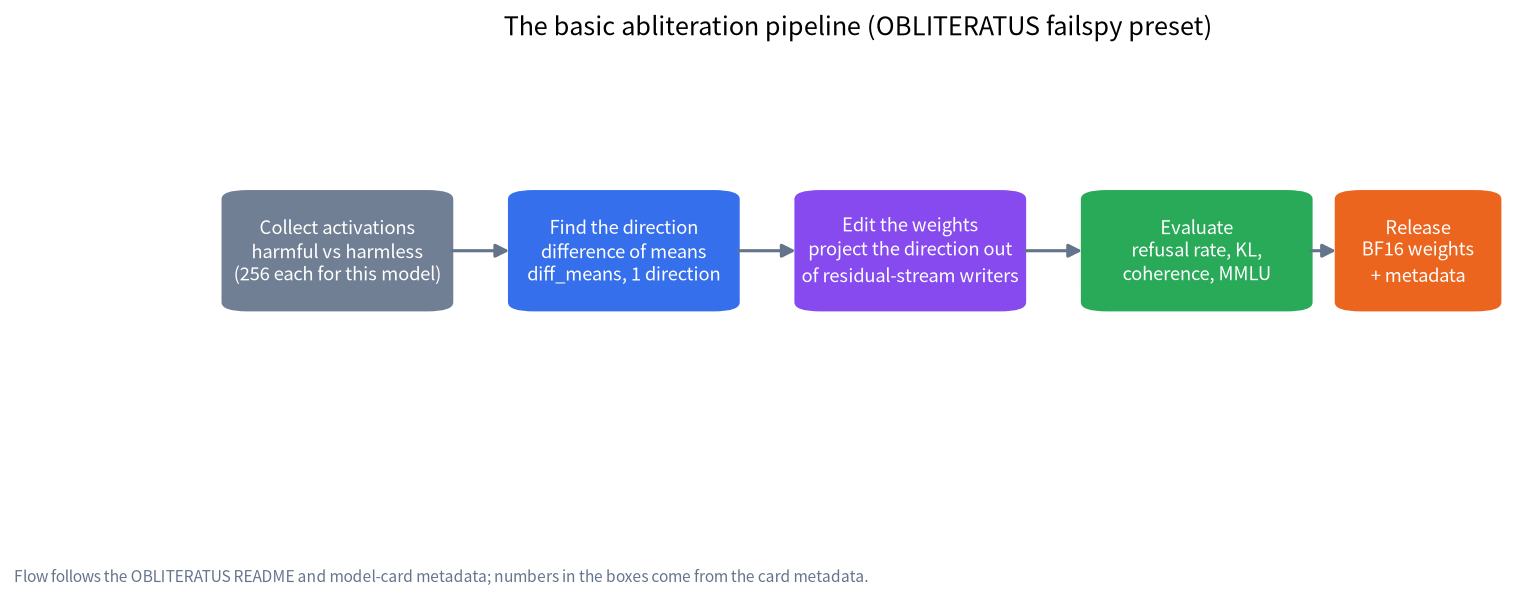
The OBLITERATUS README splits the process into six stages, SUMMON, PROBE, DISTILL, EXCISE, VERIFY and REBIRTH: load the model, gather activations, extract directions, edit weights, verify perplexity and coherence, and save the model with full metadata. Condensed into five steps, it looks like this.
| Setting | Value in this release | What it means |
|---|---|---|
| Method preset | failspy | FailSpy-style difference in means, single direction |
| Direction extraction | diff_means, 1 direction | Simplest and easiest to explain |
| Layer selection | all layers except the first | Not just one or two layers |
| Norm preservation | off | No extra constraint on weight norms |
| KL budget | 0.5; measured 0.1305 nats | Exceeding the budget triggers rollback or correction |
| Prompt counts | 256 harmful and 256 harmless | Used to find the direction |
The README’s default preset (advanced) instead uses four SVD directions, norm preservation, bias projection and two passes, so it is heavier than the failspy preset. The point is that one tool offers presets of different strength, and a model card that names the preset is more informative than “made with tool X”.
KL Divergence: Quantifying How Much Changed
Kullback–Leibler divergence measures the gap between two probability distributions. Here, the same text is given to the original and to the modified model, and their next-token probability distributions are compared. Zero means identical; larger means a bigger change; the unit is nats. The model card states this is a sequence-token forward KL with a value of 0.1305. The metadata gives a first-token KL of 0.3767 against a budget of 0.5, marked as within budget.
Three cautions apply when reading KL. First, it measures distance from the original, not quality: two models can be close and both poor, or far apart with one better. Second, it depends on the test text, so values from different datasets are not comparable. Third, any modification pushes KL above zero, and removing refusals necessarily changes the probabilities of some answers, so what matters is what changed. Read it together with the refusal rate, the harm distribution and capability evaluations; the specific numbers for this model are in our evaluation analysis.
What Are the Side Effects?
From the model card and the paper, the following can be said with reasonable confidence.
- Capability is largely kept but not unchanged. This release differs by +0.12 points on 2,500 MMLU questions, which is not significant; the paper describes minimal effect on other capabilities.
- Refusal is not binary. In the same card, full refusals drop sharply while partial refusals rise, so behavior becomes a new mixture.
- Harm-related responses increase substantially. This is the intended outcome rather than a side effect, but the user must carry it.
- There may be more than one direction, and refusal can reappear. The OBLITERATUS README describes an “Ouroboros effect” in which refusal behavior can reassemble in nearby layers, and offers extra repair passes. We did not verify whether that holds for every model.
- Later quantization changes the weights again. Whether behavior survives low-bit quantization of an ablated model needs fresh evaluation; existing results cannot be assumed to carry over.
How It Compares With Other Ways to Reduce Refusals
| Method | Needs training | Changes weights | Stability | Main cost |
|---|---|---|---|---|
| Fine-tuning (SFT) | Yes, with data | Yes | Fairly stable | Data, compute, tuning; may change more behavior |
| Preference optimization (DPO etc.) | Yes, with preference pairs | Yes | Fairly stable | Also needs training; expensive for large models |
| Prompt jailbreaks | No | No | Unstable | Must be crafted each time; easily patched |
| Runtime activation steering | No | No | Depends on framework | Needs framework support; extra step at inference |
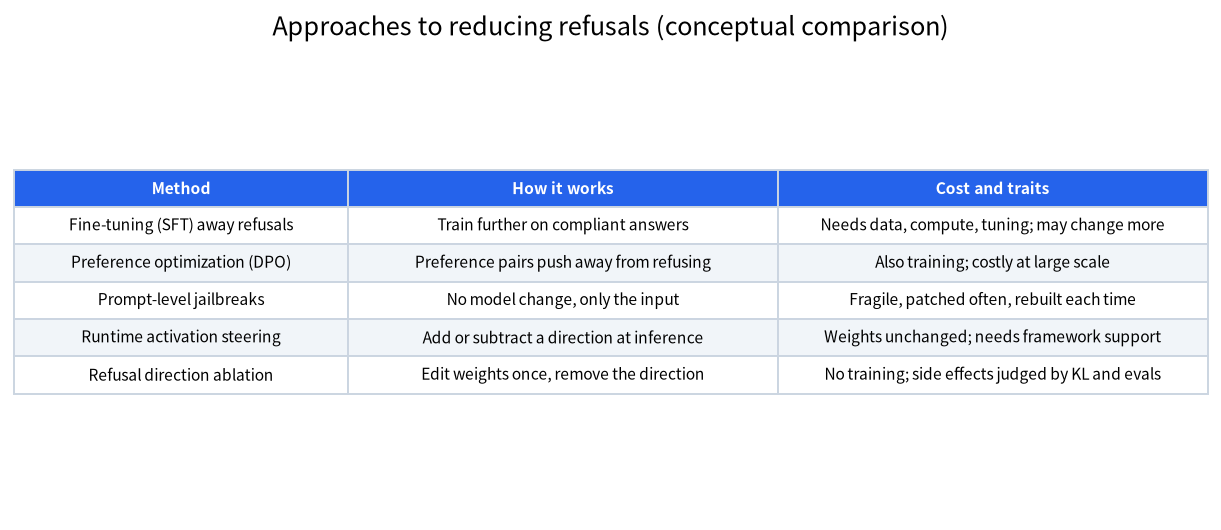
| Refusal direction ablation | No | Yes (one-off) | Fairly direct effect | Side effects found only by evaluation |
The main attraction is cost: no labeled data and no hundreds of GPUs for training, only the ability to run the model and read its activations. The price is that it is a blunt operation on a single behavior, and we cannot guarantee nothing else moved. It also changes the weights, which means a new set of weights is distributed, and provenance and integrity are the user’s problem to check.
How the Tools Compare
| Tool | Form | Emphasis in its README | Our view |
|---|---|---|---|
| FailSpy abliterator | Python library on TransformerLens | Activation caching, built-in refusal direction, notebook experiments | A pioneering lightweight implementation, closer to research notes |
| Heretic (p-e-w) | Training-free model modification tool | Suppresses refusals by default, can also reduce slop or sycophancy; claims thousands of community models | Highly automated and widely used; quality varies |
| OBLITERATUS | Open-source tool with presets, analysis and metadata | Seven presets, multiple directions, norm preservation, verification and full metadata | Writes evaluation into metadata, which makes it easier to check |
As for the many “abliterated” repositories on Hugging Face around the same base model, they use different methods, data and evaluations, most publish few details, and we audited none of them, so we do not rank them here. When choosing, look first for disclosed methods and evaluations, and for a publisher whose identity you can verify.
Understanding the Technique Responsibly
The research is valuable because it shows how brittle safety fine-tuning is: with open weights, one direction can be removed. For deployers the implication is direct. Do not treat the refusals shipped with an open model as a reliable line of defense; add a layer outside it. Common practice is to run a safety classifier such as Llama Guard on inputs and outputs, restrict tool permissions, keep logs, and add human review for high-risk scenarios.
The uses we consider defensible include red-teaming and safety research, reducing over-refusal in creative work such as fiction, and studying over-refusal itself. On risk, a model without refusals produces harmful content more easily and should not be exposed directly to the public. On compliance, the following is general information, not legal advice: in mainland China, providing generative AI services to the public means following the Interim Measures for the Management of Generative AI Services and related rules; in the EU, the AI Act sets obligations for general-purpose models; tool and weight licenses also differ (the model card lists the weights as MIT, and the OBLITERATUS tool as AGPL-3.0 with a commercial option). For memory requirements on your own machine, continue with our local deployment guide; for quantization basics see Q4_K_M quantization explained, and for reading leaderboards see how to read LLM benchmarks.
FAQ: Refusal Direction Ablation
Are refusal direction ablation and abliteration the same thing?
Essentially yes. Abliteration is the community name for the approach; both mean finding the refusal direction and removing it from activations or weights.
Why is refusal said to be mediated by a single direction?
It is an empirical finding by Arditi et al. on 13 open-source chat models of up to 72B parameters: erase the direction and the model stops refusing, add it and harmless prompts get refused. It is an empirical result, not a claim that every behavior depends on a single direction.
Is a smaller KL divergence always better?
A smaller value means the modified model is closer to the original, but that is not the same as better quality or no side effects. Read it with the refusal rate, capability evaluations and manual checks.
How is it different from fine-tuning or DPO?
Fine-tuning and DPO need data and training. Refusal direction ablation does no training and makes a one-off linear-algebra edit to the weights; it is cheap, but side effects are found only by evaluation afterwards.
Can an ablated model be quantized afterwards?
It can be, but quantization changes the weights again and behavior may shift, so it needs re-evaluation. We have not seen a public evaluation of this model’s behavior after quantization.
Is the technique legal?
The principle is published research; legality depends on your use, region and whether you serve the public. Consult a professional and add your own guardrails for production.
Talk With Us
Want to discuss model safety, evaluation or local deployment? Join the community or email admin@microaione.com.
References: Arditi et al., Refusal in Language Models Is Mediated by a Single Direction, Labonne: Uncensor any LLM with abliteration, FailSpy abliterator, Heretic, OBLITERATUS. Data read on 2026-11-01.
Further reading: Refusal rate benchmarks explained; Legal and compliance risks of uncensored models