Seedance 2.5 vs Wan 3.0 and MiniMax H3: Is It the Best Closed Video Model?
ByteDance’s Seedance 2.5 is often called “the best closed video generation model”. Here is what we could verify. On the Artificial Analysis text-to-video leaderboard (v2.1) it scores an Elo of 1157, which ranks fourth, with a rank range of 2 to 7 once uncertainty is counted, so it is not first; and among the top five it has the highest price per minute. That does not make it a bad model: it has its own strengths in multi-reference input and synchronized audio. This article uses the leaderboard, prices and our own cost arithmetic to compare Seedance 2.5 with Wan 3.0, MiniMax H3, FLUX 3 Max and Veo 3.1, and then answers the local reader’s question: a closed video model cannot run locally, so how good are the open-weights alternatives?
Verification note: Leaderboard figures and prices were read from the Artificial Analysis text-to-video board on 2026-11-01. Seedance 2.5’s API pricing comes from a third-party summary by CellCog (updated 2026-10-23; CellCog sells competing services, so check BytePlus’s own page; when we tried to load the official page it returned a server error). We have not generated sample clips ourselves and give no subjective quality scores; cost figures are our arithmetic on public unit prices.
Key takeaways (Updated 2026-11-01)
- Artificial Analysis text-to-video board: Wan 3.0 scores 1175, Utopai X 1166 (no API), MiniMax H3 (768p) 1161 and Seedance 2.5 1157, fourth place.
Prices differ widely: per minute, Artificial Analysis lists Seedance 2.5 at $34.12, Wan 3.0 at $12 and MiniMax H3 at $4.80; by our arithmetic a 10-second clip costs about $5.69 on Seedance 2.5 at 1080p and about $0.80 on H3.
The open-weights MiniMax H3 is the strongest open model on the board, but its license has territorial limits; see our H3 local deployment article.
The Short Answer: Where Does Seedance 2.5 Rank?
On the Artificial Analysis text-to-video board (v2.1), Seedance 2.5 scores 1157 (±14), with a rank range of 2 to 7, currently fourth. The board also lists prices and release dates; the table collects the leading models.
| Model | Elo | Price per minute (USD) | Note |
|---|---|---|---|
| Wan 3.0 | 1175 | 12.00 | First |
| Utopai X | 1166 | No API | Second |
| MiniMax H3 (768p) | 1161 | 4.80 | Open weights, July 2026 |
| Dreamina Seedance 2.5 | 1157 | 34.12 | July 2026, rank range 2–7 |
| FLUX 3 Max | 1157 | 4.35 | Same score |
| HeyGen Video 1 | 1156 | 2.40 | Cheapest top-tier option |
| MiniMax H3 Max | 1149 | 9.60 | Higher-spec H3 |
| Seedance 2.0 | 1136 | 22.45 | Previous generation |
| Veo 3.1 | 962 | 24.00 | Google, far behind on this board |
| Kling 3.0 1080p | 1000 | 10.08 | The board’s anchor (1000 points) |
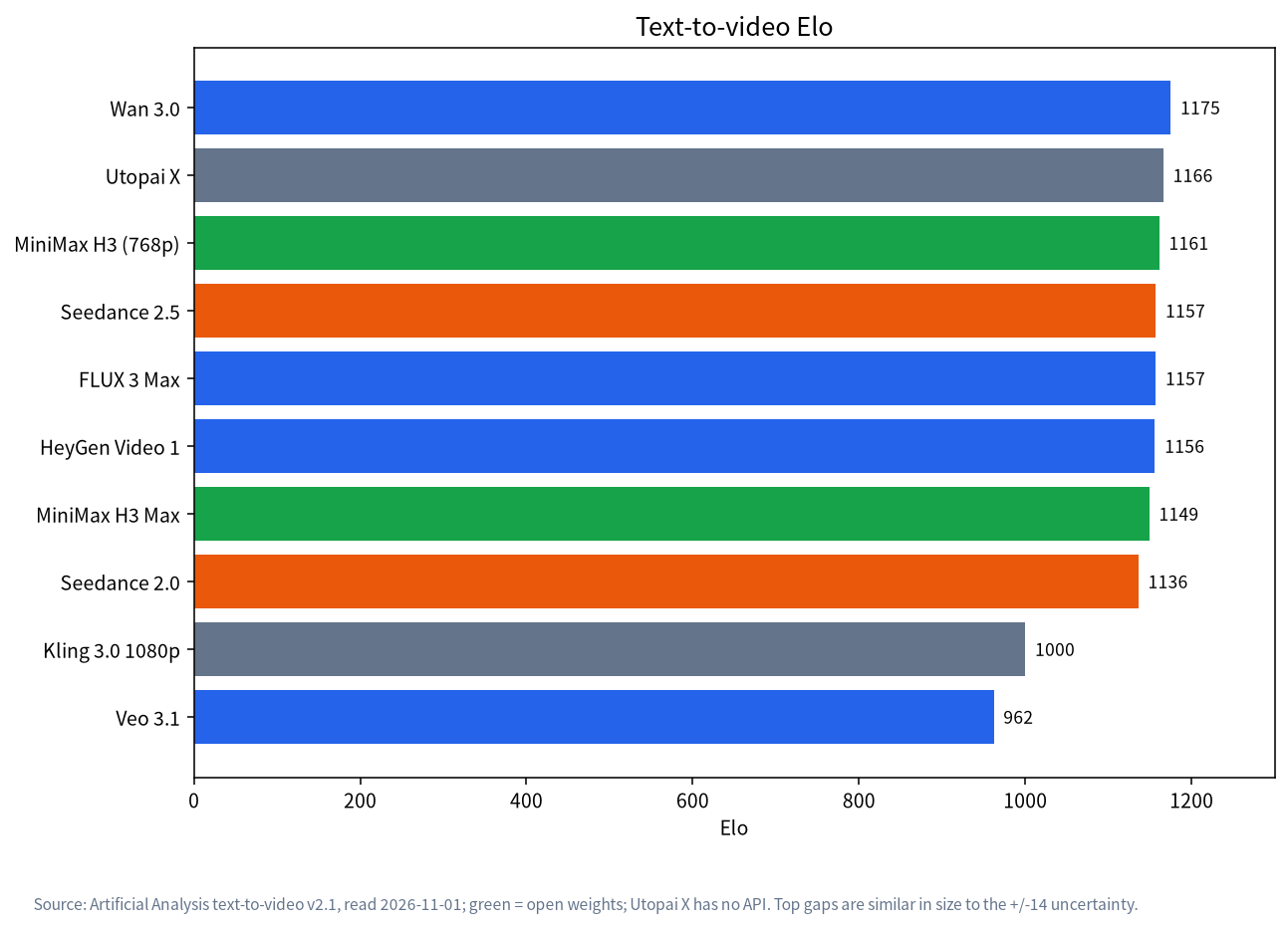
A word of caution: Elo comes from votes in pairwise blind comparisons, and the gaps between the top places (1175 versus 1157) are about the same size as the ±14 uncertainty, so “fourth” and “second” may not be statistically separable, which is why the board itself gives a range of 2 to 7. On the silent-video board Seedance 2.5 was not among the leaders we recorded (HeyGen 1143, H3 Max 1140, FLUX 3 Max 1135, Wan 3.0 1133); if you want finished clips with sound, that board matters less and you should listen for yourself. For how to read blind-vote boards, see our benchmark reading guide.
Price: Why Seedance 2.5 Is the Most Expensive
The board’s prices are per minute of video. Put on one chart, the plain conclusion is that Seedance 2.5 costs more than seven times as much as H3.
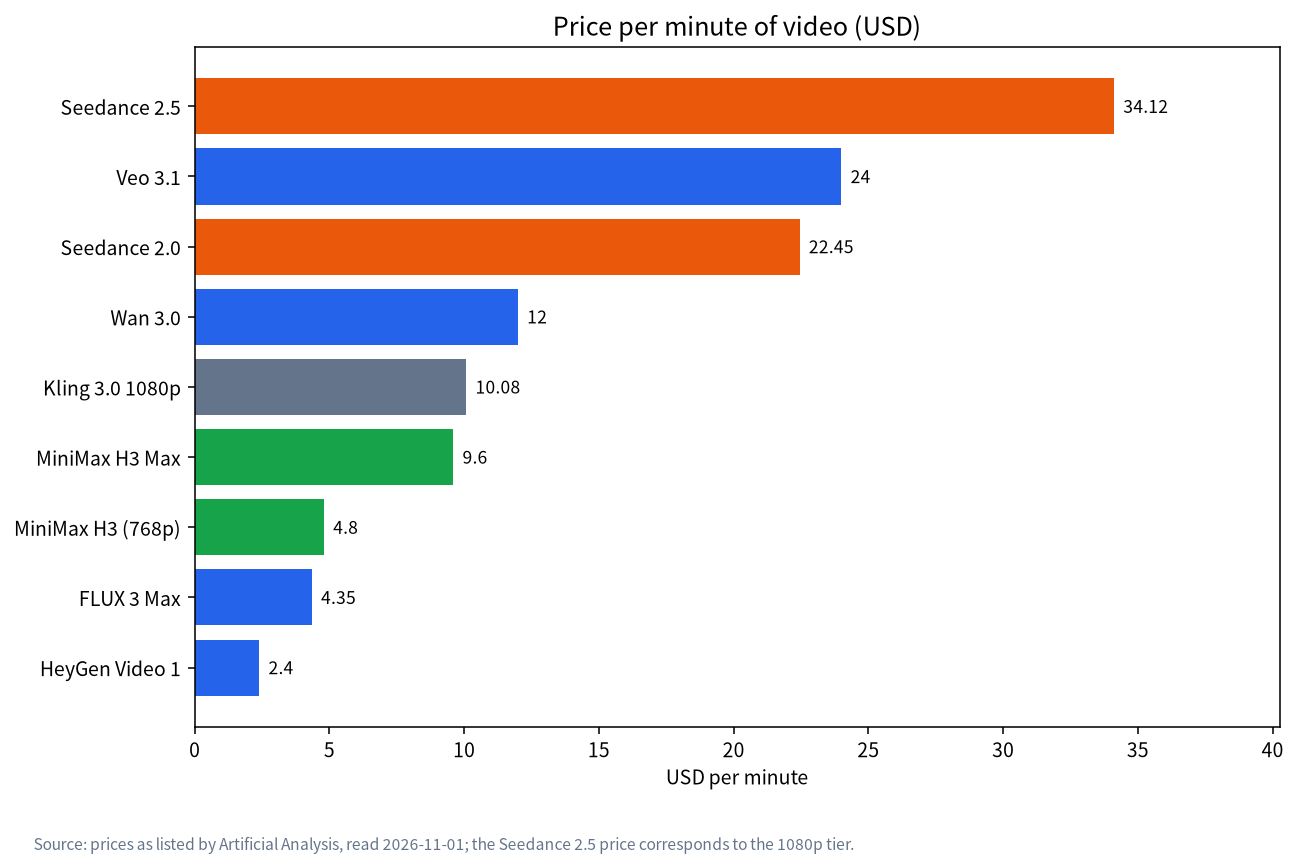
The board’s figure reflects the 1080p tier, though. According to CellCog’s summary of BytePlus ModelArk pricing (third-party; defer to the official page), 480p and 720p cost $10.70 per million tokens, about $0.103 and $0.231 per second, and 1080p costs $11.70 per million tokens, about $0.569 per second, which matches the board’s $34.12 per minute (0.569 x 60). When reference video is included in the input, the rate drops to $6.40 and $7.00 per million tokens, counting input and output tokens together. The same article says clips run 4 to 30 seconds at 24 frames per second with audio, accept up to 50 reference assets (30 images, 10 videos, 10 audio clips), that BytePlus’s official channel is not sold in the US, Canada, UK, Australia or New Zealand, and that the native 4K announced on 2026-10-23 is limited to selected enterprise customers while resellers’ 1440p and 4K tiers are upscales.
What One 10-Second Clip Costs
Our arithmetic follows (unit prices from above, clip length 10 seconds; Seedance uses BytePlus per-second rates, the others use the board’s per-minute price divided by six):
| Model and tier | Price per second | Cost of a 10-second clip |
|---|---|---|
| Seedance 2.5, 480p | about $0.103 | about $1.03 |
| Seedance 2.5, 720p | about $0.231 | about $2.31 |
| Seedance 2.5, 1080p | about $0.569 | about $5.69 |
| Wan 3.0 | $0.20 | $2.00 |
| MiniMax H3 (768p) | $0.08 | $0.80 |
| FLUX 3 Max | about $0.0725 | about $0.73 |
| HeyGen Video 1 | $0.04 | $0.40 |
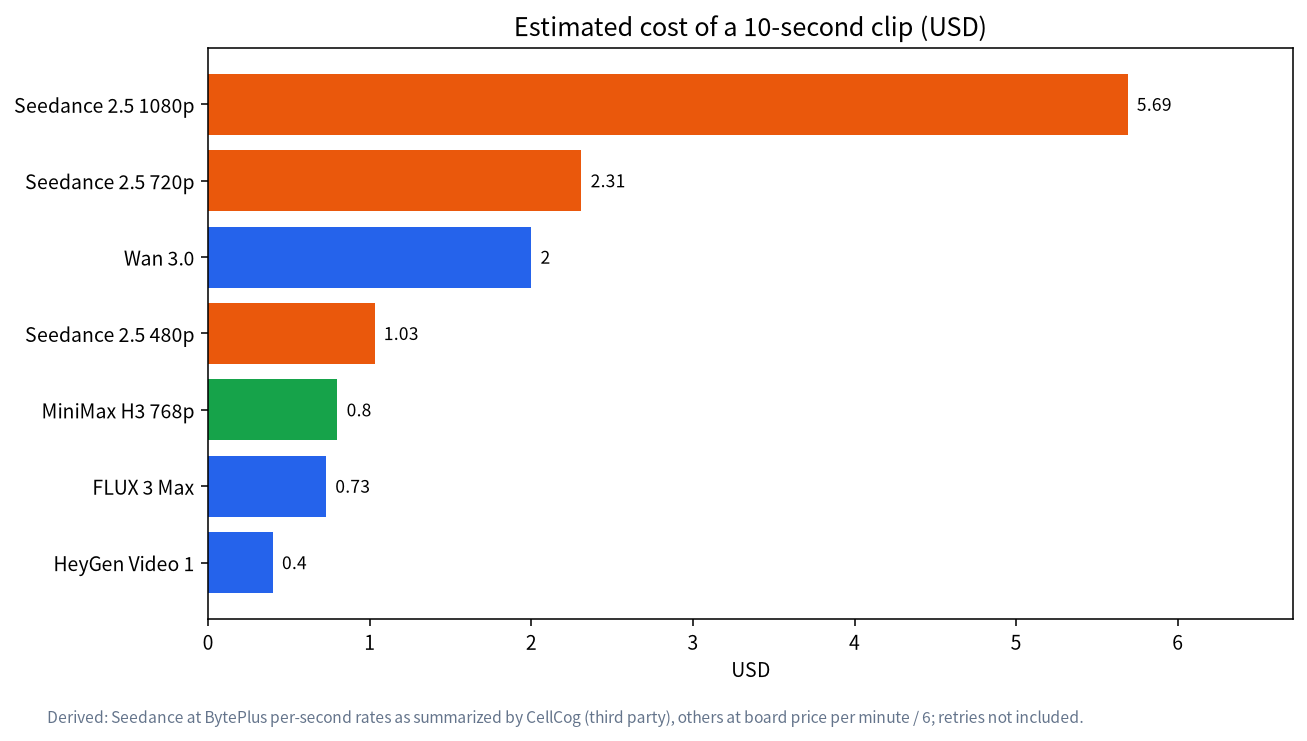
The more important concept is cost per usable clip. Video generation rarely works on the first try. Suppose (an assumption, not a measurement) you need three generations on average to get one usable clip: the cost per usable clip is then three times the single-run price, about $17.07 for Seedance 2.5 at 1080p and about $2.40 for H3. If Seedance’s usable rate were clearly higher than H3’s, say one in 1.5, the gap would shrink. The number to compare is therefore cost per usable clip, and that requires you to measure the usable rate on your own subject matter.
What 1157 Versus 1175 Means
Many people read Elo as “who is stronger”. Under the standard Elo conversion (our assumption: that Artificial Analysis’s scale converts like chess Elo; the board page does not publish the formula), score gaps map to a single-comparison win probability like this:
| Matchup | Gap | Implied single-vote win rate (derived) |
|---|---|---|
| Wan 3.0 over Seedance 2.5 | 18 | about 52.6% |
| MiniMax H3 over Seedance 2.5 | 4 | about 50.6% |
| Seedance 2.5 over Veo 3.1 | 195 | about 75% |
In other words, between first place and fourth the difference in one blind vote is only about 52.6% against 47.4%, which an ordinary viewer will hardly notice as a stable gap. What really separates them is price (more than sevenfold), how many reference assets you can use, whether you can buy it in your region, and your subject matter. Seedance 2.5 over Veo 3.1, by contrast, is a real gap, one of the few clear separations on the board.
Budget Example: 100 Usable 10-Second Clips
Keep the assumption of one usable clip per three generations (not a measurement). To get 100 usable clips you generate 300 times, or 3,000 seconds of video. At the unit prices above:
| Option | Cost of 3,000 seconds of video (derived) |
|---|---|
| Seedance 2.5, 1080p | about $1,707 |
| Seedance 2.5, 720p | about $693 |
| Wan 3.0 | $600 |
| MiniMax H3 (768p) | $240 |
This leaves out the time you spend picking clips and iterating prompts, and ignores whether you need 1080p at all. A practical approach is low first, high later: explore shots on a cheap tier (Seedance at 480p or 720p, or H3), lock the framing and action, and only regenerate the approved shots on the expensive tier. You keep the final quality and keep the cost of trial and error low.
Choosing by Need: Who Suits What
This table is our synthesis of the board, prices and known capabilities, not a measured verdict.
| Your need | Model to try first | Why |
|---|---|---|
| The best overall preference score on the board | Wan 3.0 | Elo 1175 at $12 per minute, not a high price either |
| Many reference images, videos or audio clips to keep characters consistent | Seedance 2.5 | The third-party summary lists up to 50 reference assets including audio, but it is the most expensive |
| Tight budget, lots of shot exploration | MiniMax H3 or HeyGen Video 1 | $4.80 and $2.40 per minute, both with Elo around 1160 |
| Data cannot go to the cloud, you want to control deployment | MiniMax H3 (open weights) | The strongest open model on the board, but mind the license and hardware demands |
| Finished clips with dialogue | Check the with-audio board and listen yourself | Rankings on the silent board do not predict with-audio results |
One point deserves emphasis: a leaderboard is only a tool for narrowing candidates. Your subject matter (product shots, dialogue, landscapes, animation styles) will reorder things, and the same model behaves differently across prompts. Running the blind test above, even with only 10 prompts and three colleagues, tells you more about your real situation than any board can.
For Local Readers
Seedance 2.5 is available only through APIs and cloud platforms; there are no open weights, so it cannot run locally. Among local alternatives, the strongest on the board is MiniMax H3 (768p) at Elo 1161, listed as open weights; the other open-weights models on the board are LTX-2.5 Fast and LTX-2.5 Pro at 947 and 944, far behind H3. H3’s license has territorial limits, the open release lacks some features, and the hardware demand is high; details are in our MiniMax H3 local deployment article. To understand how VRAM scales for local video and image models, start with ComfyUI hardware requirements and the GPU VRAM guide; for workstation-class cards, see the RTX PRO 6000 workstation article. Whether building your own pays off is the same question as for text models: compare usage and compliance needs in local versus cloud API.
Test It Yourself: A Blind Video Comparison
We have not generated sample clips, so we do not rate image quality. You can run a small blind test:
- Prepare 10 prompts: 2 character close-ups, 2 with large motion (running, flowing water), 2 with on-screen text, 2 multi-shot narratives, 2 needing dialogue or sound effects.
- Fix the settings: same duration (for example 8 seconds), same resolution tier, same aspect ratio, three generations per prompt per model.
- Shuffle anonymously and let three colleagues pick the better clip in pairs; record win rates.
- Log three numbers: usable rate (share you could ship), waiting time per generation and actual spend.
- Compute cost per usable clip = total spend divided by number of usable clips.
Shot: <subject and action>, <setting and lighting>, <camera move, e.g. slow push-in>.
Duration 8 seconds, 24 fps, 16:9.
On-screen text: "<text to show>".
Sound: <ambience or dialogue>.
Common Mistakes
- Reading “fourth” as “worst”, or “most expensive” as “best”. Elo gaps are about the size of the uncertainty, and price is not quality.
- Comparing prices across resolution tiers. Seedance 2.5 at 720p and 1080p differ by about 2.5 times.
- Looking only at the price per run. Cost per usable clip is what counts, so measure the usable rate first.
- Ignoring regional availability. BytePlus’s official channel is not sold in some countries, and resellers differ in price and specification.
- Treating a reseller’s 4K as native 4K. Those tiers may be upscales.
Related Reading
- MiniMax H3 locally: the best open video model?
- ComfyUI hardware requirements
- GPU VRAM guide
- Local deployment vs cloud API
- How to read benchmark leaderboards
FAQ: Seedance 2.5
Is Seedance 2.5 the best closed video generation model?
On the Artificial Analysis text-to-video board it is fourth (Elo 1157) with a rank range of 2 to 7; Wan 3.0 leads at 1175. It has the highest price per minute among the leaders.
How much does Seedance 2.5 cost?
Per third-party summaries of BytePlus pricing, about $0.103 and $0.231 per second at 480p and 720p and about $0.569 per second at 1080p; Artificial Analysis lists $34.12 per minute. Defer to the official page.
Can Seedance 2.5 run locally?
No, there are no open weights. For local use consider open-weights models such as MiniMax H3, which have higher hardware and license requirements.
Is Seedance 2.5 better than Wan 3.0?
On the board Wan 3.0 scores higher (1175 against 1157) and costs far less ($12 against $34.12 per minute), but Seedance 2.5 accepts up to 50 reference assets; which fits depends on your needs.
Why do video prices differ so much?
Resolution tier, audio, reference inputs and the sales channel all differ. Seedance 2.5 at 720p versus 1080p alone differs by about 2.5 times.
Can I use Seedance 2.5 everywhere?
BytePlus’s official channel is not sold in the US, Canada, UK, Australia or New Zealand according to the third-party summary we read; we did not verify availability elsewhere, so check the official terms.
Talk With Us
Comparing video generation options, or wondering if a workstation pays off? Join the community or email admin@microaione.com.
References: Artificial Analysis text-to-video leaderboard, CellCog: Seedance 2.5 pricing summary (third party), MiniMax: H3 local deployment guide.