
Suno v6 Review: The Best Music Generation Model? Versus Mureka, Lyria and Local ACE-Step 1.5
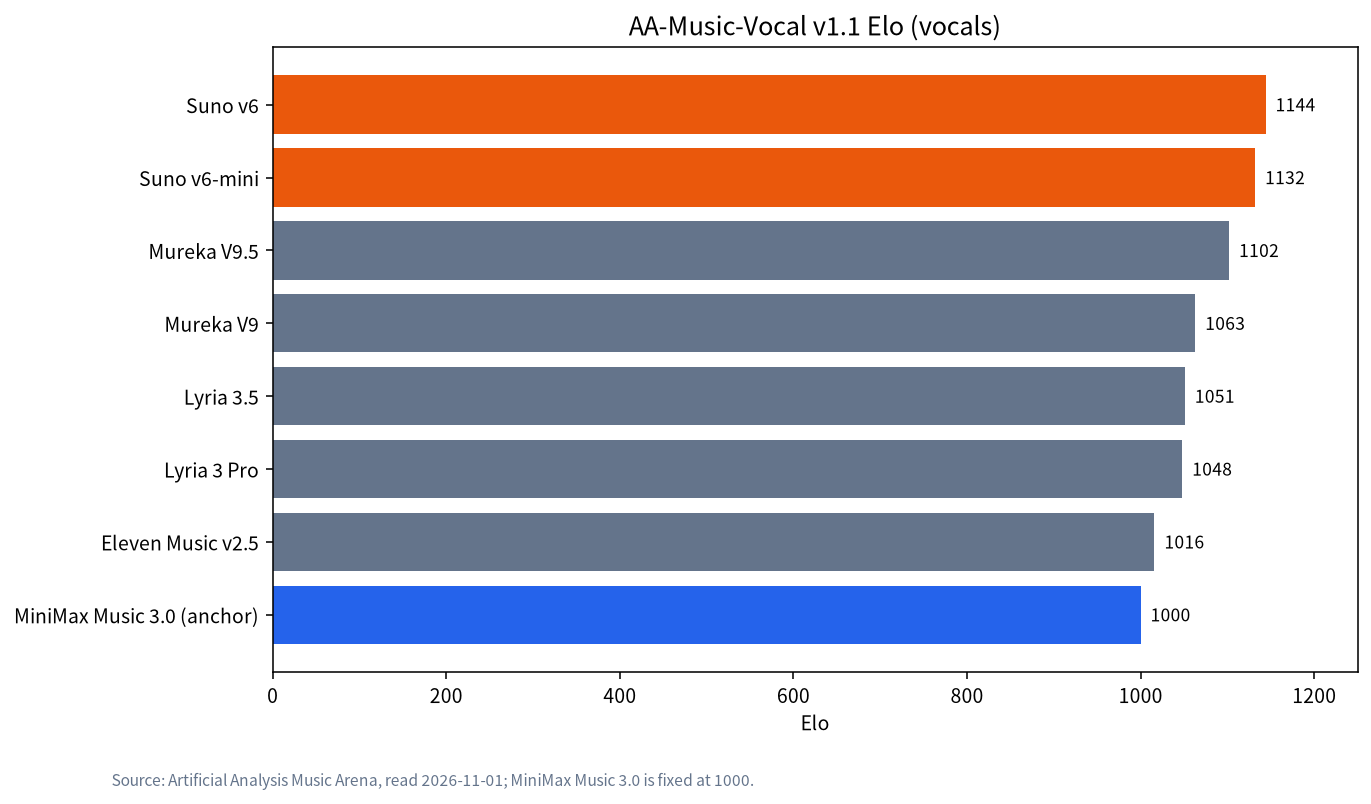
Suno v6 launched on September 9, 2026 as Suno’s flagship music generation model and its first made with record-industry support. For the claim that it is the best music generation model, this time the evidence is fairly solid: on the Artificial Analysis Music Arena (an Elo board built from blind listening votes) Suno v6 scores 1144 on the vocal track and 1148 on the instrumental track, first on both. One addition: on the vocal track the confidence interval of first place overlaps with second place (its own v6-mini, 1132), and the board lists their rank as 1 to 2. More important for local readers, Suno v6 is available only through the cloud and cannot be downloaded; the open option you can run on your own GPU is ACE-Step 1.5, but it is not on this board, so we cannot give a comparison on the same ruler.
Verification note: Elo, confidence intervals and sample counts were read from the Artificial Analysis Music Arena vocal and instrumental boards (both v1.1, 2026-11-01); Suno v6’s features come from Suno’s official release notes (2026-09-09), and training data and hands-on impressions from The Verge’s report; ACE-Step 1.5 details come from its Hugging Face model card and official GPU compatibility document, with speeds being vendor claims. We did not verify Suno’s dollar prices and cite only credit allowances from the official help pages; the win-rate conversion and the credit conversion are our derivations. We have not listened to or run these models ourselves.
Key takeaways (Updated 2026-11-01)
- AA Music Arena: vocal track Suno v6 1144±18, v6-mini 1132, Mureka V9.5 1102; instrumental track Suno v6 1148±22, v6-mini 1114, Mureka V9.5 1084.
Under the standard Elo formula, Suno v6’s expected win rate on the vocal track is about 56% against Mureka V9.5 and about 70% against MiniMax Music 3.0.
Local: ACE-Step 1.5 is MIT licensed, the vendor says it runs in under 4GB of VRAM and generates a full song in under 10 seconds on an RTX 3090; but it is not on the AA board.
The Short Answer: First on the Board, but Not a Landslide
Vocal track (AA-Music-Vocal v1.1, read 2026-11-01):
| Rank | Model | Elo | 95% interval | Samples |
|---|---|---|---|---|
| 1 | Suno v6 | 1144 | 1126 to 1162 | 3,037 |
| 2 | Suno v6-mini | 1132 | 1114 to 1150 | 3,151 |
| 3 | Mureka V9.5 | 1102 | 1084 to 1120 | 3,107 |
| 4 | Mureka V9 | 1063 | 1045 to 1081 | 3,097 |
| 5 | Lyria 3.5 | 1051 | 1033 to 1069 | 3,164 |
| 6 | Lyria 3 Pro | 1048 | 1030 to 1066 | 3,158 |
| 7 | Eleven Music v2.5 | 1016 | 998 to 1034 | 3,220 |
| 9 | MiniMax Music 3.0 | 1000 | Anchor | 3,299 |
Instrumental track (AA-Music-Instrumental v1.1):
| Rank | Model | Elo | 95% interval |
|---|---|---|---|
| 1 | Suno v6 | 1148 | 1126 to 1170 |
| 2 | Suno v6-mini | 1114 | 1093 to 1135 |
| 3 | Mureka V9.5 | 1084 | 1063 to 1105 |
| 5 | Lyria 3 Pro | 1080 | 1059 to 1101 |
| 7 | Eleven Music | 1021 | 1000 to 1042 |
| 8 | Stable Audio 3 Large | 1014 | 993 to 1035 |
| 13 | MiniMax Music 3.0 | 1000 | Anchor |
| 19 | MusicGen | 868 | 845 to 891 |
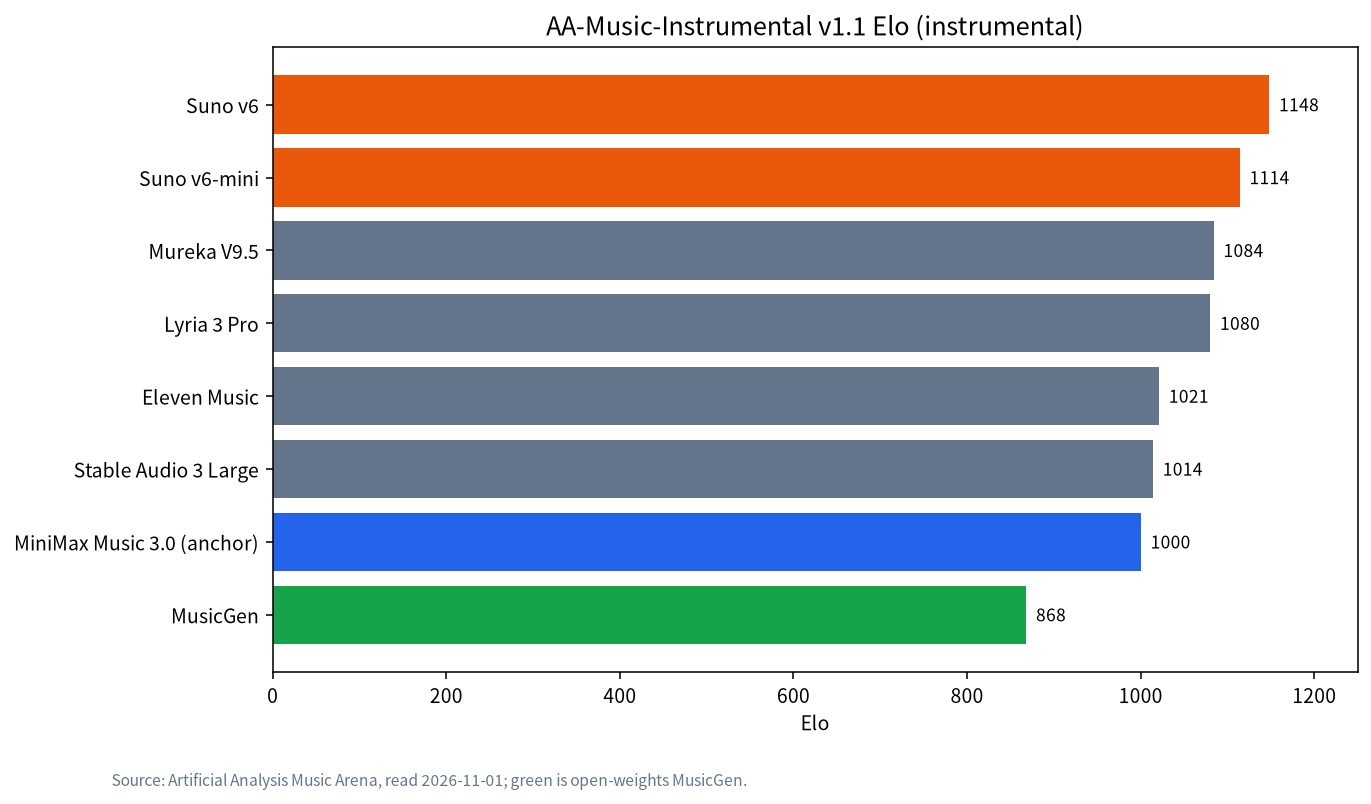
Note the “anchor”: MiniMax Music 3.0’s Elo is fixed at 1000 as the reference point of the board, so other models’ numbers are gaps relative to it, not absolute scores.
Turning Elo Gaps Into Win Rates
We assume the board uses the standard Elo scale (our assumption; the page does not state the conversion formula), so the expected win rate is 1 divided by 1 plus 10 to the power of minus the gap over 400. With the vocal track numbers:
| Opponent | Elo gap | Suno v6 expected win rate | Reading |
|---|---|---|---|
| Suno v6-mini | 12 | about 51.7% | Intervals overlap; practically indistinguishable |
| Mureka V9.5 | 42 | about 56.0% | Ahead, but listeners still prefer the other about four times in ten |
| Eleven Music v2.5 | 128 | about 67.6% | Clearly ahead |
| MiniMax Music 3.0 (anchor) | 144 | about 69.6% | About seven in ten |
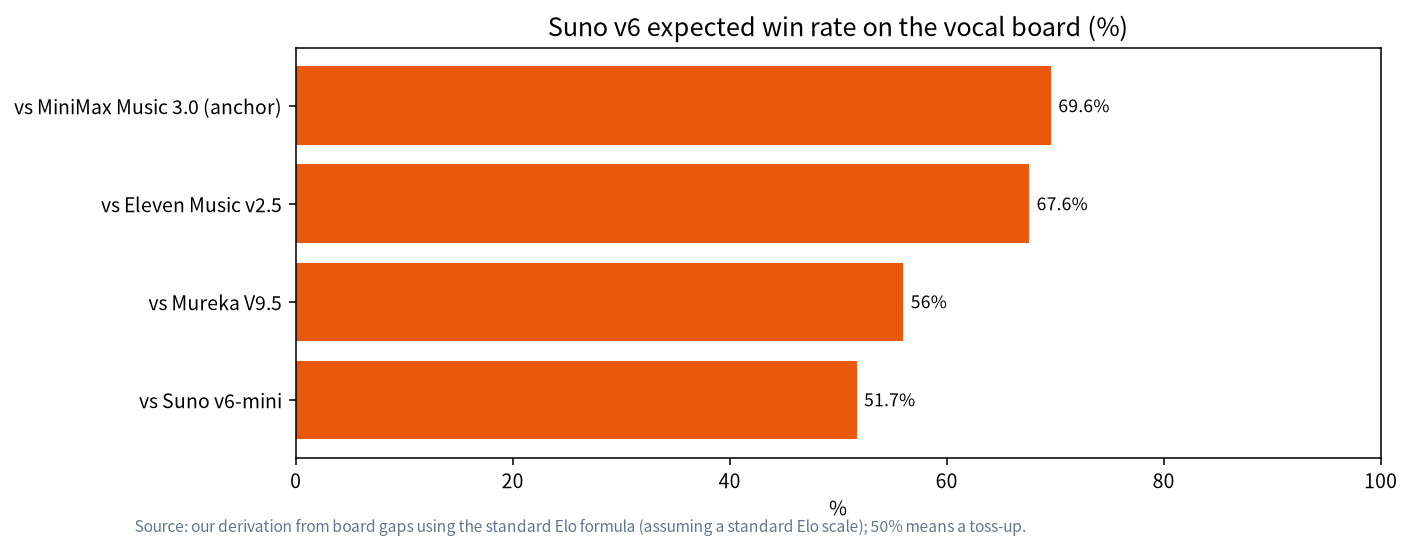
Two things follow. First, on the vocal track Suno v6 is essentially level with its own v6-mini, so the free v6-mini is a very strong entry point. Second, even against third-placed Mureka V9.5, around four in ten blind votes go the other way. “Best” is a statistical lead, not a claim that every song is better.
The Suno v6 Family: What Is Actually New
Per Suno’s release notes, the v6 family has three models: v6 is the flagship, reliable and precise; v6-wild is for exploration, less predictable and more varied; v6-mini is a faster, more resource-efficient version available to everyone, while v6 and v6-wild are for paid users only. New capabilities include editing one part of an existing song in plain language, mashing several sources together in one request, sampling and isolating to build a new beat, creating from a vibe or inspiration, using text, audio, images and video as input, and changing a single lyric without rebuilding the song. A Suno help page we read says a single generation can run up to about 8 minutes, but check the current official page for that.
The Verge’s hands-on report supplies the parts that deserve a sober look: v6 is “dramatically better” at understanding genre, but still cannot deliver “natural imperfections”, such as off-key or dissonant results, and the vocals show more of the harsh artifacts typical of AI models. The Verge also says the training data includes content licensed from Warner Music Group, BMG and Believe plus “user data”, and notes that it is unclear whether this means the training data is completely free of dubiously obtained content.
Credits and Cost: Credits Only, No Dollar Prices
A Suno help page we read (dated December 19, 2025, before v6 shipped, so it may have changed) says the free plan gives 50 credits a day, about 10 songs; Pro gives 2,500 credits a month; Premier gives 10,000 credits a month. Paid subscribers hold commercial rights to songs downloaded while subscribed (another help article, dated 2026-09-03). We did not verify dollar prices on an official page, so we do not state any; check Suno’s website.
Our derivation: if v6’s credit use matches the help page’s “50 credits is about 10 songs” (about 5 credits per song, an unverified assumption), Pro yields about 500 songs a month and Premier about 2,000. If v6 actually uses more credits, those figures shrink.
What You Can Run Locally: ACE-Step 1.5
| Item | Detail (source: ACE-Step 1.5 model card and official docs, vendor claims) |
|---|---|
| License | MIT; the project says commercial use is allowed, with users responsible for checking originality and protected styles |
| Training data | Stated as licensed music, royalty-free or public-domain music, and MIDI-synthesized audio |
| Speed | A full song in under 2 seconds on an A100 and under 10 seconds on an RTX 3090 |
| VRAM | Under 4GB (DiT-only mode); about 6GB with the 0.6B language model; the XL (4B) DiT weights take about 9GB and need 12GB (with offloading and quantization) to 20GB (without offloading) |
| Languages and length | 50+ languages, compositions up to about 10 minutes |
| Editing | Covers, repainting, vocal-to-accompaniment and more |
The official VRAM tier table shows that 4GB and below is tier 1 with no language model and a 4 to 6 minute maximum; 6 to 8GB can use the 0.6B language model; 20 to 24GB needs no offloading or quantization; and above 24GB all models work, with up to 10 minutes. That is friendly to readers with a 24GB card; see what 24GB of VRAM can run and RTX 5090, 4090 and 3090 compared. For more on GPU memory and generative models see ComfyUI hardware requirements.
The key point: ACE-Step 1.5 is not on the AA board. The open option on the board is MusicGen (instrumental 868), 280 points behind the leader, and under the same assumption the win-rate gap is lopsided. But MusicGen is an older model and cannot stand in for ACE-Step 1.5. So we cannot say how far ACE-Step 1.5 trails Suno v6; we can only say there is no comparable data, so listen for yourself.
An electricity estimate (our arithmetic, as a formula demonstration): at 350 watts and 10 seconds per song, a song uses about 0.00097 kWh (350 W times 10 s divided by 3,600 is 0.97 Wh), so electricity is practically negligible; the main cost of the local route is the GPU itself and your time tuning and choosing.
How to Choose
| Your need | Lean toward | Reason |
|---|---|---|
| The best finished output on the board, cloud is fine | Suno v6 | First on both AA Elo tracks |
| Want to try it free | Suno v6-mini | Available to all users, 1132 on the vocal track |
| Data and works must stay local | ACE-Step 1.5 | MIT, low VRAM requirement |
| Bulk generation of material | Local route | Near-zero marginal cost, but judge quality yourself |
| Commercial release | Paid Suno or a local model with a verified license | Check both commercial rights and training-data provenance |
Test It Yourself: A Blind-Listening Method
We have not listened to these models; below is a procedure you can follow directly, in the spirit of the AA arena.
- Prepare 20 prompts: covering pop, rap, folk, electronic, classical instrumental, Chinese and English lyrics, with the same text used on every model.
- Generate each prompt three times per model, with no cherry-picking; keep everything.
- Hide model names: rename files randomly and have someone else keep the key.
- Run pairwise blind listening with at least five listeners: ask only “which do you prefer”, without telling them which is which.
- Compute win rates: follow the Elo idea and report confidence intervals; more samples is more reliable.
- Check separately: whether lyrics are sung correctly, obvious vocal artifacts, whether the structure is complete, and any repetition or truncation.
- Check copyright risk: run each result through your publishing platform’s detection tool and keep generation records.
Common Mistakes
- Reading Elo first place as best on every song. First against third on the vocal track is only about a 56% win rate.
- Ignoring the anchor. 1000 is MiniMax Music 3.0’s reference point, not a perfect score.
- Treating v6-mini as the weak version. It scores 1132 on the vocal track, practically indistinguishable from v6.
- Treating Suno credits as prices. We did not verify dollar prices, and credit use may vary by model.
- Treating an open model that is not on the board as a bad model. ACE-Step 1.5 has no comparable data; it is simply unknown.
Related Reading
- ComfyUI hardware requirements
- What 24GB of VRAM can run
- RTX 5090, 4090 and 3090 compared
- Seedance 2.5 video generation comparison
- How to read model benchmarks
FAQ: Suno v6
Is Suno v6 the best music generation model?
On the AA Music Arena’s blind-listening Elo it is first on both the vocal (1144) and instrumental (1148) tracks. But on the vocal track its interval overlaps with v6-mini (1132).
Can Suno v6 run locally?
No, it is available only through Suno’s service. A local option is ACE-Step 1.5, but it is not on the AA board.
Is Suno v6 free?
v6-mini is open to all users; v6 and v6-wild are for paid users only. We did not verify dollar prices.
What GPU does ACE-Step 1.5 need?
The project says it runs in under 4GB of VRAM (DiT-only mode), needs about 6GB with the 0.6B language model, and the XL models need about 12 to 20GB.
Can the generated songs be used commercially?
Suno’s help page says paid subscribers hold commercial rights to songs downloaded while subscribed; ACE-Step 1.5 is MIT licensed and the project says commercial use is allowed. Check originality and applicable terms yourself in both cases.
Is v6’s training data legitimate?
The Verge reports that the data includes licensed content from Warner Music Group, BMG and Believe plus user data, and notes it is unclear whether there is no dubiously obtained content. We make no legal judgment.
Talk With Us
Trying local music generation? Join the community or email admin@microaione.com.
References: Artificial Analysis music vocal board, Artificial Analysis music instrumental board, Suno v6 release notes, The Verge: Suno v6, Hugging Face: ACE-Step 1.5, ACE-Step 1.5 GPU compatibility guide.