KnowLine-31B-Gen1 Review: The Best Decision Model? VRAM, Latency and Rivals
KnowLine-31B-Gen1 is a “decision model” released by PelaAI on 2026-10-24. It is not a chat model: you give it a state description and up to 64 typed questions (yes/no, choice, score), it makes one forward pass per question and outputs a probability distribution directly, with no text generation. On the full Decision Index 0.4.1 board it ties for first with GLiDE 1.2 and others; on the independent JevBench it is second on the open-weights board. “Best decision model” is supported, but by narrower evidence than the headline suggests: ties, self-submission and different rankings on different boards. This article separates those numbers and answers the three questions a local reader has: how much VRAM does it need, what do latency and cost look like, and how should you choose against similar models?
Verification note: Model facts were read from the Hugging Face model card (PelaAI/KnowLine-31B-Gen1) and the decisionmodels.io model page; independent evaluation comes from Benchmark Heaven’s JevBench (data published 2026-10-31); Decision Index data comes from the decision-index-leaderboard dataset on Hugging Face. Most numbers on the model card are the author’s own measurements, and we label them. We have not deployed or tested this model ourselves. The FP8 and 4-bit memory figures are our weight arithmetic from the parameter count, not measurements, and the author says he did not test FP8.
Key takeaways (Updated 2026-11-01)
- What it is: a 31B dense model, a LoRA fine-tune of google/gemma-4-31B-it, Apache-2.0 weights; one forward pass yields probabilities, no text generation.
Boards: Decision Index 0.4.1 full board 71.86, tied for first with GLiDE 1.2 (71.52) and others; JevBench open-weights board second with capability 85.2.
Hardware: about 63GB of BF16 weights, run by the author on a single 96GB H20; decisionmodels.io says serving takes about 75GB.
What It Is: A Decision Model, Not a Chat Model
The model card describes the input as a “state” plus up to 64 typed questions and the output as a probability distribution per question, one forward pass each, no text generated, served at /v1/systemone. The fit is tasks such as “should this action be taken”, “which of these options”, or “score this request” where you need calibrated probabilities, not essays or conversation. The author also describes training: a rank-32 LoRA on gemma-4-31B-it, merged, then averaged 0.75 fine-tuned weights with 0.25 base weights. Languages are English, Simplified Chinese and Traditional Chinese.
So you should not compare it for “smartness” against a general model like Claude Opus 5.5. Its rivals are other decision models. We found no reliable same-board comparison of decision models against general chat models, so we do not invent one.
The Boards: Tied First and Second Are Different Claims
| Board | KnowLine-31B-Gen1’s position | Context to know |
|---|---|---|
| Decision Index 0.4.1 full board | 71.86, tied for first | In the same tie band as GLiDE 1.2 (71.52) and Sieve 31B v3 (71.10); the board is submission-based |
| Decision Index public suite | 70.13, rank 11 | Not first on the public suite |
| Same-skills and new-domains subscores | Same skills 66.94, new domains 79.24 | Higher on new domains, suggesting it holds up in unseen domains |
| JevBench open-weights board | Second, capability 85.2 | Level with baselabs’ mammoth-1 at 85.2; capability is the average of intelligence and calibration |
The JevBench page also shows an “official” rank (83rd, composite 60.2). We found no definition of that composite, so we do not interpret it and simply record it.
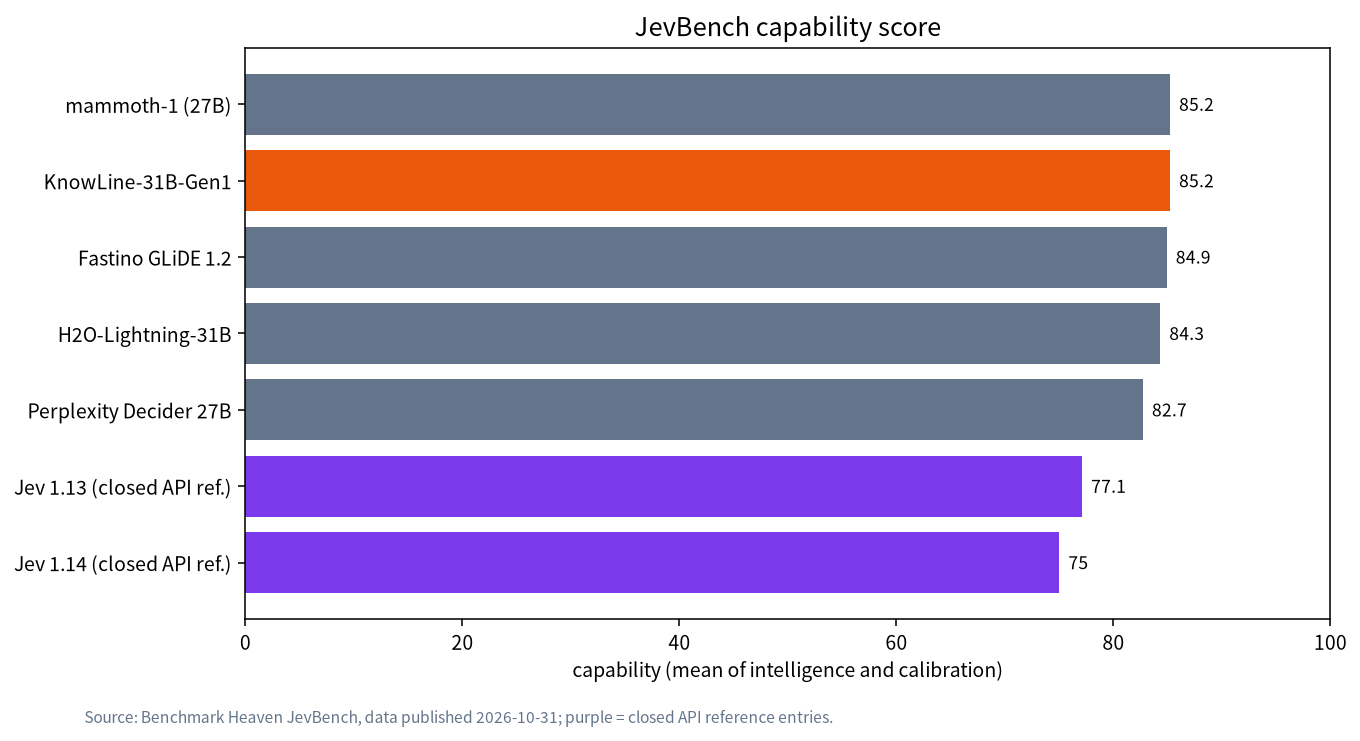
Other models on the JevBench capability board: mammoth-1 (27B, based on Qwen3.5-27B) 85.2; KnowLine-31B-Gen1 85.2; Fastino GLiDE 1.2 84.9; H2O-Lightning-31B 84.3 (FP8, p50 latency 0.065 s, and the highest intelligence score at 79.3); Perplexity Decider 27B 82.7; and the closed API reference entries Jev 1.13 and 1.14 at 77.1 and 75.0. In short, KnowLine ties mammoth-1 on capability, but its estimated cost per 1,000 decisions, about $0.061, is higher than mammoth-1 ($0.027) and GLiDE ($0.025). “Best” depends on what you value: when capability is level, a smaller and cheaper model can be the better fit.
Hardware: VRAM, Latency and Cost
| Item | Data | Source |
|---|---|---|
| Weight size | About 62.5GB in 13 shards, about 63GB in BF16 | Author (model card) |
| Author’s environment | One 96GB H20, SGLang 0.5.21, BF16 | Author (model card) |
| Serving memory | About 75GB (BF16) | decisionmodels.io |
| Independent test hardware | One 96GB RTX PRO 6000 | JevBench |
| FP8 | Not tested by the author | Author (model card) |
| Prompt overhead | “Read twice” serving makes prompt tokens about 1.54 times | Author (model card) |
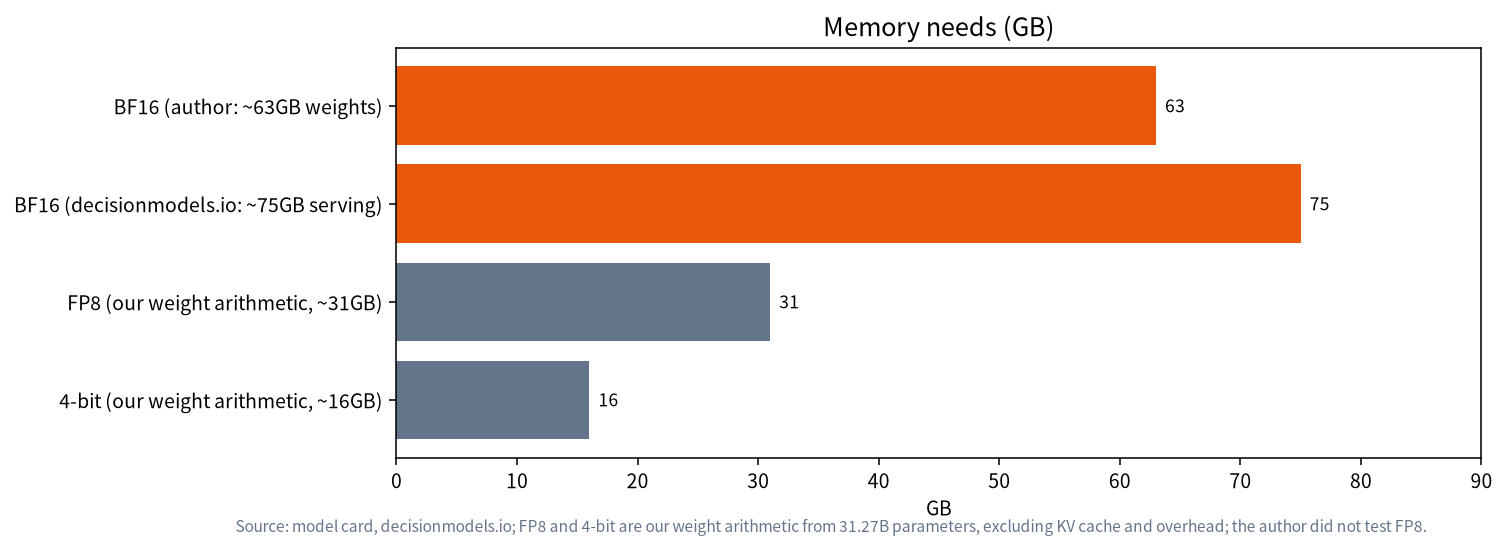
Our weight arithmetic (excluding KV cache and runtime overhead, not measured): 31.27B parameters in BF16 is about 62.5GB; FP8 would be about 31GB and 4-bit about 16GB. So a 24GB card could in theory hold 4-bit weights, but the author has not validated calibration or prompt-injection behavior after quantization, and a decision model’s value is calibration, so we would not quantize without your own evaluation. For the general effect of quantization read quantization formats explained; for 96GB workstation cards read RTX PRO 6000 workstation.
Latency has three sources with different hardware and load:
| Source | Hardware | Median latency | p95 latency |
|---|---|---|---|
| Author (model card) | One 96GB H20 | 340 ms (mean 910 ms) | 3,977 ms |
| Decision Index board | Board environment | 203.7 ms | 1,822 ms |
| JevBench | One 96GB RTX PRO 6000 | 255 ms | 469 ms |
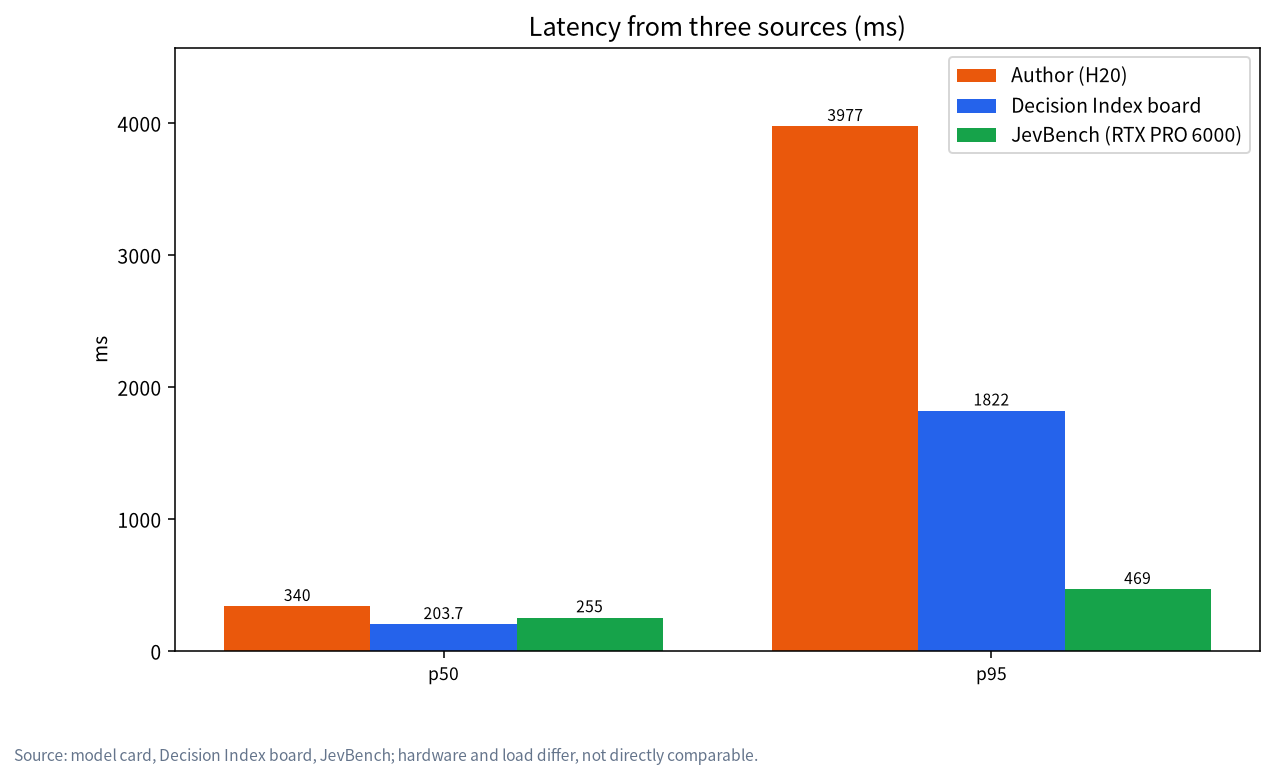
The tail latency differs by nearly an order of magnitude because load, batch size and question count differ. For online decisions, measure p95 on your own request mix rather than adopting any one source’s number. JevBench estimates cost at about $0.061 per 1,000 decisions; at that figure a million decisions would cost about $61, which is only an order-of-magnitude guide.
What Decision Models Are Good For
Think of a decision model as a calibrated classifier. Typical jobs are ticket triage (escalate, handle automatically or reject), risk scoring (fraud risk from 1 to 5), a gate in an agent that decides “should this tool call run”, and the choice of which element to click in web automation. The Mind2Web element-selection evaluations on the model card belong in this family. What they share is a finite set of answers and a need for trustworthy probabilities rather than a polished explanation. If you need an explanation, have a chat model write it separately and let the decision model supply the probability.
A useful pattern is two-stage: let a small local model or rules do the coarse filter, send uncertain cases to KnowLine for scoring, then send the ones whose probability lands in the middle band to a human. That controls cost and turns calibration into a real routing signal. To wire it into your own service see building a local LLM API server.
Three Ways to Get It
| Route | Description | Who it suits |
|---|---|---|
| Download the weights and run locally | Weights are on Hugging Face under Apache-2.0; the author runs SGLang 0.5.21 on one 96GB H20 | Teams with a 96GB-class GPU that care about data retention |
| Hosted dedicated endpoint | decisionmodels.io offers dedicated GPU endpoints, a pay-per-token hosted API, local install and pre-installed hardware | Anyone who wants to try it first or has no large-VRAM card |
| Corporate intranet deployment | Plan permissions and audit along the lines of enterprise private deployment | Companies with compliance requirements |
One clarification: the installer pricing mentioned on the decisionmodels.io page (free for individuals and companies with up to 10 employees and up to $1M ARR; larger companies pay $1,000 once plus $100 per month) refers to its installer tool, not to the model weights; for the weights’ license defer to the model card.
What “Read Twice” Means for Cost
The model card says serving uses a “read twice” approach that makes prompt tokens about 1.54 times as many. This is easy to miss in cost estimates: if your state description is 1,500 tokens, that factor means roughly 2,310 tokens of forward computation (our arithmetic). Because the output generates no text, there is no token-by-token decoding, and cost is dominated by the prompt forward pass. The lesson is that longer states and more questions scale latency and cost close to linearly, so trim irrelevant context when designing prompts.
The Weakness to Plan For: Prompt Injection
The model card discloses a weakness itself: in prompt-injection tests, 0.4% of answers changed on seen templates and 5.3% on unseen templates, which the author says is worse than sibling models. For decision scenarios that process untrusted input, such as user text that smuggles in instructions, retest with your own adversarial cases before launch. On calibration, the author reports an ECE of 0.012–0.021 on the public suite (self-measured).
Choosing: KnowLine or Its Peers
| Your situation | Lean toward | Reason |
|---|---|---|
| You have a 96GB-class GPU and want to be near the top of both boards | KnowLine-31B-Gen1 | Tied first on Decision Index, second on JevBench |
| You care about per-decision cost and latency | mammoth-1, GLiDE 1.2 or H2O-Lightning | Similar capability on the board, lower estimated cost or shorter latency |
| You only have a 24GB card | A smaller peer first, or validate quantization yourself | 31B in BF16 exceeds a 24GB card |
| You need Chinese-language decisions | KnowLine (Simplified and Traditional Chinese) | We did not verify other models’ language support |
| Inputs may contain hostile text | Retest prompt injection first | The author discloses 5.3% on unseen templates |
Test It Yourself: Evaluation Method
- Prepare 200 decision examples from your domain, each with a clear ground-truth answer and an edge-case variant.
- Run the same set through three models: KnowLine, a smaller peer, and whatever you use today.
- Record accuracy and calibration: bin predicted probabilities into 10 buckets, plot a reliability curve and compute ECE.
- Run an injection test: embed instruction text in 20 examples and count how often the answer changes.
- Stress latency: use your real concurrency and question counts and record p50 and p95.
- Record cost per decision: GPU rental or depreciation plus electricity, divided by decisions made.
State: a user submitted a refund request, order value 89, delivered 3 days ago, 0 prior refunds.
Question 1 (yes/no): should the refund be approved automatically?
Question 2 (score 1-5): how high is the fraud risk of this request?
Question 3 (choice): escalate to a human, approve automatically or reject?
Common Mistakes
- Treating it as a chat model. It generates no text, and its interface differs completely.
- Reading “tied first” as “wins”. 71.86 and 71.52 sit in the same tie band.
- Ignoring that the board is submission-based. Self-measured numbers need independent reproduction.
- Capacity planning from the author’s latency. The three sources differ widely.
- Quantizing without retesting calibration. A decision model lives on probability quality.
Related Reading
- RTX PRO 6000 workstation
- vLLM and SGLang introduction
- GPU VRAM guide
- Quantization formats explained
- How to read model benchmarks
FAQ: KnowLine-31B-Gen1
What is KnowLine-31B-Gen1?
A 31B dense decision model based on gemma-4-31B-it that outputs probability distributions for typed questions, one forward pass per question, with no text generation.
Is it really the best decision model?
It ties for first on the full Decision Index 0.4.1 board (71.86) with GLiDE 1.2 and others, and is second on the JevBench open-weights board (capability 85.2, level with mammoth-1). On the public suite it ranks 11th.
How much VRAM does it need?
The author runs BF16 on a 96GB H20 with about 63GB of weights; decisionmodels.io says serving needs about 75GB. The author has not tested FP8.
Can it run on a 24GB GPU?
Not in BF16. By our arithmetic 4-bit weights are about 16GB, but quality after quantization is unvalidated, so we do not recommend adopting it directly.
What is the license?
The model page states Apache-2.0 weights and MIT code; defer to the model card.
Can it replace a chat model?
No. It only produces probabilities for typed questions and generates no text.
Talk With Us
Evaluating a local decision model? Join the community or email admin@microaione.com.
References: Hugging Face: PelaAI/KnowLine-31B-Gen1, decisionmodels.io model page, Benchmark Heaven: JevBench page, Decision Index leaderboard dataset.