DeepSeek Local Deployment Cost: From ¥8,000 to ¥1M, Three Routes and the Break-Even Against the API
Ask what the DeepSeek local deployment cost is and the answers differ by a factor of a hundred: one person says an ¥8,000 PC is enough, another says an enterprise appliance costs over a million. Both can be right because they are not talking about the same model. This article splits local DeepSeek into three routes — small distilled models, the full V4.1 Flash, and simply calling the API — and works out the one-off hardware cost, the monthly electricity, and the break-even against official API prices. Every price has a source and a date, and every assumption (exchange rate, usage, power draw, electricity tariff) sits next to the formula so you can plug in your own numbers. We have not run the full V4.1 Flash locally, so no speed figures here are measured by us.
Key points (updated 2026-11-04)
- Distilled route (R1 distills 7B to 70B on Ollama): reference systems run from ¥7,899 (RTX 3060 12GB entry) to ¥33,214 (RTX 4090 24GB).
Full V4.1 Flash route: about 763B parameters; Unsloth’s 1-bit quantization needs roughly 128 to 145GB of RAM plus VRAM. A 128GB system starts around ¥24,566, but that sits at the bottom of the requirement, so speed and feasibility must be verified.
API route: the official
deepseek-flashcosts $0.15 per million input tokens off-peak ($0.003 cache hit) and $0.60 output, doubled at peak. Our “light” user pays about ¥19 a month.- Break-even: for light and medium users hardware essentially never pays back through saved API fees; only heavy users spending over a thousand yuan a month might break even in one to two years. Saving money is not the main reason to run locally; privacy, offline use and control are.
First, which DeepSeek are you deploying?
“Local DeepSeek” online means at least three things with very different costs:
| Route | What it actually is | Size scale | Typical hardware |
|---|---|---|---|
| Distilled models | Small models trained on DeepSeek-R1 outputs, built on Qwen or Llama; Ollama tags 7b, 14b, 32b, 70b | 4.7GB to 43GB (Ollama quantized) | 8GB to 48GB of VRAM |
| Full V4.1 Flash | DeepSeek’s own latest model, about 763B parameters, MIT license | Unsloth quants of 233GB to 508GB; 1-bit needs about 128 to 145GB RAM plus VRAM | Big-memory workstation, server, or unified-memory system |
| Official API | Not local; pay per token | None | Anything with internet |
The key point: a distilled model is not DeepSeek itself. It is another base model plus R1’s reasoning data, and its capability is in a different class from V4.1 Flash. Comparing “a 4090 running a 32B distill” with “the API serving V4.1 Flash” is comparing two different products. We covered this in DeepSeek R1 distill sizes and the full-model deployment guide. For a beginner walkthrough see the DeepSeek local deployment tutorial.
DeepSeek local deployment cost, part one: one-off hardware (our reference prices)
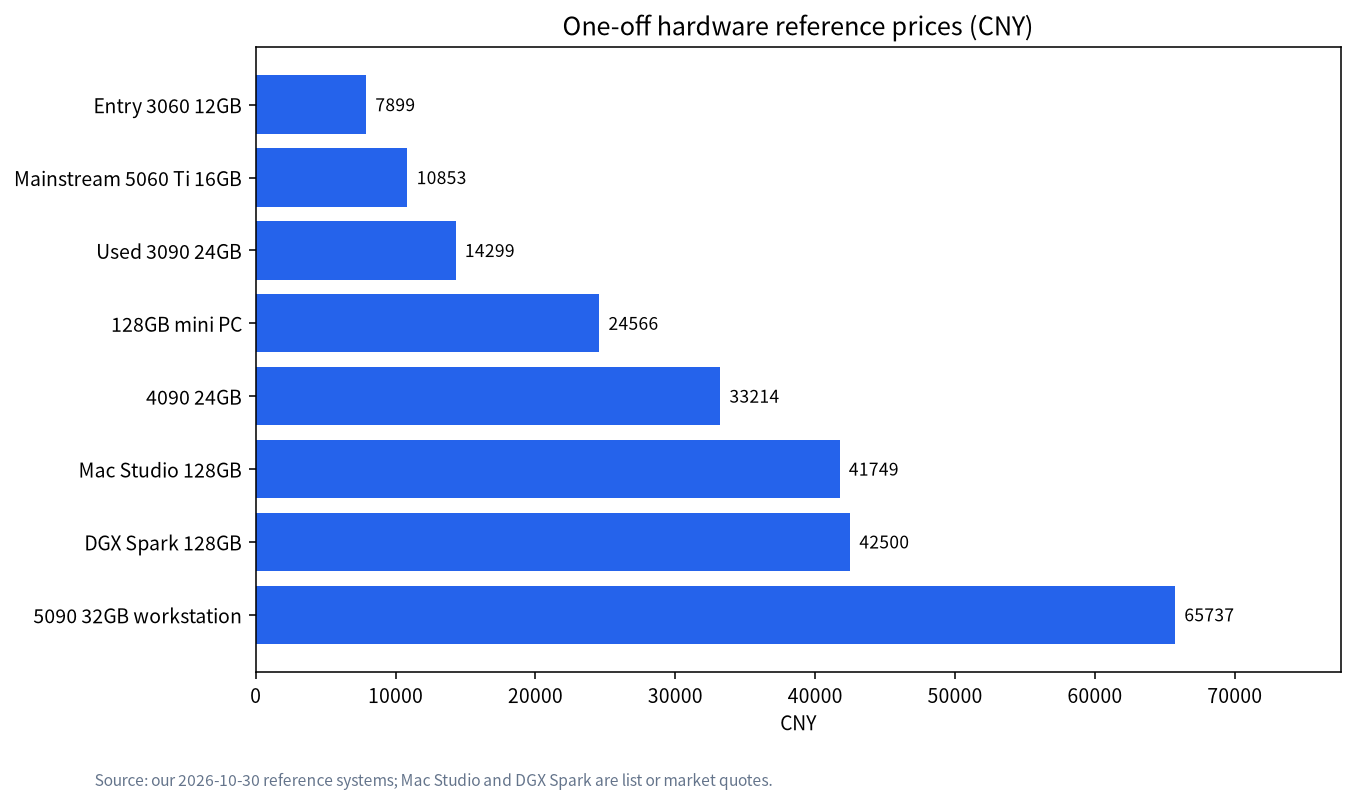
The table comes from our reference systems compiled on 2026-10-30 (market-median estimates; excluding monitor, peripherals, OS license, shipping and assembly fees; check live quotes).
| Route | Reference configuration | Price (CNY) | What it can run |
|---|---|---|---|
| Distill, entry | RTX 3060 12GB + i5-12600KF + 32GB RAM | 7,899 | 7B and 8B distills; 14B with short context |
| Distill, mainstream | RTX 5060 Ti 16GB + i5-14600KF + 32GB RAM | 10,853 | 14B distill comfortably |
| Distill, advanced | Used RTX 3090 24GB + i5-14600KF + 32GB RAM | 14,299 | 32B distill, short context |
| Distill, advanced alternative | RTX 4090 24GB + same platform | 33,214 | Same, faster |
| Big-VRAM workstation | RTX 5090 32GB + R7 9700X + 64GB RAM | 65,737 | 32B distill with more headroom |
| Big-memory mini PC | Ryzen AI Max+ 395 128GB system | 24,566 | Large memory; MoE and low-bit quants, verify yourself |
| Reference: branded | Mac Studio M5 Max 128GB/1TB (official list) | 41,749 | Same |
| Reference: branded | DGX Spark / GB10 128GB (market quote) | 42,500 | Same |
| Reference: enterprise | 671B full-size tier (market quote, not ours) | 1,350,000 | Full DeepSeek-class model for many users |
Two cautions. First, a 32B distill needs about 22GB at 8K context and about 24GB at 16K on a 24GB card, which is right at the limit; see what a 24GB card can run. Second, at home prices the only plausible route to the full V4.1 Flash is a big unified-memory system, but 1-bit needs 128 to 145GB and a 128GB machine sits at the bottom of that range, so it would lean on disk offload or smaller quants. We have not measured speed or stability, so do not treat it as a promise. The memory/VRAM trade-offs are in RAM versus VRAM and CPU offload.
API cost: read the official prices precisely
We read DeepSeek’s official pricing page on 2026-11-04. For deepseek-flash (DeepSeek-V4.1-Flash-1017) the off-peak price per million tokens is $0.003 for cache hit, $0.15 for cache miss and $0.60 for output; peak is double. Peak hours are UTC 01:00 to 04:00 and 06:00 to 10:00 on weekdays, which is 09:00 to 12:00 and 14:00 to 18:00 Beijing time, i.e. office hours; Chinese holidays are excluded per the official note. Context is 1M. Older model names have been retired, so rely on the official page.
Monthly cost for three typical users (assumed rate $1 = ¥7.1; the usage levels are our own examples, not statistics):
| User type | Input tokens/month | Cache hit share | Output tokens/month | Off-peak monthly cost | Peak monthly cost |
|---|---|---|---|---|---|
| Light (occasional Q&A) | 12M | 50% | 3M | about $2.72 = ¥19 | about $5.44 = ¥39 |
| Medium (daily writing and coding help) | 120M | 50% | 30M | about $27.18 = ¥193 | about $54.36 = ¥386 |
| Heavy (a coding agent always on) | 1,200M | 80% | 300M | about $218.88 = ¥1,554 | about $437.76 = ¥3,108 |
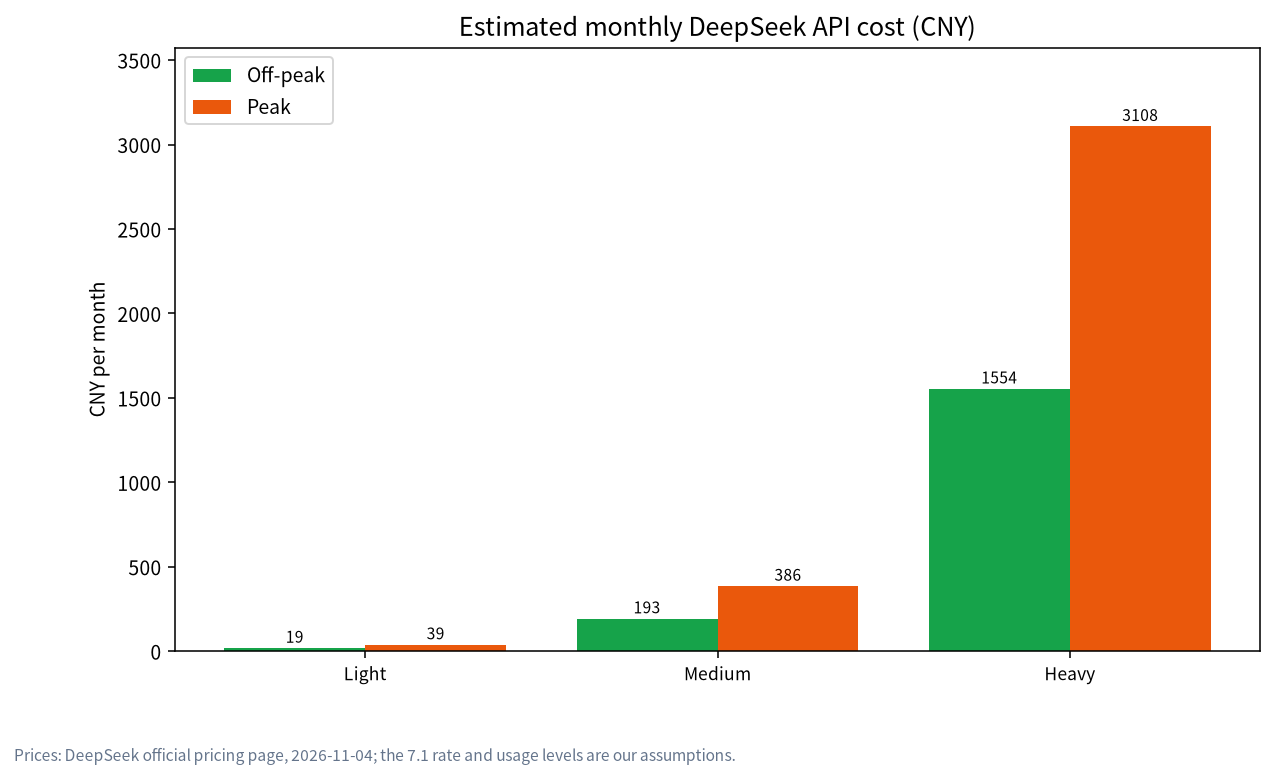
Worked example (light, off-peak): input 12M, of which 6M hit and 6M miss, plus 3M output. Cost = 6 × 0.003 + 6 × 0.15 + 3 × 0.60 = 0.018 + 0.90 + 1.80 = $2.718, about ¥19. The heavy case works the same way: 960M hits at $0.003 per million is $2.88, 240M misses at $0.15 is $36, 300M output at $0.60 is $180, total $218.88. Output tokens dominate, and cache hits are almost free. Shifting non-urgent jobs to off-peak halves the bill. We gave a similar comparison frame in local versus cloud API.
Monthly electricity: worth computing, rarely the big item
Electricity = power × hours per day × 30 days ÷ 1000 × tariff. We assume ¥0.6 per kWh and 4 hours of full load per day:
| System | Assumed full-load system power | kWh per month | Monthly cost |
|---|---|---|---|
| Entry PC (RTX 3060 12GB) | 350W | 42 | about ¥25 |
| 4090 system | 600W (450W GPU plus about 150W other) | 72 | about ¥43 |
| 128GB mini PC | 140W | 16.8 | about ¥10 |
| Mac Studio | 120W | 14.4 | about ¥9 |
The power figures are our assumptions; measure with a plug-in power meter. At 8 hours a day the bill doubles but stays in the tens to low hundreds of yuan, far below depreciation. The 4090’s 450W draw and PSU needs are covered in RTX 5090, 4090 and 3090 compared.
Break-even: how long before hardware beats the API
Break-even months = one-off hardware price ÷ (monthly API cost − monthly electricity). We use the medium and heavy levels at off-peak prices:
| System | One-off price | Monthly electricity | Break-even vs medium API (¥193/mo) | Break-even vs heavy API (¥1,554/mo) |
|---|---|---|---|---|
| Entry PC ¥7,899 | 7,899 | ¥25 | about 47 months | about 5.2 months |
| 4090 system ¥33,214 | 33,214 | ¥43 | about 222 months | about 22 months |
| 128GB mini PC ¥24,566 | 24,566 | ¥10 | about 134 months | about 15.9 months |
| Mac Studio ¥41,749 | 41,749 | ¥9 | about 227 months | about 27 months |
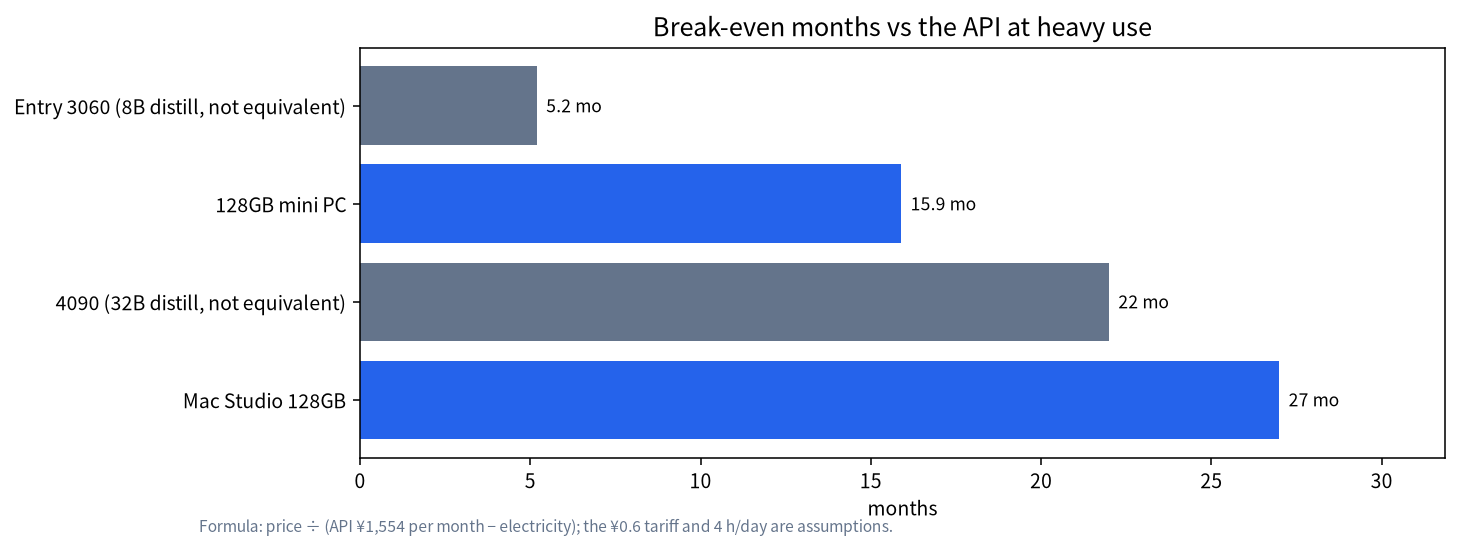
Worked example (4090, heavy): 33,214 ÷ (1,554 − 43) = 33,214 ÷ 1,511 ≈ 22 months. Three “not equivalent” warnings:
- Models are not equivalent. The entry PC and the 4090 run distills, not V4.1 Flash; the entry PC’s “5 months” assumes you accept an 8B distill in place of a flagship model on the API, a large quality gap. Only 128GB-class machines such as the mini PC or Mac Studio could even attempt a near-full model, and you must verify that yourself.
- Speed is not equivalent. API speed comes from data centers (the third-party figure we cited earlier was about 175 tokens/s); local speed depends on memory bandwidth and must be measured.
- Value is not equivalent. The calculation ignores residual value after depreciation, your time, noise and failures, and the value of privacy and offline use.
So the conclusion: if you only want to save money, the API is cheaper for most people. Local makes sense when usage is very heavy, when data may not leave your machine, or when you need to work offline.
Hidden costs checklist
- Storage: model files run tens to hundreds of GB; start with a 2TB SSD, more if you swap models often.
- Power and cooling: a 4090-class system wants an 850W PSU, as in the reference configuration; airflow and noise matter too.
- Time: setup, tuning and troubleshooting are not free.
- Upgrades: models turn over fast, and when VRAM runs short you often replace the whole card.
- Operations and security: serving others needs authentication and audit logs; see the local API server guide.
Choosing a route by scenario
- Just trying it: use the API, or run a 7B or 8B distill on the computer you already have, at close to zero cost.
- Personal daily use with sensitive data: a 24GB card running a 32B distill or similar, from about ¥14,000 (used 3090).
- Want near-full capability: a big-memory system at roughly ¥25,000 to ¥40,000, with speed to be tested. For what to do when memory falls short see 12GB VRAM with SSD streaming.
- A team with concurrent users: an enterprise appliance or cloud GPUs, from tens of thousands to over a million yuan, assessed separately.
FAQ
What is the minimum DeepSeek local deployment cost?
Running a 1.5B to 8B distill on a computer you already own costs close to nothing; if you buy hardware for it, our reference entry system is ¥7,899 (RTX 3060 12GB).
How much does it cost to run the full DeepSeek locally?
The model is about 763B parameters and Unsloth’s 1-bit quant needs roughly 128 to 145GB of RAM plus VRAM. A big-memory home system is about ¥25,000 to ¥40,000, with feasibility and speed to be tested; the market quote for an enterprise full-size appliance is about ¥1.35M (not our quote).
Is local DeepSeek cheaper than the API?
For most people no. At light use the API costs about ¥19 a month, medium about ¥193; only heavy users might break even in one to two years, and only if the local model meets their needs.
What does the official DeepSeek API cost now?
On 2026-11-04 we read deepseek-flash off-peak prices of $0.003 (cache hit), $0.15 (miss) and $0.60 (output) per million tokens, doubled at peak. Prices change; use the official page.
Is electricity expensive?
At 4 hours of full load a day and ¥0.6 per kWh, a 4090 system is about ¥43 a month and a big-memory mini PC about ¥10, so electricity is not the main cost.
How do distilled models differ from DeepSeek itself?
Distills are small Qwen or Llama base models trained on R1’s reasoning data, not DeepSeek’s own large model, and they sit in a different capability class. See distill sizes explained.
Talk to us
If you want the break-even redone for your own budget and usage, send the usage level, budget and your local electricity tariff to the community or email admin@microaione.com and we will run the numbers with you. Check live quotes before buying; the prices here are 2026-10-30 references.
References: DeepSeek API pricing page, Unsloth’s local DeepSeek guide, Ollama deepseek-r1 page. Prices read on 2026-11-04, Beijing time.
Further reading: DeepSeek local install: Windows and Docker