Free Local AI Guide: Tools, Models, and the Real Limits
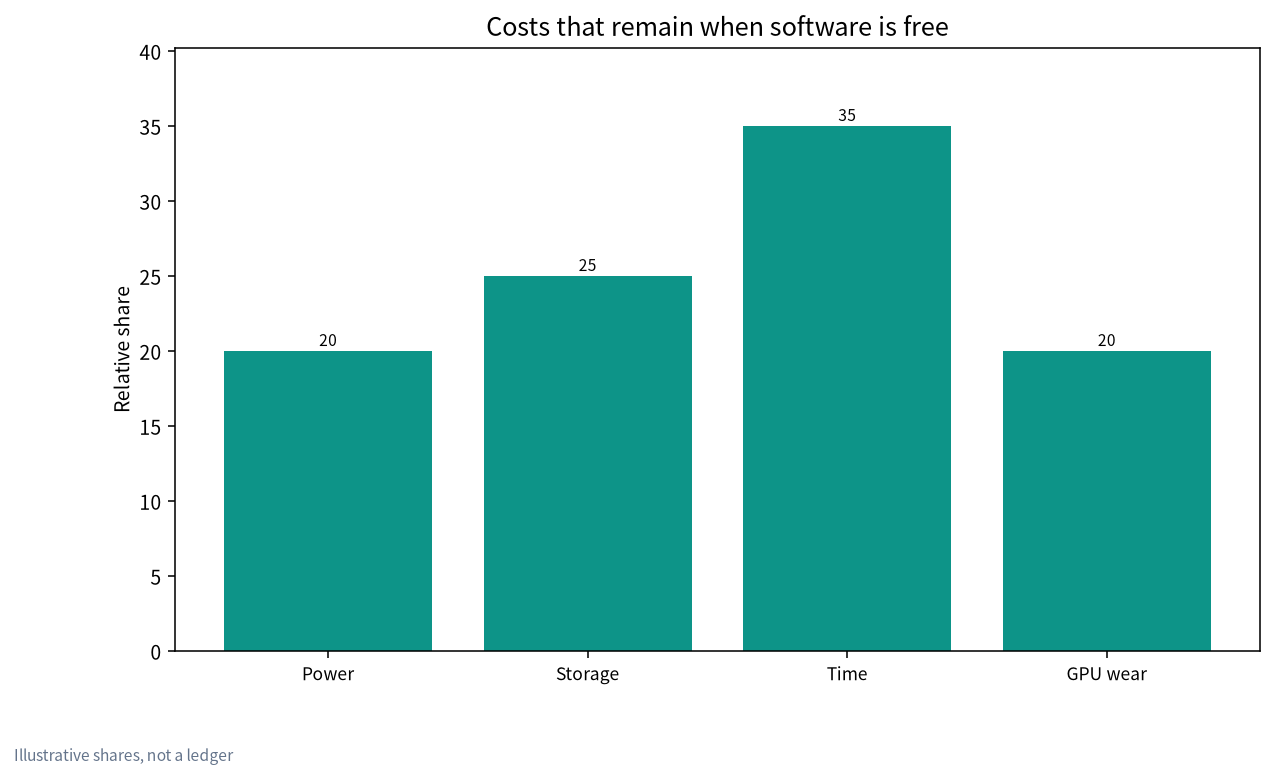
Search results for free local AI often blur three different ideas: software with no subscription, open-weight models you can download, and “zero total cost.” In practice, free local AI usually means you can run inference tools and some open weights without a per-token bill—while you still pay for electricity, disks, GPU depreciation, and time, and while licenses may restrict commercial use. This guide lists common tools, a runnable path, and the boundaries you should respect.
Verification notes. Features follow upstream docs and change quickly; licenses follow the LICENSE file in each model repo. We do not provide cracks, keygens, or bypasses for paid models or hosted plans.
Key takeaways (updated 2026-11-05)
- Free software ≠ zero total cost ≠ unlimited commercial rights.
Beginner path: LM Studio or Ollama + one 7B/8B quant + optional Open WebUI.
Read licenses before production; enterprises: custom private deployment.
- Offline has limits: does offline LLM need internet.
Free local AI: what you actually save
What you actually save
| Cost | Cloud API | Free local stack |
|---|---|---|
| Per-token bill | Yes | Usually no |
| Software license | Subscription/usage | Many OSS tools are zero-fee |
| Hardware & power | Bundled in price | You pay |
| Ops time | Lower | Higher |
| Data egress risk | Vendor-dependent | Often more controllable |
Tool checklist
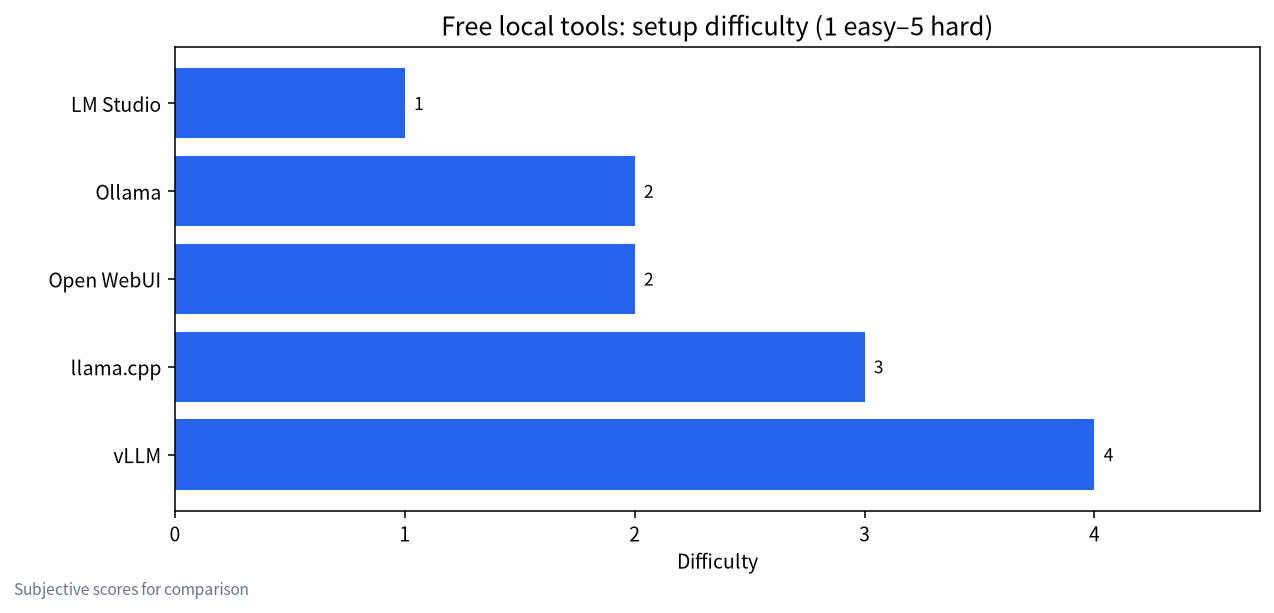
| Tool | Role | Difficulty | Notes |
|---|---|---|---|
| LM Studio | GUI download/chat | Low | Good for Windows newcomers (no-CLI guide) |
| Ollama | Pull/serve models | Low–mid | Install guide |
| Open WebUI | Browser front-end | Mid | Often with Ollama (Open WebUI) |
| llama.cpp | Fast local backend | Mid | Flexible, steeper |
| vLLM | High-concurrency serve | High | Linux-server leaning |
| Newer engines (e.g. Strata) | Agent/IDE scenarios | Varies | Strata explained |
Knowledge-base stacks such as Dify/RAGFlow local may be open-source in self-host form while hosted tiers bill separately—read the fine print.
Models you can run without a per-token fee
Open weights appear on Hugging Face, ModelScope, and the Ollama library. Size still follows VRAM: start 7B–8B, main 14B–32B (budget PCs, open-source LLM guide). Downloadable ≠ commercially cleared.
Boundaries
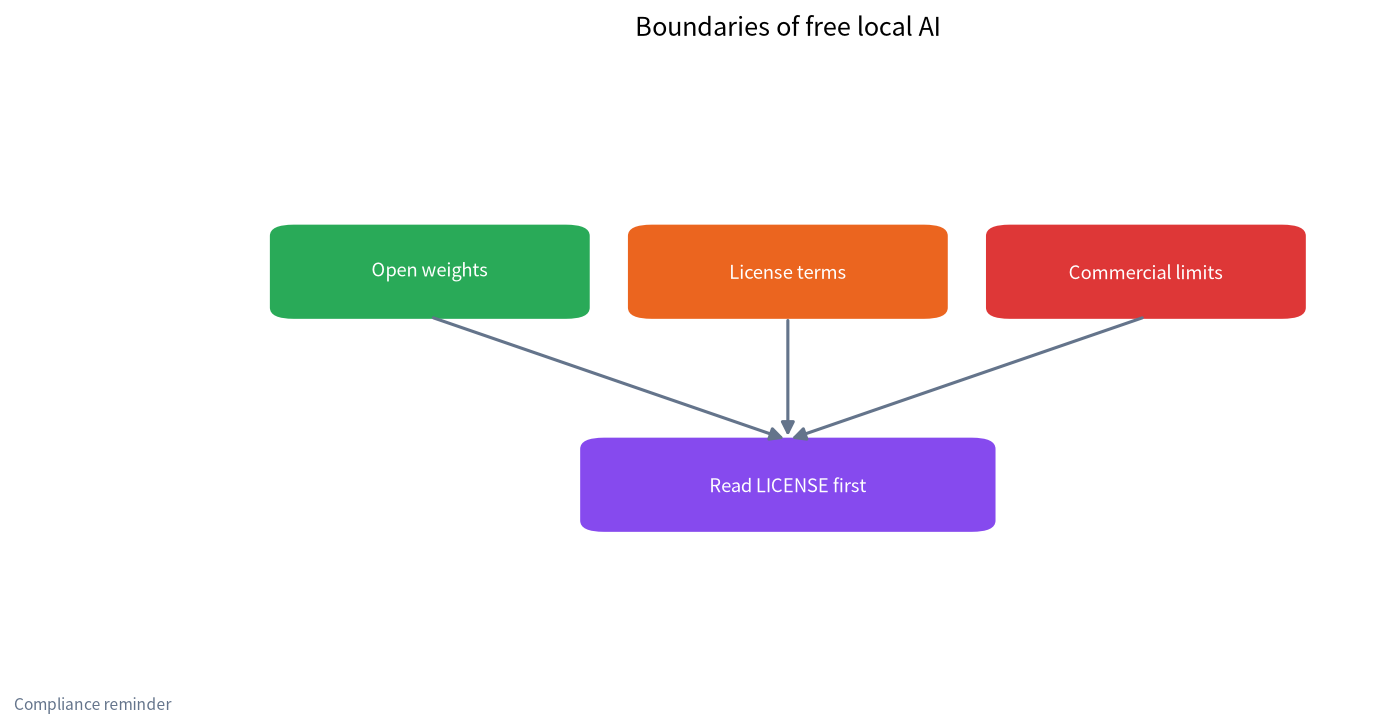
- Licenses may allow research only, restrict SaaS, or require attribution.
- Law & safety: local does not legalize illegal uses; see uncensored compliance risks.
- Capability: a small local model is not automatically a top closed API.
- Offline: first downloads usually need network; air-gap requires pre-cache (offline guide).
- “Cracked free editions” are out of scope for this site.
A weekend free path
- Check VRAM (8GB can still learn on small quants).
- Install LM Studio or Ollama.
- Download one 7B/8B quant; complete 20 real tasks.
- Log speed and failures before adding WebUI or RAG.
- If used at work, paste license terms into the project README.
When free stacks are not enough
High concurrency, hard SLAs, complex ACL, or vendor support needs push you into enterprise procurement and governance. Free local AI is excellent for learning and small pilots—not always the production end state.
What we verified—and what we did not
No pixel-perfect GUI QA for every release; no piracy assistance; no guaranteed tokens/s on your hardware.
A three-day validation instead of a three-month fantasy
Long guides still leave people unsure what to do on Monday morning. Replace fantasy roadmaps with a three-day validation: day one ends with a successful install and one real conversation; day two runs ten authentic tasks and logs failure modes; day three decides whether to add retrieval, change model size, or simply improve prompts. Hardware purchases and fine-tuning plans should follow evidence, not anxiety.
If the same failure repeats—tables break, citations point at the wrong paragraph—fix the process for that failure class before you buy a more expensive GPU. Table issues may need stricter output constraints or post-processing; citation issues usually need chunking and retrieval work. A tiny spreadsheet of failure classes is already a cheap evaluation set.
Responsibility boundaries (worth repeating)
Local deployment reduces the intuitive risk of data leaving your network; it does not finish compliance for you. Pasting customer lists into prompts, fine-tuning on unauthorized repositories, or exposing an intranet API to the public internet are process failures. Write down which data classes may never enter prompts or train sets, who can merge adapters, and how to halt and audit incidents. Tutorials answer “how to run”; charters answer “whether we may run” and “who owns the blast radius.”
For hobbyists, the bar can be light: do not spread others’ private data, do not pursue illegal uses, and do not treat mystery weights as trusted software. For companies, boundaries must be auditable. In both cases, “open” never means “no obligations.”
How to read neighboring articles on this site
If the bottleneck is buying too large or too small a machine, start with budget builds and VRAM math. If knowledge goes stale, read RAG first. If tone and format are unstable, then read LoRA training. If the pain is organizational access control, read enterprise private deployment and the safety checklist. If the pain is licensing, read the open-weight and free-local boundary pieces. Reading by bottleneck beats reading by publish date. When you hit an internal link, open the relevant section instead of only bookmarking the title.
Maintenance after the exciting first weekend
Weights accumulate, logs grow, drivers age. Schedule a monthly hour: delete unused weights, check disk health, confirm backups still restore, and skim upstream security notes. If you treat a local model like a forever-forgotten portable app, the common six-month ending is a full disk and a broken driver after an OS update—followed by the false conclusion that “local AI does not work.” Maintenance is boring; it is also what keeps the shopping and training advice valuable.
Composite anecdotes (anonymized patterns)
We repeatedly see a student laptop with 8GB VRAM chasing a 70B download “because the chart looked cool,” a startup exposing Ollama on 0.0.0.0 “just for the hackathon,” and a department fine-tuning on raw mail exports that still contain personal data. None of these failures required exotic research. They required slowing down at license text, network bind addresses, and data classification. If your project currently matches one of those patterns, pause new downloads until the basics are written down and reviewed by a second person.
A three-day/6 validation instead of a three-month fantasy
Long guides still leave people unsure what to do on Monday morning. Replace fantasy roadmaps with a three-day validation: day one ends with a successful install and one real conversation; day two runs ten authentic tasks and logs failure modes; day three decides whether to add retrieval, change model size, or simply improve prompts. Hardware purchases and fine-tuning plans should follow evidence, not anxiety.
If the same failure repeats—tables break, citations point at the wrong paragraph—fix the process for that failure class before you buy a more expensive GPU. Table issues may need stricter output constraints or post-processing; citation issues usually need chunking and retrieval work. A tiny spreadsheet of failure classes is already a cheap evaluation set.
Responsibility boundaries (worth repeating)
Local deployment reduces the intuitive risk of data leaving your network; it does not finish compliance for you. Pasting customer lists into prompts, fine-tuning on unauthorized repositories, or exposing an intranet API to the public internet are process failures. Write down which data classes may never enter prompts or train sets, who can merge adapters, and how to halt and audit incidents. Tutorials answer “how to run”; charters answer “whether we may run” and “who owns the blast radius.”
For hobbyists, the bar can be light: do not spread others’ private data, do not pursue illegal uses, and do not treat mystery weights as trusted software. For companies, boundaries must be auditable. In both cases, “open” never means “no obligations.”
How to read neighboring articles on this site
If the bottleneck is buying too large or too small a machine, start with budget builds and VRAM math. If knowledge goes stale, read RAG first. If tone and format are unstable, then read LoRA training. If the pain is organizational access control, read enterprise private deployment and the safety checklist. If the pain is licensing, read the open-weight and free-local boundary pieces. Reading by bottleneck beats reading by publish date. When you hit an internal link, open the relevant section instead of only bookmarking the title.
Maintenance after the exciting first weekend
Weights accumulate, logs grow, drivers age. Schedule a monthly hour: delete unused weights, check disk health, confirm backups still restore, and skim upstream security notes. If you treat a local model like a forever-forgotten portable app, the common six-month ending is a full disk and a broken driver after an OS update—followed by the false conclusion that “local AI does not work.” Maintenance is boring; it is also what keeps the shopping and training advice valuable.
Composite anecdotes (anonymized patterns)
We repeatedly see a student laptop with 8GB VRAM chasing a 70B download “because the chart looked cool,” a startup exposing Ollama on 0.0.0.0 “just for the hackathon,” and a department fine-tuning on raw mail exports that still contain personal data. None of these failures required exotic research. They required slowing down at license text, network bind addresses, and data classification. If your project currently matches one of those patterns, pause new downloads until the basics are written down and reviewed by a second person.
A three-day/11 validation instead of a three-month fantasy
Long guides still leave people unsure what to do on Monday morning. Replace fantasy roadmaps with a three-day validation: day one ends with a successful install and one real conversation; day two runs ten authentic tasks and logs failure modes; day three decides whether to add retrieval, change model size, or simply improve prompts. Hardware purchases and fine-tuning plans should follow evidence, not anxiety.
If the same failure repeats—tables break, citations point at the wrong paragraph—fix the process for that failure class before you buy a more expensive GPU. Table issues may need stricter output constraints or post-processing; citation issues usually need chunking and retrieval work. A tiny spreadsheet of failure classes is already a cheap evaluation set.
Responsibility boundaries (worth repeating)
Local deployment reduces the intuitive risk of data leaving your network; it does not finish compliance for you. Pasting customer lists into prompts, fine-tuning on unauthorized repositories, or exposing an intranet API to the public internet are process failures. Write down which data classes may never enter prompts or train sets, who can merge adapters, and how to halt and audit incidents. Tutorials answer “how to run”; charters answer “whether we may run” and “who owns the blast radius.”
For hobbyists, the bar can be light: do not spread others’ private data, do not pursue illegal uses, and do not treat mystery weights as trusted software. For companies, boundaries must be auditable. In both cases, “open” never means “no obligations.”
How to read neighboring articles on this site
If the bottleneck is buying too large or too small a machine, start with budget builds and VRAM math. If knowledge goes stale, read RAG first. If tone and format are unstable, then read LoRA training. If the pain is organizational access control, read enterprise private deployment and the safety checklist. If the pain is licensing, read the open-weight and free-local boundary pieces. Reading by bottleneck beats reading by publish date. When you hit an internal link, open the relevant section instead of only bookmarking the title.
Maintenance after the exciting first weekend
Weights accumulate, logs grow, drivers age. Schedule a monthly hour: delete unused weights, check disk health, confirm backups still restore, and skim upstream security notes. If you treat a local model like a forever-forgotten portable app, the common six-month ending is a full disk and a broken driver after an OS update—followed by the false conclusion that “local AI does not work.” Maintenance is boring; it is also what keeps the shopping and training advice valuable.
Extra verification and reading order
Read this article beside the VRAM, budget-build, and private-deployment guides: confirm workload and VRAM first, then tools and models, and only then training or enterprise governance. Keep key prompts, weight filenames, and eval notes in one place so a two-week retrospective beats a folder of unread bookmarks. If your environment has special compliance rules, follow legal and security counsel; this page is technical education.
The lasting value of local deployment is rarely a single successful demo. It is repeatability, rollback, and explainability. Whether you choose free tools or an enterprise path, keep a change log: which weight changed on which day, who approved an adapter merge, which eval failed. That log makes the next incident an order of magnitude cheaper. If you still do not know where to start, write three real tasks first, then return to the VRAM and build tables as a multiple-choice problem instead of buying hardware on impulse.
FAQ
Is free local AI truly zero cost?
Software may be zero-license-fee; power, disk, GPU, and time are not.
Can I use free local AI commercially?
Only if each model/tool license and your jurisdiction/contracts allow it.
What should beginners install on day one?
LM Studio or Ollama plus one small quant—finish real tasks before expanding.
How is this different from free cloud credits?
Credits still throttle and involve egress; local shifts cost to hardware and ops.
Will the open-run checklist go stale?
Yes. Trust upstream docs and watch license changes.
Can you share cracked model weights?
No.
Share your free setup?
Post in the community or email admin@microaione.com with GPU and tools. Our Shenzhen team can sanity-check VRAM and license caveats.
Sources: Ollama, LM Studio, Hugging Face Hub, our best offline local apps, open-source LLM guide.