GPT Image 2.5 Review: The Best Image Model? Versus Nano Banana 2.1 and Local FLUX 3 Klein
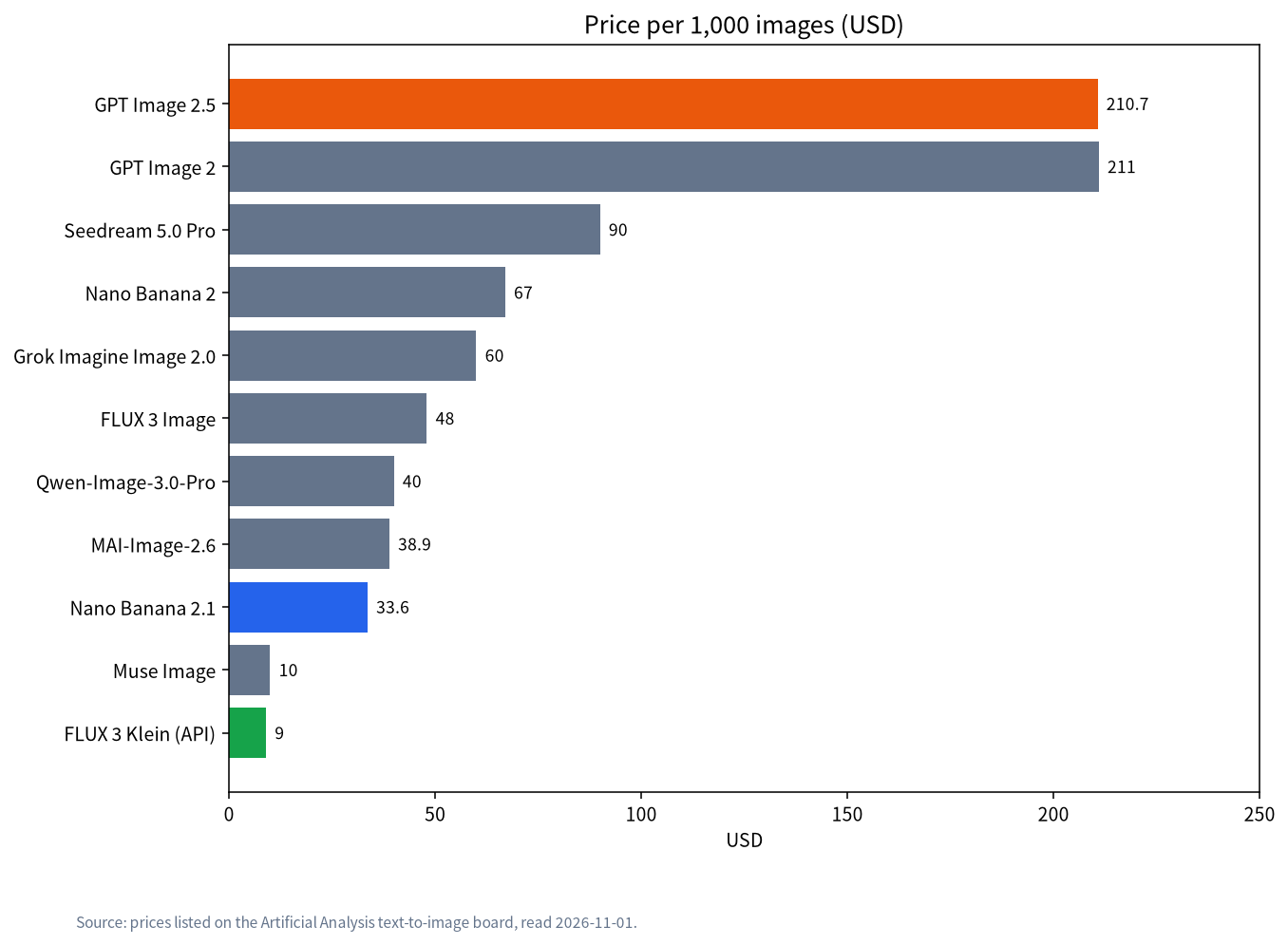
Ask which image generation model is best right now and, going by the Artificial Analysis text-to-image leaderboard (v2.1, read on 2026-11-01), the answer is clear: GPT Image 2.5 holds the top two places with its two API variants, Sunburst at an Elo of 1222 and Flare at 1207, more than 20 points ahead of third place. That lead has a price: about $210.70 per 1,000 images, more than six times Nano Banana 2.1 in fourth place at about $33.60. This article puts the leaderboard, the prices and our cost arithmetic together, compares GPT Image 2.5 with Nano Banana 2.1, Grok Imagine, MAI-Image and Muse Image, and answers the local reader’s questions: what is the strongest open-weights model, how much VRAM does it need, and how big is the gap?
Verification note: Leaderboard and price data was read from the Artificial Analysis text-to-image board on 2026-11-01; model variants and release information come from OpenAI’s announcement of 2026-09-08; FLUX 3 Image Klein sizes and speeds come from Black Forest Labs’ 2026-10-15 post (speeds measured by NVIDIA with the distilled 16-step INT8 build). Qwen-Image-2.1 VRAM figures come from community discussion rather than an official source and are labelled as such. We have not generated sample images ourselves and give no subjective quality scores; cost figures are our own arithmetic.
Key takeaways (Updated 2026-11-01)
- Artificial Analysis text-to-image board: GPT Image 2.5 Sunburst 1222, Flare 1207, GPT Image 2 (high) 1186, Nano Banana 2.1 1176.
Price per 1,000 images as listed: GPT Image 2.5 about $210.70, Nano Banana 2.1 about $33.60, Muse Image about $10, FLUX 3 Image Klein via API about $9.
Local: the strongest open-weights model is FLUX 3 Image Klein (Elo 1043), 5.6B parameters, which the vendor says runs from 8GB VRAM in an INT8 build; it trails the leader by about 180 points.
The Short Answer: Deserved Lead, but Mind the Price
The top of the board (a higher Elo means blind voters prefer the model more often):
| Rank | Model | Elo | Per 1,000 images (USD) | Released |
|---|---|---|---|---|
| 1 | GPT Image 2.5 Sunburst (max) | 1222 (±10) | 210.7 | September 2026 |
| 2 | GPT Image 2.5 Flare (max) | 1207 | 210.7 | September 2026 |
| 3 | GPT Image 2 (high) | 1186 | 211.0 | April 2026 |
| 4 | Nano Banana 2.1 | 1176 | 33.6 | October 2026 |
| 5 | MAI-Image-2.6 | 1166 | 38.9 | — |
| 6 | Grok Imagine Image 2.0 | 1166 | 60.0 | — |
| 7 | Nano Banana 2 | 1140 | 67.0 | — |
| 8 | Muse Image | 1127 | 10.0 | — |
| 13 | FLUX 3 Image | 1117 | 48.0 | — |
| 16 | Seedream 5.0 Pro | 1100 | 90.0 | — |
| 17 | Qwen-Image-3.0-Pro | 1095 | 40.0 | — |
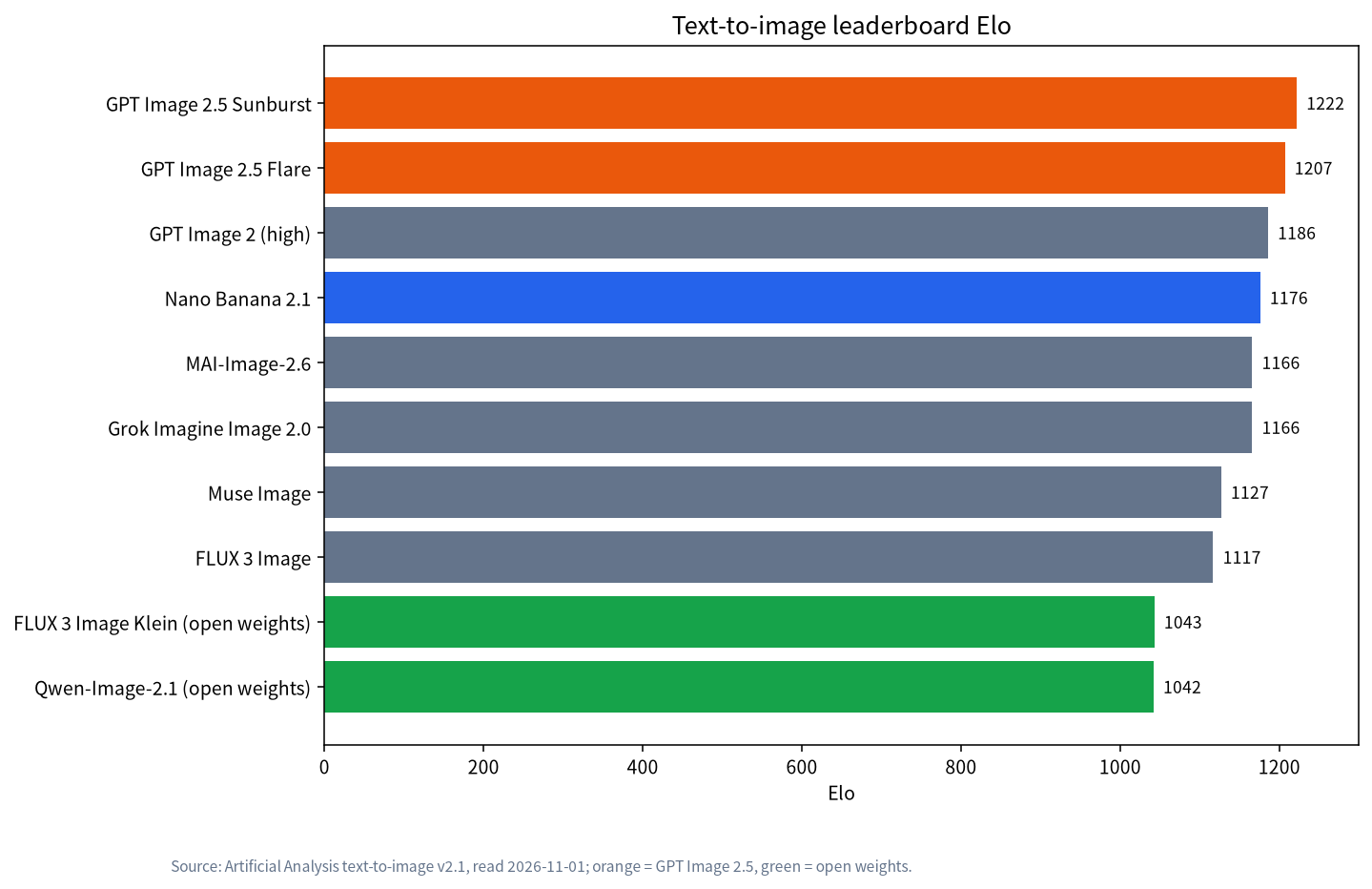
OpenAI’s announcement says GPT Image 2.5 ships as two API models: Flare is the default and cuts latency by up to about half compared with GPT-Image-2; Sunburst targets high precision and takes longer to generate. Both carry C2PA content credentials and an invisible watermark. Both are listed at the max setting on the board, so “best image model” holds on the leaderboard. Note that Sunburst’s ±10 interval is the same order as its 15-point lead over Flare, so their order is not settled.
What 1222 Versus 1176 Means
Using the standard Elo conversion (our assumption; the board does not publish a formula), the score gaps translate to head-to-head preference like this:
| Comparison | Gap | Implied single-vote win rate (estimate) |
|---|---|---|
| Sunburst vs Flare | 15 | about 52.2% |
| Sunburst vs Nano Banana 2.1 | 46 | about 56.6% |
| Sunburst vs the strongest open model, FLUX 3 Image Klein | 179 | about 73.7% |
So between first and fourth place, 100 paired blind votes split roughly 57 to 43. That is a real advantage but far smaller than the price gap, which is more than sixfold. For social images, drafts or bulk assets the preference gap often does not justify the cost; for a few high-stakes finished images, the leader is worth it.
Price and Monthly Cost
The board lists price per 1,000 images. Per image that is about $0.2107 for GPT Image 2.5, about $0.0336 for Nano Banana 2.1, about $0.01 for Muse Image and about $0.009 for FLUX 3 Image Klein via API.
A monthly worked example (our arithmetic, excluding retries and prompt iteration):
| Images per month | GPT Image 2.5 | Nano Banana 2.1 | Muse Image | FLUX 3 Klein (API) |
|---|---|---|---|---|
| 500 | about $105.35 | about $16.80 | $5.00 | $4.50 |
| 5,000 | about $1,053.50 | about $168.00 | $50.00 | $45.00 |
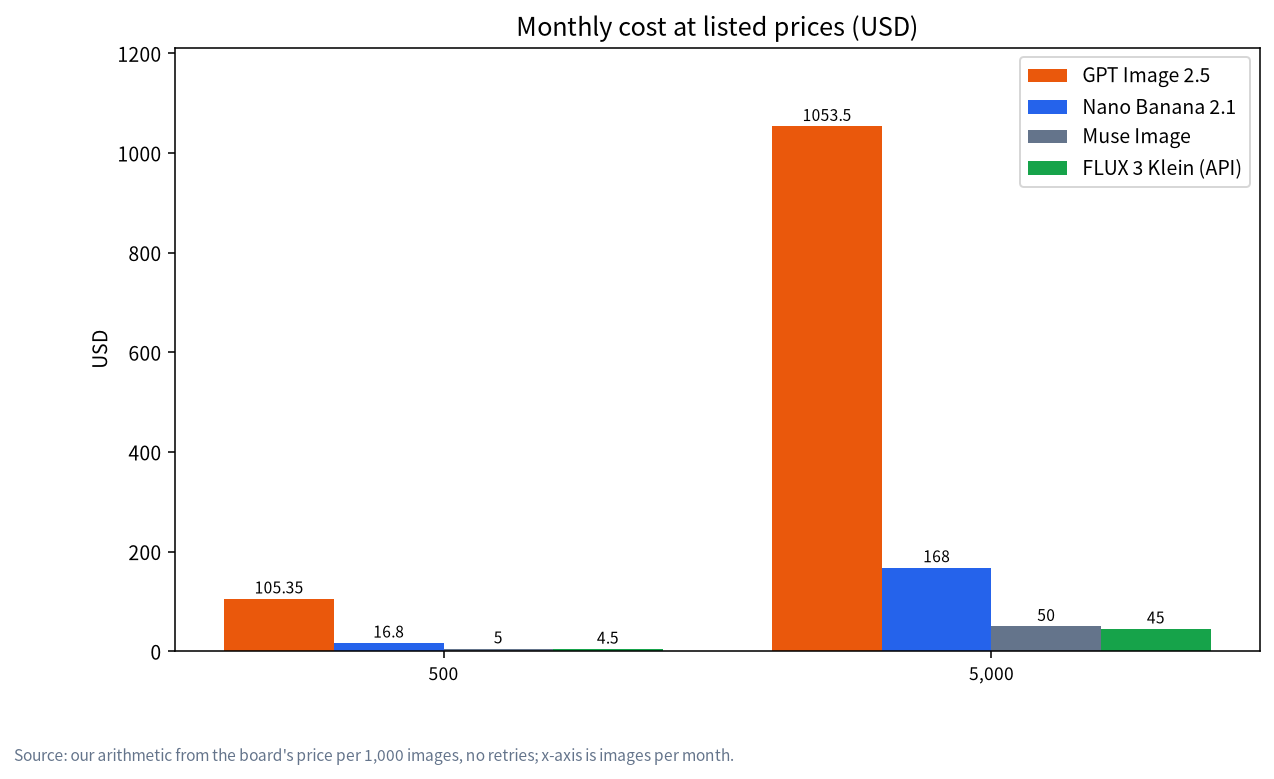
At a few hundred images a month the total is small whichever model you pick, so choose the best quality. At thousands per month the price gap becomes real money, and you can tier the work: drafts and bulk assets on a cheaper model, and only the final selection regenerated on GPT Image 2.5.
The Local Reader’s Option: FLUX 3 Image Klein
GPT Image 2.5 is available only through OpenAI’s products and API and has no open weights. The strongest open-weights entry on the board is FLUX 3 Image Klein (Elo 1043), followed by Qwen-Image-2.1 (1042, shown without an API) and Fibo 2.0 (1039); all sit about 180 points below the leader.
| Local model | Size | VRAM and speed | License and notes |
|---|---|---|---|
| FLUX 3 Image Klein | 5.6B; about 11.2GB in BF16, about 5.6GB in FP8 | The vendor says an INT8 build runs from 8GB VRAM; NVIDIA measured a 1-megapixel image in ComfyUI at about 4 s on an RTX 5090 and under 9 s on an RTX 4070 (distilled 16 steps, INT8) | FLUX Kommunity License, read the commercial terms yourself |
| Qwen-Image-2.1 | 7B diffusion model plus a Qwen3-VL 8B text encoder | Community report: about 21.3GB in BF16, about 16.6GB in FP8, about 10.6GB at 4-bit (1024 resolution; unofficial, not verified by us) | Research and evaluation license; commercial use needs a separate license |
Our arithmetic: if an RTX 4070 takes under 9 seconds per image, eight hours of continuous running yields at least 3,200 images (28,800 / 9), and an RTX 5090 at about 4 seconds yields about 7,200. These are NVIDIA figures for a particular setup and exclude your own prompt iteration and selection time. If you make thousands of images a month and do not need leader-level quality, running Klein locally costs little more than electricity; at a few hundred images a month an API is simpler. For how VRAM scales with these models, read ComfyUI hardware requirements and the GPU VRAM guide; readers with 8GB or 12–16GB cards can use the 8GB VRAM guide and the 12–16GB VRAM guide to place their card.
How to Read the Board: Elo, Intervals and Versions
The Artificial Analysis text-to-image board comes from blind votes: a user sees two models’ images for the same prompt, picks the one they prefer, and the system computes an Elo from the results. Three cautions apply. First, scores carry error: Sunburst’s interval is ±10, so adjacent places are not necessarily firm. Second, the board measures preference, not correctness: it cannot tell you whether a model renders a Chinese headline correctly or counts three coffee beans; test that with your own prompts. Third, boards update with versions: this article reads the v2.1 snapshot of 2026-11-01, and rankings may shift within weeks. More on reading leaderboards in how to read model benchmarks.
Choosing by Scenario
| Scenario | Suggested choice | Reason (from the board and prices) |
|---|---|---|
| A few finished images at the highest bar | GPT Image 2.5 Sunburst | Highest Elo (1222), about $0.21 per image |
| You need lower latency | GPT Image 2.5 Flare | OpenAI says latency is up to about half that of GPT-Image-2; Elo is still second (1207) |
| Bulk assets on a budget | Nano Banana 2.1 | Elo 1176, about $0.034 per image |
| Cheapest drafts | Muse Image or Klein (API) | About $0.01 per image or less, lower scores |
| Images must not leave your machine | FLUX 3 Image Klein (local) | Open weights; the vendor says an INT8 build runs on 8GB VRAM |
| Running a commercial service locally | Read the license first | Klein and Qwen-Image terms differ; we draw no conclusion here |
What the Extra Money Buys
Our arithmetic on the premium: Sunburst costs $177.10 more per 1,000 images than Nano Banana 2.1 and buys 46 Elo points, about $3.85 per 1,000 images per point; against Klein’s API it costs $201.70 more and buys 179 points, about $1.13 per 1,000 images per point. This is crude, since Elo is not linear value, but it makes one point: moving from “cheap and good enough” to “the leader”, the unit price of each extra bit of quality rises, and the last few dozen points cost the most.
A Hybrid Cloud and Local Workflow
Many teams tier their work: use a cheap model or local Klein to batch drafts and compositions, shortlist a few directions, then give the final prompt to GPT Image 2.5 Sunburst to regenerate. That keeps the leader’s quality while holding most images to a few cents each. If your images contain sensitive material that cannot go to the cloud, local is the only option, and you must accept a preference gap of about 180 points and make it up with prompting and post-processing. A general framework for cloud versus local is in local versus cloud API.
Test It Yourself: A Blind Method for Image Models
We have not generated images ourselves, so we do not judge quality. You can run this:
- Prepare 12 prompts: three text-heavy posters (one each in Chinese and English, plus one mixed), three people including hands, three product shots, three with multi-object counting and spatial relations.
- Fix the settings: the same resolution and aspect ratio, four images per prompt per model.
- Score with a checklist: tick subject, count, text, hands and style per image instead of going on feel.
- Blind preference: shuffle the models’ images and ask three colleagues to pick pairwise.
- Compute cost per usable image = total spend divided by usable images; for local runs add electricity and depreciation.
A coffee shop opening poster, headline "Grand Opening", subline "今日开业",
a latte in the center, three coffee beans on the left,
warm wood-grain background, portrait 3:4, all text sharp and legible.
Common Mistakes
- Reading the leader’s edge as a landslide. It is 46 points over fourth place, about 57 to 43.
- Ignoring the price gap. $0.21 versus $0.034 per image matters at volume.
- Generalizing NVIDIA’s speed. The numbers apply to a specific step count and precision.
- Treating community VRAM numbers for Qwen-Image as official. We mark them unverified.
- Skipping licenses. FLUX and Qwen-Image have different commercial terms; read them first.
Related Reading
- ComfyUI hardware requirements
- GPU VRAM guide
- What 12–16GB of VRAM can run
- Video generation model comparison
- Local or cloud API
FAQ: GPT Image 2.5
Is GPT Image 2.5 the best image generation model?
On the Artificial Analysis text-to-image board its Sunburst and Flare variants rank first and second at Elo 1222 and 1207, ahead of GPT Image 2 at 1186. The board measures blind preference, and your subject matter may differ.
How much does GPT Image 2.5 cost?
The board lists about $210.70 per 1,000 images, about $0.21 per image. Check OpenAI for actual billing.
What is the difference between Sunburst and Flare?
According to OpenAI’s announcement, Flare is the default with lower latency; Sunburst targets high precision and takes longer to generate.
Can GPT Image 2.5 run locally?
No, it has no open weights. For local use consider FLUX 3 Image Klein, which the vendor says runs from 8GB VRAM in an INT8 build.
How far behind is local image generation?
The best open-weights entry, Klein, scores 1043, 179 points below Sunburst, roughly a 74 to 26 preference split under standard Elo.
Which model is the best value?
It depends on your quality bar. Nano Banana 2.1 (1176) costs about $0.034 per image and is the “close to the top, much cheaper” option; Muse Image and Klein via API are cheaper but score lower.
Talk With Us
Choosing an image stack for your team? Join the community or email admin@microaione.com.
References: Artificial Analysis text-to-image leaderboard, OpenAI: ChatGPT Images 2.5, Black Forest Labs: FLUX 3 Image Klein, Hugging Face: Qwen-Image-2.1.