RTX 5090 vs 4090 vs 3090 for LLM: Which Flagship GPU Should You Buy for Local Models?
Three graphics cards dominate every conversation about serious local AI: the RTX 3090 that you can still find used, the RTX 4090 that became the default choice, and the RTX 5090 with 32GB of memory. They are not three steps of the same ladder. They differ in how much VRAM they carry, how fast they read it, how much power they draw and, above all, what they cost. This guide on RTX 5090 vs 4090 vs 3090 for LLM compares them using NVIDIA’s published specifications and our reference prices, shows derived speed ceilings, and ends with a rule for choosing. If your budget is lower, start with our 24GB build guide or the used GPU buying guide.
Verification note: Memory, bus width, power, PSU and temperature figures come from NVIDIA’s specification pages for each card, read on 2026-10-30. Prices are reference medians from our price file dated 2026-10-30, mixed from several Chinese market sources, and they move daily. Speed figures are derived from memory bandwidth, not measured, because we did not benchmark these cards for this article.
Key takeaways (Updated 2026-10-30)
- The 3090 and 4090 both carry 24GB; the 5090 carries 32GB and about 1.8 times the 4090’s memory bandwidth, so only the 5090 changes which models fit comfortably.
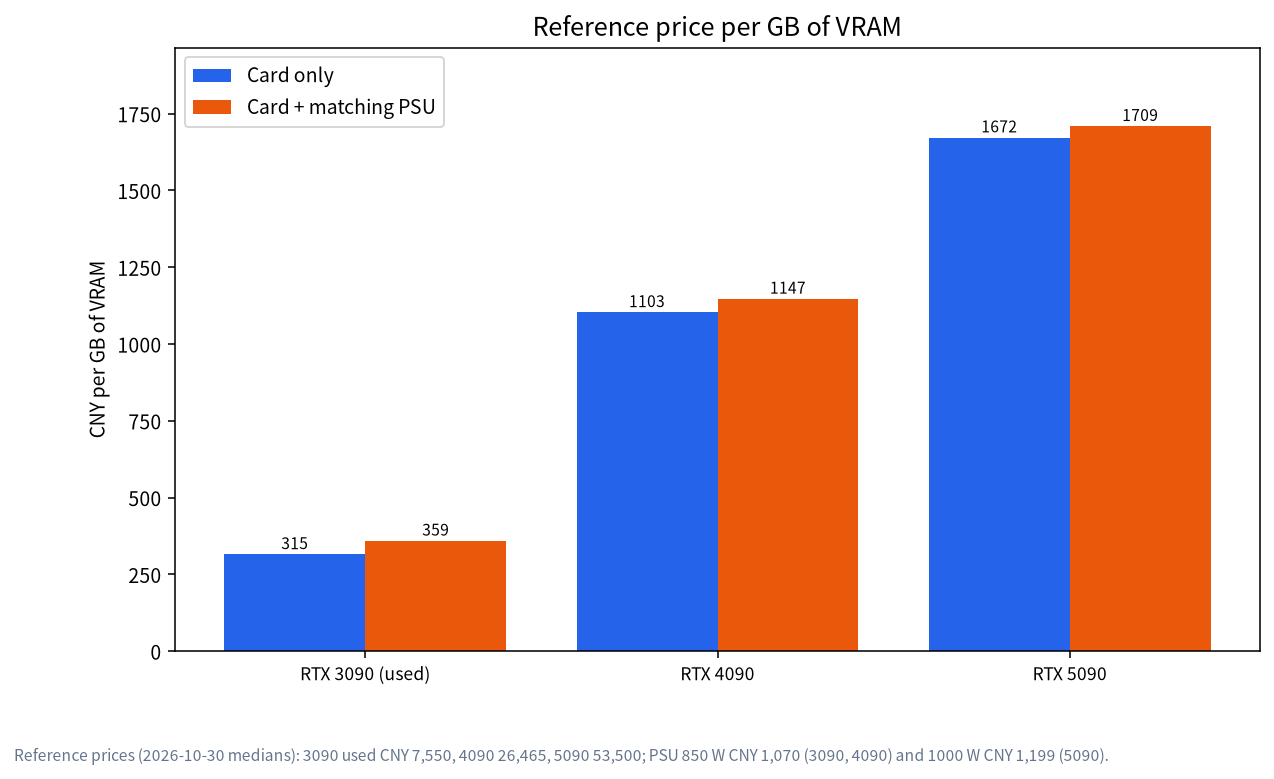
At reference prices, the used 3090 costs about 315 yuan per GB of VRAM, the 4090 about 1,103 and the 5090 about 1,672.
For most local LLM users, a used 3090 is the value choice, a 5090 is the “one fast card” choice, and the 4090 only makes sense when its price gap to the 3090 is small enough for you.
RTX 5090 vs 4090 vs 3090 for LLM: The Spec Sheet
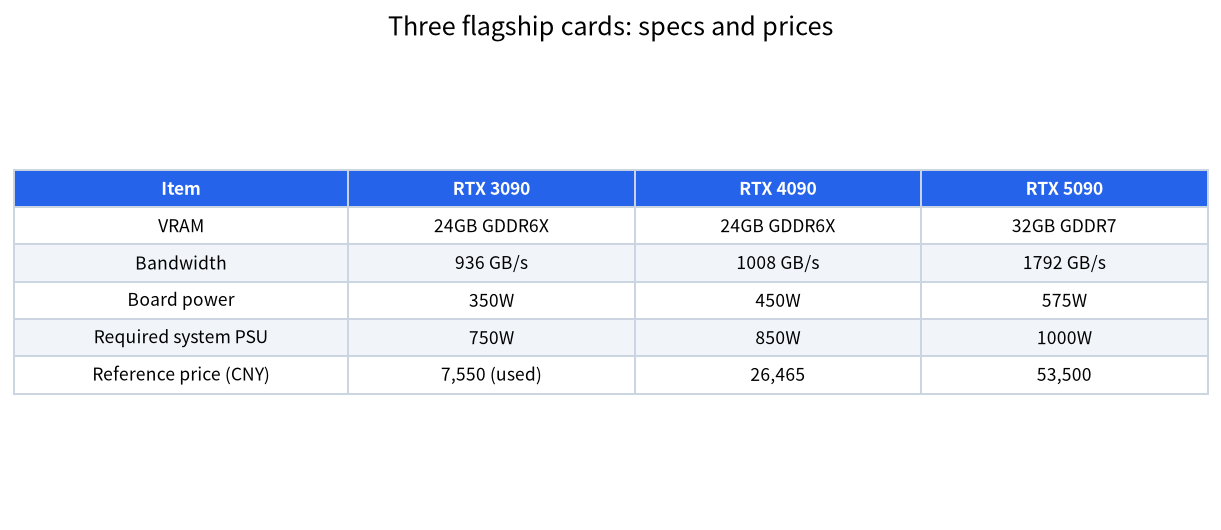
| Item | RTX 3090 | RTX 4090 | RTX 5090 |
|---|---|---|---|
| VRAM | 24GB GDDR6X | 24GB GDDR6X | 32GB GDDR7 |
| Memory bus | 384-bit | 384-bit | 512-bit |
| Bandwidth | 936 GB/s | 1008 GB/s | 1792 GB/s |
| Board power | 350W | 450W | 575W |
| Required system PSU | 750W | 850W | 1000W |
| Reference price (CNY) | 7,550 used | 26,465 | 53,500 |
Notice what changes and what does not. Between the 3090 and 4090, memory size is identical and bandwidth differs by only 8 percent, so for token generation, which is limited by how fast weights are read, the cards are close. The 4090’s advantage lies in compute, which helps prompt processing, image generation and fine-tuning more than chat speed. The 5090 is different on both counts: 8GB more memory and a much wider bus. Our guide to GPU VRAM for local LLMs explains why memory size decides what you can run at all.
What Fits in 24GB and in 32GB
A Q4_K_M model needs roughly 0.61 GB per billion parameters, so a 32B model takes about 19.7GB and a 70B model about 43.1GB. On a 24GB card, a 32B model leaves only a few gigabytes for the KV cache and the runtime, which means a context in the range of 8K to 16K for a model like Qwen2.5-32B, whose cache costs about 256 KiB per token in f16. On a 32GB card the same model leaves about 12GB, enough for roughly 32K tokens of f16 cache or more with a quantised cache. That is the practical benefit of the 5090: the same model with a longer, more comfortable context, or a larger quantisation with higher quality.
No single card in this comparison holds a 70B model at Q4_K_M. Two 24GB cards give 48GB, which fits it with a small context; this is why two used 3090 cards are a popular route, described in our dual GPU build guide. A 5090 plus offloading to system memory also works but slows down sharply, as our offloading guide explains.
Derived Speed Ceilings
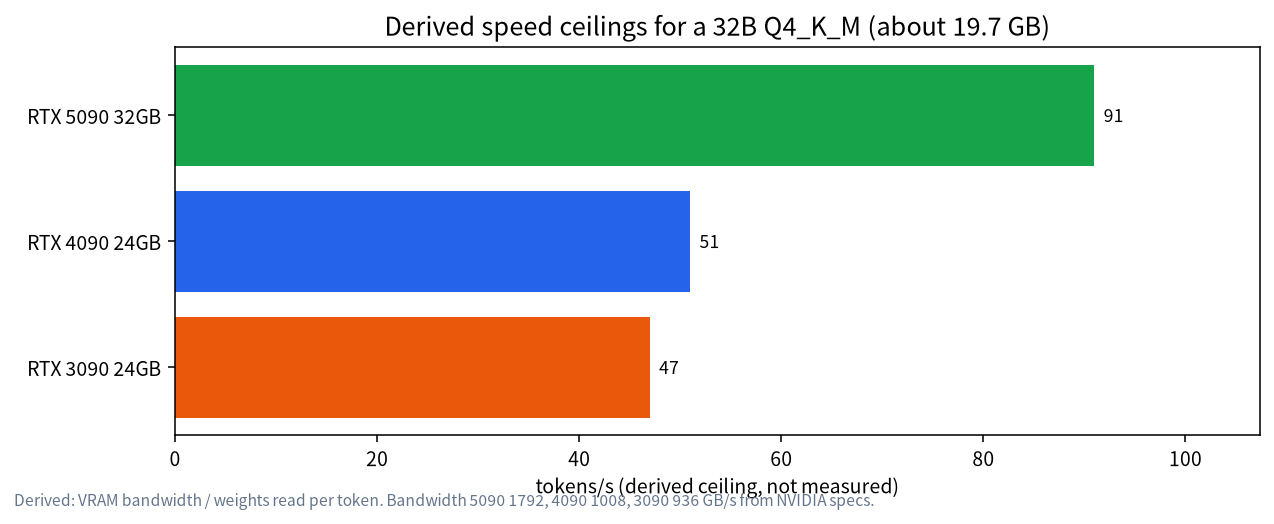
Token generation reads all model weights once per token, so the ceiling is memory bandwidth divided by the weight size. For a 32B Q4_K_M model of about 19.7GB, that is about 91 tokens per second on the 5090, 51 on the 4090 and 47 on the 3090. For an 8B model of about 4.9GB, the ceilings are 366, 206 and 191. These are upper limits that real software does not reach, and they are labelled as derived, not measured. What they show is the ratio: the 5090 can be roughly 1.8 times faster than the 4090, while the 4090 is only about 8 percent faster than the 3090 on generation.
Price per Gigabyte
| Card | Reference price (CNY) | Per GB of VRAM | Card plus matching PSU |
|---|---|---|---|
| RTX 3090, used | 7,550 | 315 | 8,620 (850W PSU 1,070) |
| RTX 4090 | 26,465 | 1,103 | 27,535 (850W PSU 1,070) |
| RTX 5090 | 53,500 | 1,672 | 54,699 (1000W PSU 1,199) |
Price is where the cards separate most. A used 3090 at the reference median costs less than a third of a 4090 and about a seventh of a 5090. Two used 3090 cards cost about 15,100 yuan, still far below one 5090, and give 48GB in total. The trade-offs are risks: a used card has no warranty, may have worn fans or memory, and two cards need a larger case, a stronger PSU and a motherboard with room. Read the used GPU guide before buying, and note that the reference prices mix new and used listings, so check current quotes.
Power, Heat and the Rest of the Build
NVIDIA lists 350W for the 3090, 450W for the 4090 and 575W for the 5090, with required system supplies of 750W, 850W and 1000W. The maximum GPU temperatures in the specification pages are 93, 90 and 90 degrees Celsius. A 5090 build therefore needs a stronger PSU, better airflow and a case that tolerates the heat. For founders edition cards, NVIDIA lists a length of 304 mm for both the 4090 and the 5090, and 313 mm for the 3090, but partner cards vary, so measure your case. Our power and cooling guide covers the PSU margin, power limits and airflow, and our build configuration guide shows complete systems.
Beyond Chat: Where Compute Matters
Token generation is limited by memory bandwidth, but other workloads are limited by compute, and there the generations differ more. Prompt processing, the phase in which the model reads a long document before it writes the first word, is compute-heavy, so a newer card shortens the wait on long inputs in retrieval and coding assistants. Image and video generation with ComfyUI also scale with compute and with VRAM, as our ComfyUI hardware guide explains, and so does fine-tuning. If your use is mostly chat with short prompts, the bandwidth ratio is the number to watch, and the 3090 and 4090 are close. If you also generate images, process long documents or train adapters, the newer cards earn more of their price.
Three Worked Scenarios
A student with a 9,000 yuan budget. A used 3090 at the reference price of about 7,550 yuan plus a 1,070 yuan 850W supply already reaches 8,620 yuan, and that assumes the rest of the PC exists. The 4090 and 5090 are out of reach, and the 24GB card runs 32B models at Q4_K_M with a modest context. Spend the remainder on a power supply with margin, not on a larger case.
A small studio that wants a 70B model. Two used 3090 cards cost about 15,100 yuan together and provide 48GB, which fits a 70B Q4_K_M of 43.1GB with only a small cache. That is cheaper than a single 5090, but it needs a case, a motherboard and a power supply sized for two cards, and the context must stay short. If that context is too short for the work, look at a larger-memory machine such as those in our mini PC guide.
A developer who wants one quiet, fast card for 32B coding models. The 5090 gives about 12GB of headroom for a 32B model, which is enough for a long context, and its bandwidth lifts the generation ceiling to about 91 tokens per second. At 53,500 yuan plus a 1000W supply, it is a premium solution, so decide whether the time saved is worth the price difference over a used 3090.
Checklist Before You Buy
Confirm your power supply rating and the connectors it provides before ordering the card. Measure the case for length, thickness and cooler clearance, and leave room for airflow. Check that the motherboard slot and the case allow the card to be fitted without bending. For a used card, ask for photos of the serial number and a video of the card running a stress test, and keep the receipt. Finally, look at timing: card prices move, and our price timing guide explains how to avoid buying at a peak.
Running Costs and Power Limits
A flagship card also changes your electricity bill, though less than the price tag suggests for a machine that mostly sits idle. NVIDIA’s page for the 4090 lists an idle power of about 19W, so a card waiting for your next question draws little. The cost appears under load: a 575W board running for an hour uses 0.575 kWh, a 350W board 0.35 kWh, so multiply by your local tariff and your daily hours of heavy use to find the monthly difference. For a home user who generates for an hour or two a day, the difference between cards is small compared with the purchase price. For a shared server running all day, it is worth calculating.
You can also cap power. Lowering the power limit of a card with the NVIDIA driver tools reduces heat and noise, and because token generation is limited by memory bandwidth rather than compute, a moderate cap often costs little generation speed. Test this on your own card and model, as the effect varies. Our cooling guide shows how to measure it safely.
A Buying Rule
| Your situation | Best fit | Reason |
|---|---|---|
| Tight budget, want 24GB | Used 3090 | Lowest price per GB, similar generation speed to the 4090 |
| Want 70B with a long context | Two used 3090 cards | 48GB total, cheaper than one 5090 |
| Want one fast card and a long context for 32B | RTX 5090 | 32GB and 1792 GB/s |
| Also do image or video work and train models | RTX 4090 or 5090 | More compute than the 3090 |
| Need a warranty and a quiet small build | New card from a store | Used cards carry risk |
Common Mistakes
- Buying a 4090 for chat speed alone. Its generation ceiling is only about 8 percent above the 3090’s.
- Forgetting the PSU. A 5090 needs a 1000W supply per NVIDIA’s specification.
- Ignoring card size. Partner cards can be longer and thicker than founders editions.
- Paying the new price for a used-card risk. Compare quotes and check the seller.
- Expecting 70B on one card. Q4_K_M needs about 43GB.
FAQ: RTX 5090 vs 4090 vs 3090 for LLM
Is the RTX 5090 worth it for local LLMs?
If you want one card with 32GB and the highest bandwidth, yes. If your budget matters, a used 3090 offers far more VRAM per yuan.
Is the 4090 much faster than the 3090 for chat?
Its memory bandwidth is only about 8 percent higher, so the generation ceiling is close. It is much stronger in compute work such as image generation and training.
Can I run a 70B model on one of these cards?
Not entirely in VRAM at Q4_K_M, which needs about 43GB. Use two 24GB cards or accept offloading to system memory.
Do I need a 1000W power supply for a 5090?
NVIDIA lists 1000W as the required system power for the 5090. Follow it and leave a margin.
Are used 3090 cards safe to buy?
They carry risk: no warranty, worn fans, hot memory. Buy from a seller with a return policy and stress-test the card on arrival.
Which card is best for a first local AI machine?
For most beginners, a 24GB used 3090 or a new 16GB card is enough. Our 24GB guide lists what runs on it.
Talk With Us
Choosing between these cards for your budget? Join the community or email admin@microaione.com.
References: NVIDIA RTX 5090, NVIDIA RTX 4090, NVIDIA RTX 3090 and 3090 Ti.